Showing posts with label popular culture. Show all posts

Friday, 15 January 2016

How Eaton's Influenced Canadian Culture


"Eaton's Department Store, Simpson's and the Hudson's Bay Company were the three major stores that represented Canadian pride, nationalism and modernity in the late nineteenth and early twentieth centuries," 
(Donica Belisle, Retail Nation:  Department Stores and the Making of Modern Canada )


Eaton's helped bring Canada into the modern age with its catalogue which reached rural places that would otherwise not have access to its products.  Selling everything from farm implements to prefabricated houses to the latest appliances, the catalogue represented modern culture at its best.  As an Eaton's advertisement from 1892 announced:  "This is emphatically an age of PROGRESS.  The golden age is before us, not behind, and those who're unwilling to keep up with the procession will have the decency to STAND ASIDE." 


Eaton's represented Canadian nationalism and pride, particularly during the First and Second World Wars.  The Eaton's Catalogue displayed patriotic covers during the war years.  Gift baskets were sent to Canadian soldiers overseas to boost their morale.  Eaton's employees who served overseas had their jobs held for them until they returned.  Sometimes their medical expenses due to war injuries were paid by Eaton's.

Eaton's also affected popular culture.  The Santa Claus Parade, which debuted in 1905, set the tone for other major parades in North America (see http://alinefromlinda.blogspot.ca/2013/11/november-30.html).  Many Canadian children grew up watching the parade either from Toronto's Yonge Street or on their television screen.  Those children often grew up to be Eaton's customers.

Eaton's is even mentioned in Canadian literature, specifically the French Canadian folktale Le Chandail de Hockey (The Hockey Sweater) in which a young Roch Carrier asks his mother to buy him a new hockey sweater.  He is so disappointed when his mother, who writes to Monsieur Eaton, receives a Toronto Maples Leafs jersey rather than a Montreal Canadiens one.  For fear of offending Monsieur Eaton, Roch's mother insists that he wear "le chandail".  Being a Torontonian, I guess it only made sense that Monsieur Eaton would have been a Leafs fan.

Timothy Eaton has also left his mark on the world of religion.  A former Presbyterian who converted to Methodism during the tent revivals in Southern Ontario, Timothy was a devout Christian.  After his death, his widow had a church built in his memory, Timothy Eaton Memorial Methodist Church, later United, which is still in use today.
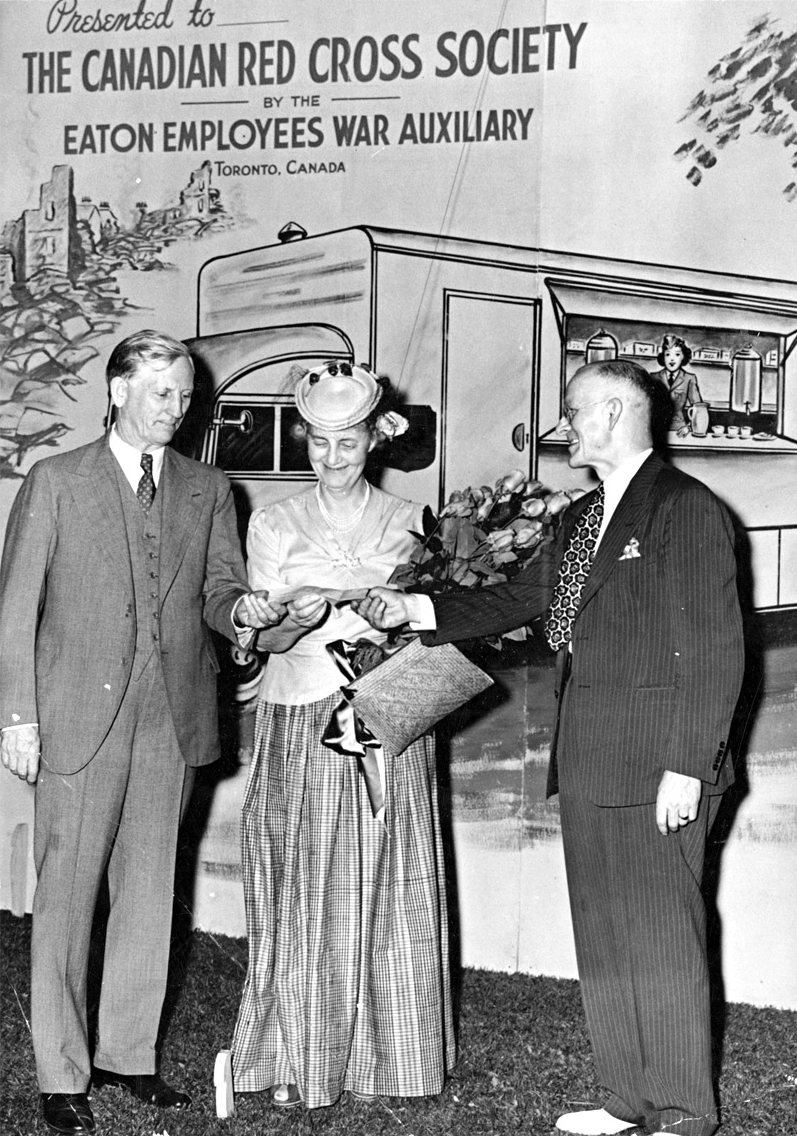


Flora Eaton, an active fundraiser for the Red Cross, allowed Eaton Hall to be used as a military hospital during the Second World War courtesy https://en.wikipedia.org/wiki/Feminism_in_Canada.


Saturday, 7 March 2015

You Had Me at the Hook

Remember the movie Jerry McGuire starring Tom Cruise and Renee Zellwegger?  They had dated for a few months, but broke up.  Afterwards, Tom's character experienced success as a football player's agent, but realized it was empty if he had no one to share it with.  So he went back to Renee's character with a humble heart, begging her to come back to him.  Tom's character delivered a long drawn out speech to which Renee's character responded:  "You had me at hello."  When you write, try to have the same effect on your readers.  Give them a hook that is powerful enough to reel them in.

While your hook is found at the beginning of your newspaper article, Dawn Copeman recommends that you write it at the end.  After your first draft, you will have a better idea of the focus of your piece.  Dawn Copeman recommends that your write both a hook and a lead for your article.  The lead introduces the story.

"When my daughter Eleanor was eight months old, I gave her some scrambled eggs to eat.  Within minutes she was screaming, her eyes and nose were running, she had a rash all over and was having difficulty breathing.  This was my introduction to food allergy."

The hook, on the other hand, answers the reader's question:  "Why should I keep reading?"   Here is Dawn Copeman's hook for her food allergy article:

"What neither of us knew then was that egg is the most common form of food allergy in babies...It is considered so dangerous that doctors recommend that you don't give eggs to babies until they are one year old.  While you might think this is an over reaction, the fact is that food allergies are on the increase.  Approximately 8% of all children under five have a food allergy; twenty five years ago, it was only 4%."

Dawn Copeman recommends that at the end of your article, you either answer the question posed or resolve the issue presented in the hook.

ex.  "Yes, food allergies are on the rise.  Statistics show that they have doubled in the past ten years and scientists fear that this increase shows no signs of abating.  But now you know how to reduce the risk of your child developping a food allergy; hopefully your child will not be one of the statistics."

Below are some strategies to hook the reader.

1.  Use the news

ex.  "The Star's Wednesday editorial by Juliet Guichon and Dr. Rupert Kaul calls the Gardasil story troubling and disappointing, and the editorial's headline 'Science shows HPV vaccine has no dark side' challenges the original article's suggestion that Gardasil is linked to complications in young women." Visit http://www.cbc.ca/news/canada/manitoba/the-gardasil-girls-how-toronto-star-story-on-young-women-hurt-public-trust-in-vaccine-1.2957524 for the full article.

2.  Tell a dramatic anecdote

"The first sign of trouble was powder in the baby's urine.  Then there was blood.  By the time the parents took their son to the hospital, he had no urine at all."  For the article in its entirety, visit http://www.nytimes.com/2008/10/17/world/asia/17milk.html?em.

3.  Reference popular culture

ex.  "My 14 year old niece Jennie just got her first smart phone in December...But you'll never see Jennie and her BFFs on Facebook.  They don't even have accounts.  They'd rather swap silly pictures and texts using smart phone apps like Instagram and Snapchat." Read the remainder of the article here http://michellerafter.com/2014/07/14/writing-basics-the-lead/.

4.  Paint a picture

ex. "They young Egyptian professional could pass for any New York bachelor.  Dressed in a crisp polo shirt and swathed in cologne, he races his Nissan Maxima through the rain slicked streets of Manhattan, late for a date with a tall brunette." For the rest of the Pulitzer prize winning article, see
http://www.pulitzer.org/archives/7140.

5.  Use wit and irony to point out a contradiction

"Environmentalists Drive Gas Guzzler from Protest Site" (http://www.freedomworks.org/content/environmentalists-drive-gas-guzzler-protest-site).

6.  Commemorate an anniversary

ex. "On the 50th anniversary of the Bloody Sunday march that erupted in police violence on Selma's Edmund Pettus Bridge, President Barack Obama praised the figures of a civil rights era he was too young to know." See the full article at http://www.thestar.com/news/world/2015/03/07/obama-to-join-in-50th-anniversary-of-bloody-sunday-in-selma.html.

7.  Cite a major new study

ex. New evidence puts into doubt the long standing belief that a deficiency in seratonin -- a chemical messenger in the brain -- plays a central role in depression.  For the entire article, visit http://www.acs.org/content/acs/en/pressroom/presspacs/2014/acs-presspac-august-27-2014/new-study-throws-into-question-long-held-belief-about-depression.html.

8.  Use a personal example

ex. "The day had come.  I'd lasted as long as I could in my marriage.  Once my husband, Bill, left for work, I packed a bag for myself and my fourteen month old son and left our home." For more, read
http://www.todayschristianwoman.com/articles/2008/september/list-that-saved-my-marriage.html.

9.  Include a famous quote

ex. "In a coffee shop not long ago I saw a mug with an inspiration from Henry David Thoreau:  'Go confidently in the direction of your dreams!  Live the life you've imagined.'" See
http://www.nytimes.com/2011/08/30/opinion/falser-words-were-never-spoken.html.