Monday, 13 March 2017

Rocky Road to Dublin

"Rocky Road to Dublin" is a song written about the Irish capital (http://www.dublinlive.ie/whats-on/arts-culture-news/rocky-road-dublin-17-greatest-10948795). Here are some other interesting facts about Dublin, Ireland.

1.  Dublin's O'Connell Bridge was originally made of rope and could carry only one man and one donkey.  In 1801, it was replaced with a wooden structure and in 1863, a concrete one, first called "Carlisle Bridge".

2.  Dublin's oldest workhouse, which closed in 1969, held 10,037 orphan children during its 170 years of operation.

3.  Dublin, originally called Dubh Linn or Black Pool, was named after the oldest treacle (British term for molasses) lake in North Europe, and currently forms the centrepiece of the penguin enclosure of the Dublin Zoo.


4.  The average Dubliner earns 19000 pounds per year and gives 12 pounds to charity and 162 pounds in tips.

5.  The Dublin Mountains are technically not high enough to merit the name, the highest, Sugarloaf, reaches only 1389 feet above sea level.


6.  Dublin's oldest traffic light is situated beside the Renault garage; the light, still in working order, was installed in 1893 outside the home of Fergus Mitchell, the first Dubliner to own a car.

7.  In 1761, a family of itinerants from Navan, Ireland, was refused entry to Dublin.  They settled in Rush on the outskirts of the city.  Today, almost all 250 inhabitants there can trace their roots to this family.

8.  Dubliners drink an average of 9800 pints an hour between Friday at 5:30 pm and Monday at 3:00 am.
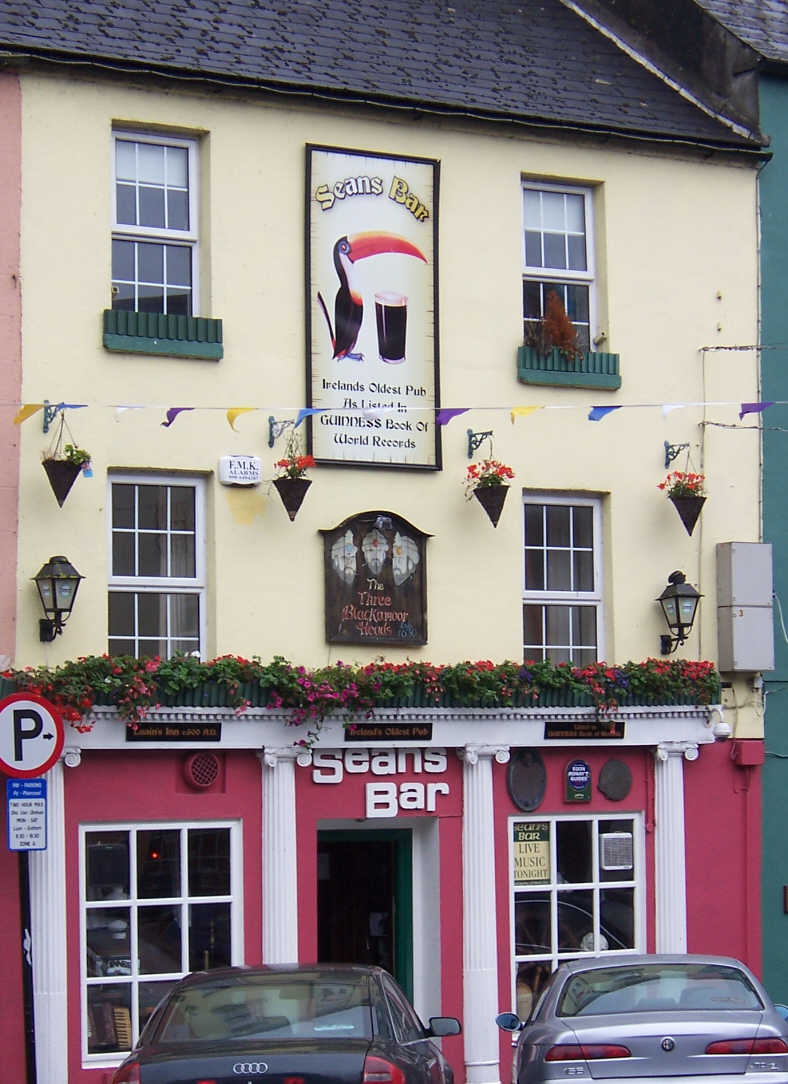

Sean's Bar, established in 900 AD, is Ireland's oldest pub courtesy https://en.wikipedia.org/wiki/Sean's_Bar.


9.  Harold's Cross got its name from a tribe that lived in the Wickow Mountains.  The Archbishop of Dublin wouldn't let them come any closer than that point.

10.  Leinster Garden once had a large statue of Queen Victoria.  However, it was removed when the Republic of Ireland was formed in 1948.  In 1988, it was donated to Sydney Australia to mark their 200th Anniversary.


11.  The largest cake every baked in Dublin, weighing 190 pounds, was made to celebrate the city's millennium in 1988.  The cake, never eaten, was finally thrown out in 1991.

12.  Dublin contains 46 rivers and streams including;  Delvin, Hurley, Corduff, Finglas, and Shanganagh.

13.  Nelson's Pillar was blown up in 1966 to mark the 50th anniversary of the Easter Rising (http://alinefromlinda.blogspot.ca/2017/03/easter-rising-1916.html) .  It now lies in a heap in the valley in County Wicklow.


14.  Dublin contains five areas which end in the letter "O":  Rialto, Marino, Portobello, Phibsboro, Pimlico.

15.  The original name of Trinity College was Trinity College near Dublin.  The city was a lot smaller when the college was founded.


Source:  http://www.irelandrevealed.com/facts-and-interesting-stuff-about-dublin/45-facts-of-so-you-think-you-know-dublin/

Sunday, 12 March 2017

Drisheen, Crubeens & Periwinkles

Here are some typical Irish dishes:

1.  Drisheen:  a type of pudding made from cow's, sheep's or pig's blood.


2.  Periwinkles:  sea snails boiled in salt water.

3.  Coddles:   layers of pork sausages or bacon usually thinly sliced; somewhat fatty back bacon with sliced potatoes and onions.

4.  Colcannon:  Mashed potatoes with kale or cabbage.


Image result


5.  Barmbrack:  a leavened bread with sultanas and raisins.

6.  Boxty:  finely grated raw potato and mashed potato mixed with flour, baking soda, buttermilk and occasionally egg, then cooked like a pancake on a griddle

7.  Champ:  mashed potatoes and chopped scallions with butter and milk.

8.  Crubeens:  boiled pig's feet.


9.  Farl:  a triangular quick bread.

10.  Pastie:  a round, battered pie of minced pork, onion, pototo and seasoning.


Source:  https://en.wikipedia.org/wiki/List_of_Irish_dishes

Saturday, 11 March 2017

Are There Really No Snakes in Ireland?


Legend has it that St. Patrick drove the snakes out of Ireland in the 5th Century.  While it is true that Ireland has no snakes it is for geographical, not human, reasons.  When the snake evolved about 100 million years ago, during the late Cretaceous period, Ireland was completed submerged under water. During the Cenozoic Era, about 65 million years ago, the world started to dry out and vast grasslands dominated the Northern Hemisphere.

Predecessors to the cobras and pythons first appeared 50 million years ago while modern day cobras and pythons appeared 25 million years ago.  Today, snakes are found everywhere but Ireland, New Zealand, Greenland, Iceland and Antarctica.  Serpents haven't figured out how to migrate across the ocean to a new home.  While land bridges formed over past millennia, snakes would have frozen during the Ice Age.

How did the myth of St. Patrick and the snakes evolve?  In Christian cultures, snakes have always symbolized paganism starting with the serpent that tempted Eve in the Garden of Eden.  Therefore, St. Patrick, who helped convert many pagans to Christianity in Ireland, would be a likely candidate to banish the snakes.

Source:  http://www.rte.ie/tv/scope/SCOPE4_show03_snakes.html


Friday, 10 March 2017

Ireland's Topography


Kilkenny Harbour forms a natural barrier between Galway and Mayo courtesy https://en.wikipedia.org/wiki/Geography_of_Ireland.


1.  Ireland, which occupies 84,4009 square miles, is about half the size of Arkansas.

2.  It's greatest length, between Toor Head, County Antrim and Mizen Head, County Cork, spans 302 miles.

3.  It's greatest breadth, from Dundrum Head, County Down to Annagh Head, County Mayo, spans 104 miles.

4.  Its highest cliffs are found on the northern coast at Achill Island, County Mayo, an area which suffered an earthquake in 2012.

5.  The longest river, Shannon, flows 204 miles before pouring into the Atlantic Ocean at Limerick.

6.  The island's coastline runs 1907 miles.

7.  The largest lake, Lough Neagh, measures 153 square miles and supplies Ireland with 40% of its water.

8.  Ireland consists of four provinces broken up into 32 counties, six of which are part of Northern Ireland.

9.  The mountains are composed of granite, sandstone, limestone, karst and basalt.

10.  Ireland has 4,633 square miles of bogland consisting of blanket bogs and raised bogs.


Thursday, 9 March 2017

The Tithe War

"In something of a dress rehearsal for the Land War of the 1880's, the Tithe War began in Kilkenny, Wexford and Tipperary with public meetings of men carrying hurley sticks which could be represented as sporting occasions." (Myles Dungan)


Tithes were levies paid by Irish farmers, not landlords, to the Church of Ireland, the established church. These tithes helped keep the clergy in relative comfort.  The farmers, in the meantime were bled dry, leading to great unrest in 1830's Ireland.  The Catholics bitterly resented these tithes.  While the rent they paid gave them a roof over their heads, they received nothing in return for the tithes.  

"In something of a dress rehearsal for the Land War of the 1880's, the Tithe War began in Kilkenny, Wexford and Tipperary with public meetings of men carrying hurley sticks which could be represented as sporting occasions."  Soon, Irish farmers were refusing to pay the tithes as a form of protest.  

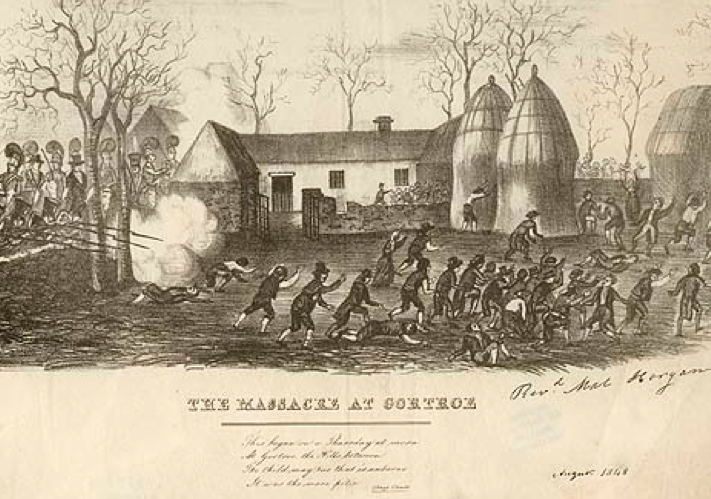
On June 18, 1831, a tragedy occurred in Newtonbarry, Wexford where an Anglican rector had seized the cattle of farmers who refused to pay the tithe.  As the cattle were being auctioned, some of them got loose.  In trying to retrieve their cattle, the farmers were fired upon by Protest militia.  When the gunpowder cleared, eighteen farmers were dead.

The following December, vengeance was in the hearts of the Kilkenny farmers who attacked a force of constables armed with summonses for those who had refused to pay their tithes.  The vigilante group tried to get the process server, Edmund Butler to eat the summonses, but he refused.  Armed with rocks and pitchforks, they attacked the constables, killing thirteen of them, including Butler.

Finally, in 1838, the Irish court ruled that the farmers would no longer pay the much hated tithes, but rather the landlords would.  However, it was a bittersweet victory:  the landlords passed the payments on to the farmers in the form of higher rents.


Wednesday, 8 March 2017

Easter Rising 1916

"I die that the Irish nation might live!" (Sean McDermott)


It made the front page of the New York Times eight days in a row.  It divided an island.  Sixteen of its leaders were executed, all of which have railway stations named after them.(http://www.thejournal.ie/irish-rail-1916-2-2744978-Apr2016/)

The Easter Rising began on East Monday, 1916.  It was planned by the Irish Republican Military Council.  Contrary to what the name implies, the Council's members were not all politicians or military men. Thomas McDonough and Joseph Plunkett were poets.  Plunkett married his fiancee only eight hours before his execution.  Patrick Pearse was a writer and a schoolteacher.  James Connolly, a republic leader, was not even born in Ireland but in the United States.  Connolly was so injured that he was carried on a stretcher to his execution.  Eamon de Valera, a fellow American was a prominent politician and statesman in Ireland.  Thomas Clarke, an Irish revolutionary who started the Brooklyn Gaelic Society, was English born. Sean McDermott, who editted the IRB newspaper Irish Freedom, wrote in 1916:  "I die that the Irish nation might live!"

When the Rising began when the Irish Republicans took over significant buildings in Dublin, amid little resistance.  When the fighting began in earnest, the Irish Republican troops outnumbered the British ones 1000 to 400. Within a week, that all changed;  the British boasted 19000 troops to the Irish Republican's 1600.  While fighting occurred in various parts of Ireland, the IRB were most successful in Dublin where they established headquarters at the post office.  The deadliest battle took place at Mount Street Bridge in Dublin.  The entire Easter Rising lasted only six days.

Rather than seeing the IRB leaders as heroes, they were initially considered traitors by many Irish citizens.  Irish civilians incurred 154 deaths and 2000 injuries during the revolt.  However, once the execution of the uprising's instigators began, the national mood changed.  Songs were sung to honour the Rising's leaders, funds were collected to aid their families and Irish Republican flags appeared.  While 3000 were arrested after the revolt, they were granted amnesty by the British government in 1917.

Scenes of destruction during the Rising.

Tuesday, 7 March 2017

Titanic by Numbers

The White Star Line wanted a luxury liner to compete with the Cunard Line's Lusitania and Mauretania.  Not to be outdone, it built three ships:  Olympia, Britannia and Titanic.  Here are some facts about the most famous of three:

1.  26 months:  the length of time it took the Belfast workers to build the Titanic

2.  228 feet:  the height of the gantry built over the Titanic, the world's highest at the time

3.  14,000:  the number of workers employed to build the Titanic at Harland & Wolff Shipyard in Belfast, Ireland

4.  246:  the number of injuries during construction

5.  8:  the number of deaths during construction

6.  15:  the number of predicted deaths based on the ratio of 1 death for every 100,000 pounds spent

7.  200:  the number of rivets completed by a four man crew each day

8.  20:  the number of horses to pull the main anchor

9.  49:  the average workweek for shipbuilder

10.  2:  the number of pounds for weekly wage

11.  6:  the number of days shipbuilders worked (they quit early on Saturday and had Sunday off for church)

12.  $166,000,000:  the price tag for Titanic in today's dollars (it's still cheaper than the price tage for the 1997 movie Titanic which cost $200,000)

13.  3,000,000:  the number of rivets used to construct a metal & iron hull

14.  401:  the yard number given to the Titanic when her keel was laid down

15.  3,000:  the approximate number of men who built the Titanic (20% of the workforce)


Titanic under construction.

The Titanic under construction courtesy http://www.titanicfacts.net/building-the-titanic.html.