Showing posts with label Kilkenny. Show all posts

Friday, 24 March 2017

The Irish Cottage

In 1840, 40% of Irish families lived in one room thatched cottages.  Here are ten things you may not know about the Irish cottage.

1.  A fireplace or hearth, built of stone, was located in the middle of the house, often with a bedroom on either end.

2.  Roofs were usually constructed of coupled rafters stuffed with turf for insulation and thatched to prevent leaking water.

3.  A primary source of timber was wood washed ashore from wrecked ships.

4.  For those with more money, there was the thatched mansion, a two story cottage.  The Old Farm Cottage in Kilkenny is one example.

5.  The half door had three purposes:  it kept the children in and the animals out; it permitted light and air to circulate in the damp and dusty cottage; it served as a prop to lean on while smoking a pipe.

6.  The Irish cottage was filled with a couple, their six or seven children, a pig and a dresser of hens or chickens.

7.  Irish cottages often had two doors, one entrance for the mother in law, the other for the daughter in law.

8.  Irish cottages usually had small windows, limited in number.  The size was to keep the heat in, the number to prevent being taxed for having more than six windows, a law enforced between 1799 and 1851.

9.  Water was supplied by a well, located by a local diviner with a divining rod.

10.  The "good room" sometimes added on to cottages at a later date, was the parlour, reserved for guests like priests or teachers.


Irish Thatch Roof Cottage

Thursday, 9 March 2017

The Tithe War

"In something of a dress rehearsal for the Land War of the 1880's, the Tithe War began in Kilkenny, Wexford and Tipperary with public meetings of men carrying hurley sticks which could be represented as sporting occasions." (Myles Dungan)


Tithes were levies paid by Irish farmers, not landlords, to the Church of Ireland, the established church. These tithes helped keep the clergy in relative comfort.  The farmers, in the meantime were bled dry, leading to great unrest in 1830's Ireland.  The Catholics bitterly resented these tithes.  While the rent they paid gave them a roof over their heads, they received nothing in return for the tithes.  

"In something of a dress rehearsal for the Land War of the 1880's, the Tithe War began in Kilkenny, Wexford and Tipperary with public meetings of men carrying hurley sticks which could be represented as sporting occasions."  Soon, Irish farmers were refusing to pay the tithes as a form of protest.  

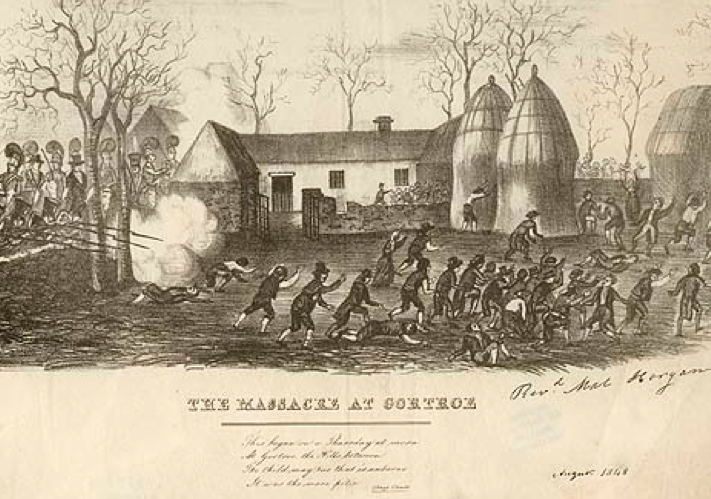
On June 18, 1831, a tragedy occurred in Newtonbarry, Wexford where an Anglican rector had seized the cattle of farmers who refused to pay the tithe.  As the cattle were being auctioned, some of them got loose.  In trying to retrieve their cattle, the farmers were fired upon by Protest militia.  When the gunpowder cleared, eighteen farmers were dead.

The following December, vengeance was in the hearts of the Kilkenny farmers who attacked a force of constables armed with summonses for those who had refused to pay their tithes.  The vigilante group tried to get the process server, Edmund Butler to eat the summonses, but he refused.  Armed with rocks and pitchforks, they attacked the constables, killing thirteen of them, including Butler.

Finally, in 1838, the Irish court ruled that the farmers would no longer pay the much hated tithes, but rather the landlords would.  However, it was a bittersweet victory:  the landlords passed the payments on to the farmers in the form of higher rents.