Saturday, 17 September 2016

Polish Immigrant Clara Rudder

"If you hate, you lose yourself.  There's nothing left in this world after hate.  I can't hate.  I have never been taught to hate.  Even after pogroms, after all that happened in our town, my father tried to explain...I was ten years old.  I asked the question:  Why?  There was no answer to it  There still isn't." (Clara Rudder)
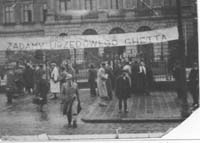


Demonstration of Polish students demanding implementation of ghetto benches at Lwow Polytechnic circa 1937 courtesy https://en.wikipedia.org/wiki/History_of_the_Jews_in_Poland.


Clara Rudder grew up in a devout Jewish family in the Carpathia Mountains in Poland.  Her father owned a store which sold pots and pans.  Her mother raised her and her siblings along with a niece.  The Rudders hailed from Spain where they had lived for four hundred years.  The Polish king encouraged Jews to come to his country in order to build commerce.  

On the Sabbath, someone came to the Rudder's house to warn them that their town was about to undergo a pogrom.  Clara's father warned the congregation at their synagogue to escape, taking their silver menorahs with them.  The Rudder's fled to a Gentile's house where he hid them in his barn. When they returned the following day, all the doors had been broken, all the windows shattered and sacs of flour, which were too heavy to carry, were doused with petrol.  

The only structure left untouched was the Rudder's store, perhaps because Mr. Rudder was such an honest businessman, or perhaps simply because the invaders didn't need any pots and pans.  Mrs. Rudder took the biggest pot they owned and made meals for the community.  Little Clara said they did not sleep for four weeks.

Yet, when Clara returned to school, the children shouted at her:  "Get out of here!"  Vowing never to raise her own children in Poland, Clara planned that day to immigrate when she grew up.  At 20, she suggested Palestine as a destination to her mom, to which she replied:  "You're going to split rocks in Palestine.  I did not bring up a child of mine to go and split rocks."

Clara's brother and sister moved to Antwerp, Belgium and she suggested that she immigrate there.  She encouraged her parents to join her, but they felt like having been born and raised in rural Poland, that's where they should stay.  Clara dated a young Jewish man who studied in Prague, Czechoslovakia.  Only three percent of Jewish Poles were accepted at university, forcing the remainder to study elsewhere.  After Clara and her boyfriend got engaged, she invited him to join her in Belgium and he agreed to continued his studies there.  However, her fiance, rejected at the Brussels university chose to return to Poland rather than immigrate.  Clara returned the ring to him.

After moving to Belgium, Clara met a diamond dealer named Paul.  They married and had a son.  In the meantime, Hitler's panzers started rolling over Europe, forcing the couple to move to France.  When the Nazis reached France, the couple was driven back to Belgium.  Clara was more determined than every to get out of Nazi occupied Europe.  

In 1940, a Paraguay attache offered to drive the couple across France to Spain and then Portugal.  Clara's sister, who had taken the trip first, wrote her a letter:  'Everything is fine, we are across the border.  Take two valises and come..."  Closing up their apartment, the couple took some diamonds and $12,000 in cash for the journey.  Stopping in Perpignan, France to secure visas, the Paraguay attache explained that he could not take them any further as his car had broken down.  The couple, planning to continue their journey by train, realized they had only $1,000 left in their possession.  Their driver had absconded with the bulk of their savings.  


German soldiers march down the Champs Elysees circa June 1940 courtesy https://en.wikipedia.org/wiki/Paris_in_World_War_II.


Reaching Lisbon, Clara and her family booked passage to America on a Greek ship.  However, Germany invaded Greece in the meantime and the ship never sailed.  It took three months for her to find another boat, this time a cattle boat.  On the twelve day voyage Clara, nervous about the mine infested waters, barely ate.  

When the boat finally reached Ellis Island, Clara was asked what she wanted.  "I want a good glass of milk...The milk tasted like cream.  It was delicious."  However, Clara was disappointed with Ellis Island.  She said that the authorities would not let them off the island.  She felt like she was in jail.  What made matters worse, was that Clara could not speak English.  The big room where the immigrates were processed was filled with 300 to 400 people.  "I couldn't breathe," explained Clara.

After seven weeks at Ellis Island, the mystery as to why Clara and her family wasn't released was cleared up.  Clara's brother in law, had given the money for their trans-Atlantic passage to a lawyer.  The lawyer had taken the money and then wrote the ship company a cheque which had bounced.  The family was being detained for the passage money.

After the Second World War, Clara discovered that her parents, her cousins, the entire town had been murdered, gassed in the ovens at Auschwitz.


Inmates forced to carry rocks at Mauthausen Concentration Camp in Austria courtesy https://en.wikipedia.org/wiki/Extermination_through_labour.


Note:  For more information about Jews fleeing the Nazis, during the Second World War, part of the largest motorized evacuation in history, read "The Journey that Saved Curious George" at http://alinefromlinda.blogspot.ca/2012/10/october-21.html.

Friday, 16 September 2016

Hungarian Immigrant Harriet Kovak

"I almost fainted, because in Europe at that time the reputation of Ellis Island was terrible; that it's a dungeon and they beat people up." (Harriet Kovak)


Image result for budapest, hungary history


In 1947, with a visa in hand, Harriet headed to Paris to meet her sister for a two week vacation to the United States.  However, upon reaching Paris, her sister told her that she and her husband were not going after all.  Since the visa was still good for a year, Harriet chose to go to America the following year.  Harriet sailed from Le Havre aboard the luxury ship the Normandie.  

When she reached Ellis Island, the officials detained her, saying she had no affidavit.  In order to continue, she would have to pay $1000.  "I almost fainted, because in Europe at that time the reputation of Ellis Island was terrible; that it's a dungeon and they beat people up."

Things started to look up when a woman in a white robe with a big bunch of keys approached her and asked "Are you hungry?  The cafeteria is closed but I can get you something."  While Harriet did not have to pay the $1000 affidavit she did have to pay $500 bail.  

Harriet had a pleasant surprise waiting for her in New York City:  she fell in love.  The following year she returned to America and married him.  Harriet got pregnant right away and was not able to return to Hungary.  Therefore, the immigrant officials refused to return her $500.  Her husband, a lawyer, filed a lawsuit to get her money back.  While she never was reimbursed, she did enjoy a long happy life with her husband and children.


Dining room at Ellis Island courtesy https://www.britannica.com/place/Ellis-Island.


Thursday, 15 September 2016

Russian Immigrant Betty Garoff

"When the soldiers came to look for us, we were hidden in a closet.  She fed them food and drinks until they were intoxicated." (Betty Garoff)


Shoemakers making army boots circa 1903 to 1905 courtesy http://www.thehistorialist.com/2012/11/at-museum-northampton-museums-art.html


In 1913, Betty's Garoff's father immigrated to the United States to avoid being drafted into the Russian Army during the First World War.  Her mother, still pregnant with Betty, sold salt illegally to put food on the table.  At the age of four or five, Betty and her brother were separated from their mother when their town was invaded by the enemy.  The children slept during the day in barns and travelled by night.  Eventually, a couple who knew Betty's grandfather, took them in and raised them as their own grandchildren.  "When the soldiers came to look for us, we were hidden in a closet.  She fed them food and drinks until they were intoxicated.

Reunited with her mother, her father had saved enough money to buy the family tickets to America. The family, with just the clothes on their back, made it as far as Amsterdam when Betty's brother developped an infection from a nail, thereby failing to pass the physical exam.  Their original visa had been for a particular ship on a particular day.  Now it was rendered null and void.  Betty's mother took her two children to Poland to apply for another visa.  They stayed with relatives in a Warsaw ghetto apartment.  Betty remembers the curfew that everyone had to observe; no one was permitted to leave or enter the gate after a certain hour.

In December of 1921, the Carmania set sail for America.  Betty and her family, staying in steerage, survived on hard boiled eggs and raw potatoes.  The Russian farm girl was bewildered by the sheer number of people coming and going at Ellis Island.  Betty waited and waited for her father to come and get her; all of her shipmates had already left when he finally arrived.  It was the first time he had laid eyes on her.  Her mother suggested:  "Stand up and show your father how tall you are."  The first time Betty saw New York's lower east side, she spotted immigrants huddled around metal drums filled with fire, warming their hands.


Betty and her family got a furnished apartment with an outdoor toilet in New York City.  Within a year and a half, her father opened a shoe repair business in the Bronx.  Because Betty only knew how to speak Yiddish, and not English, her classmates would help her to converse with the teacher.  Ten years after immigrating, Betty's mother gave birth to another girl, followed five years later by a boy.  Betty married a doctor, moved to Chicago and "lived a wonderful life."


The Bronx circa 1930's courtesy

Wednesday, 14 September 2016

English Immigrant Sara Miles

"[My mother] had a box of shredded wheat biscuits, which was quite a treat for us.  And on the back of the box was an advertisement about Niagara Falls.  That was my first knowledge of America.  I had a dream that one day I would visit Niagara Falls." (Sara Miles)


Sara, one of ten children, grew up in England.  Her house, which contained four bedrooms, had no electricity and no telephone.  Sara and her siblings would hover around the fireplace in the winter time.  At night, Sara, the only girl, would keep warm under her father's overcoat.  Stretched for money, the children would wake up at 4:30 in the morning to pick strawberries during the summer to earn enough money to buy school shoes for the fall.  At Christmas time, they did not have  Christmas tree or ornaments, but they did have a "Nice piece of beef" given to them by a local farmer.  During the First World War, Sara's dad sent her and her brothers down to the docks to witness first hand the wounded soldiers returning from the battlefield:  it was a lesson she would never forget.  

"[My mother] had a box of shredded wheat biscuits, which was quite a treat for us.  And on the back of the box was an advertisement about Niagara Falls.  That was my first knowledge of America.  I had a dream that one day I would visit Niagara Falls."  Sara wrote a letter to her two uncles who lived in Fultonville, New York asking them if they would send her money for passage to America.  She promised to work until she earned enough money to pay them back.  Her brother Frank agreed to accompany her to the New World.

Sara's parents borrowed a car to drive her and her brother to Southampton where they boarded the SS Olympic.  The siblings travelled third class and Sara, like many of the passengers, suffered from seasickness.  The first thing Sara saw upon entering New York Harbor was a giant billboard for Lipton's Tea.  "Welcome to America."  

In Fultonville, Sara moved in with one uncle, her brother Frank with the other.  Sara was hired at a stocking and glove factory.  While Frank married his childhood sweetheart and brought her to America to live.  Sara married an American.  She eventually lived her dream when she paid a visit to Niagara Falls.


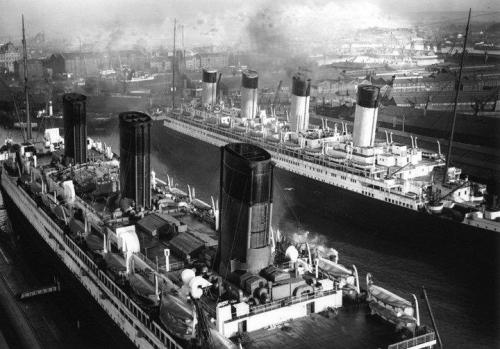
Olympic and Berengaria at Southampton port courtesy https://www.tumblr.com/search/rms%20oceanic.


Tuesday, 13 September 2016

Irish Immigrant Martha O'Flanagan

"You have to be Irish to have dark hair.  This notion that Irish people have red hair is not true.  We got the red hair from the Danes when they invaded Ireland in 1014, and they married Irish girls." 
(Martha O'Flanagan)


Irish history

Emerald Isle courtesy 


Martha O'Flanagan grew up in Roscommon Country, Ireland where there is a "colour of green [emerald] that you cannot find in this country or any other country".  Martha grew up on a potato farm in a thatched cottage with stone walls.  One of six children, she had three brothers much older than her.  She and her brothers helped their father plant the potatoes, a task which involved a steeve to make the holes.  For entertainment, Martha attended dances where fiddlers provided the music. Every house in Ireland had a fiddle.  

When she grew up, one of her brothers left for England and one, named Thomas, for America.  Martha longed to follow Thomas, a wish which he made possible when he sent her $200.  Martha rode her bike to Dublin to have her passport stamped, said goodbye to her parents and third brother, and boarded a ship bound for America. 


"One thousand single women looking for a spouse" on the SS Baltic as it arrives at Ellis Island 


In 1925, the ship set sail from County Cork. "The S.S. Baltic was beautiful.  I didn't want to get off," reminisced Martha, referring to the blue waters of the Atlantic.  Many of the Irish passengers embarked to Boston where they had family waiting for them.  However, Martha chose to stay in New York City where she met up with Thomas.  

Martha, who reached the ripe old age of 94, reminisced:  "I remember my first St. Patrick's Day here.  It was the parade, and my cousins gave me a green dress to wear and I said, 'I'm not going to wear that ren.  I'm not going to wear green in the United States.'  They laughed at me."  


Monday, 12 September 2016

Italian Immigrant Angelina Palmiero

"They got us kids to take the almonds out of the shells and put them in a burlap bag.  We wanted to get into the bag because they said the bag was going to America." (Angelina Palmiero)


Facciata della Chiesa Madre in San Cataldo, Sicily circa 1940's courtesy https://commons.wikimedia.org/wiki/File:Facciata_della_Chiesa_Madre_di_San_Cataldo.jpg. 


Growing up on an olive and almond ranch, Angelina Palmiero and her siblings had to help out.  "They got us kids to take the almonds out of the shells and put them in a burlap bag.  We wanted to get into the bag because they said the bag was going to America."  Angelina remembers marching around the playground of her school the day that Mussolini took power.  

While Angelina's family held down the fort in Sicily, her father set out for America.  Once employed, he started sending his family money, with the intent of sending for them once he was established.  However, just before Angelina's family set out for America, she received a black eye.  Her mother cried, terrified that they would be rejected due to the injury.  With the eye healed, the Italian family boarded the Giuseppe Verdi, packing all of their belongings in two trunks.  The tickets were free of charge, since Mr. Palmiero had returned to Italy from the United States to serve in the First World War in exchange for free passage for his wife and children.  Angelina was teary eyed when she waved goodbye to her grandfathers and grandmother.


During the thirteen day voyage across the Atlantic, Angelina suffered from swollen glands and a high fever.  Arriving in America on her birthday, "Somebody yelled:  'The Statue of Liberty, the Statue of Liberty!'  We all ran to the railing to see, and everybody was praying and kissing and happy that we were coming up the Hudson."  With Ellis Island crowded, the Giuseppe Verdi weighed anchor and its passengers waited.

Finally, Angelina's father arrived on a tugboat and she set eyes on him for the first time.  A bunch of bananas in his hand, she took one ready to bite into it.  "Don't eat it like that.  Take the skin off first," shouted her father.  

The passengers disembarked on the island where Angelina, separated from her family, convalesced in the hospital for 23 days.  Her parents and sisters travelled to Pennsylvania where her aunt and uncle lived, paying a $250 bond promising that they would return for Angelina.  No one explained to Angelina where her family had gone.  With "two lumps the size of walnuts in her throat", Angelina was given medicine everyday.  At night, she remembers opening a gate and looking up at the Statue of Liberty, all lit up.  


One day, Angelina stood in front of the judge in the big hall at Ellis Island and he declared that she could go.  She recognized her father by his grey hair which belied his 33 years.  On the train from New Jersey to Pennsylvania, her father bought her a Hershey's chocolate bar, her first.  

Her parents now reunited, Angelina's mother started having more babies, on average one a year.  Angelina became like a little mother to her younger siblings.  Her father worked at the Edison Company.  Angelina enrolled in Grade 1.  While a bright student, she struggled at first to learn English.  At 16, she took a trip to visit her aunt but never returned, settling in New York City.


Sunday, 11 September 2016

French Immigrant Lara Bisset

"I saw the Statue of Liberty.  It was so impressive, so majestic, so meaningful.  Freedom!  Opportunity!  And most of all, it linked to us, America and France, because we knew that it was given to America by France." (Lara Bisset)


Jews flee the Cossacks circa 1905 courtesy 


In 1990, Lara Bisset visited the newly renovated Ellis Island for the first time since she immigrated to America in 1920.  What struck her was the Odessa, Ukraine Exhibit which explained the murder of hundreds of Jews at the hands of Russian Cossacks in 1905.  Lara's parents, also Odessa Jews, had escaped over the German border with their six month old son.  Trudging through the deep snow, her mother was "frozen up to the waist".  But she refused to go on without her baby, her legs "like two purple sticks".  

The Bisset's wandered around first Germany, then Luxembourg and finally Belgium, but didn't like any of the countries.  However, once they entered France, they knew they were home.  It was there that Lara was born in 1909.  While the Bisset's were poor, they managed to survive thanks to the help of their uncle who owned a dry goods store.  They would buy up dry goods to sell at foires (country fairs) which would help to put food on the table.  

It was a happy time for Lara.  The Bisset's new hometown did not have a synogogue but it did have a Roman Catholic church.  "You have to be exposed to religion," said Mrs. Bisset, who sent them to the Roman Catholic church only a block away.  She remembers picnics in the park where the family would munch on saucisses and peasant bread.  Entertainment came in the form of an accordion.  


After Mr Bisset served in the French Legion during the First World War, Mrs. Bisset begged him to go to America where her three siblings lived.  After much resistance, Mr. Bisset gave in and the family immigrated in 1920.  As the Touraine entered New York Harbor, Lara recalled:  "I saw the Statue of Liberty.  It was so impressive, so majestic, so meaningful.  Freedom!  Opportunity!  And most of all, it linked to us, America and France, because we knew that it was given to America by France." 


While the boat ride was exciting, the immigration process was less pleasant.  Adults and children were immediately segregated, a scary experience for Lara.  The sights and sounds were an assault to the senses.  Lara recalls:  "I remember hordes of people.  There were quite a few children and mothers, walking up those wide steps into the main building.  I remember the darkness, the wooden benches, the poorly lit hall, the babies screaming the children crying, adults crying.  It was awful."

With the tedious paperwork behind them, the Bissett family collected their luggage and took the ferry to the mainland where Lara's uncle picked them up in a Model T at Battery Park.  Language was an immediate barrier as the Bissett's spoke French and their brother spoke English.  Yiddish was their only common language.  

Lara would forge a new identity in New Jersey, retiring to Florida in the 1980's.