Showing posts with label Auschwitz. Show all posts

Wednesday, 21 September 2016

Czech Immigrant Estelle Zeller

"And there were two thousand of us, all young women.  They used us to unload brick from ships.  We would make a human chain and pass the brick one to the other all day long until the tips of our fingers bled." (Estelle Zeller)


Estelle Zeller grew up in a Jewish family in Ushorod, Czechoslovakia.  Her father operated a bakery in town.  On the night of November 10, 1938, her father was searching for the midwife to tend to her mother who was in labour.  At the same time, his bakery was being vandalized, part of Kristallnacht, or The Night of Broken Glass (http://alinefromlinda.blogspot.ca/2014/11/november-9.html).
Occupied by the Germans, all of the Jewish bakeries in Ushorod were either denied licences or denied their flour allocations.  Estelle's father was drafted into the military.

In 1943, with Jews being rounded up across Europe by the Nazis, Estelle's mother suggested she go into hiding with a Christian family.  However, Estelle watned to remain with her family.  Soon, all of the jews in Ushorod were rounded up and put into a ghetto.  Later, they were stuffed in cattle cars and taken to the infamous Auschwitz where Estelle was separated from her parents and siblings.  

While many of the Jews were sent directly to the gas chambers, Estelle was sent to Germany to work as a slave labourer.  "And there were two thousand of us, all young women.  They used us to unload brick from ships.  We would make a human chain and pass the brick one to the other all day long until the tips of our fingers bled."  While the days were draining, the nights were equally difficult:  bombs were flying overhead.  

Later, Estelle was one of 500 young women to be transported to Essen to work in a munitions factory.  They had a long walk to the factory.  In winter time, they used to wear wooden shoes and the snow would stick to the soles of their shoes.  The German soldiers would use their bayonets to scrape the snow off.  

Towards the end of the war, Estelle was transferred to another concentration camp, this time Bergen Belsen.  "People were dying like flies" as a result of malnutrition and disease.  On April 15, 1945, the guards suddently disappeared.  They were liberated.  

Sweden welcomed some of the Jewish refugees.  That is where Estelle ended up in the years after the war.  Estelle's father returned to his hometown only to find that his family was not there.  He escaped Czechoslovakia before the Communists had a chance to take over, and fled to Germany where he stayed in a displaced persons camp for three years, then joined Estelle in Sweden.

Estelle had the opportunity to immigrate to America in 1952.  She sailed across the Atlantic on the Gripsholm.  "It was New Years Eve.  I was wearing a beautiful dress.  There was a great party on the ship and I was dancing and having a great time.  Suddenly, I had terrible stomach pains and went back to my cabin.  I ha an attack of appendicitis."  Because medical bills were high in the United States, Estelle had the ship's doctor perform an appendectomy on board the Swedish ship.  

Estelle said that her greatest shock occurred once she reached Ellis Island.  "It was a scary experience, because when I arrived at Ellis Island, I saw the same guard stands with guards I remembered at Bergen Belsen  It brought back terrible memories and I really didn't know what the outcome of my stay would be.'

Estelle's father and stepmother followed her to America and the three of them rented an apartment in Brooklyn behind a butcher shop.  Her father was hired at Ebbinger's Bakery in Brooklyn and her stepmother as a seamstress.  Estelle met her husband that June and married in September.  The couple raised two daughters.  

After more than three decades, Estelle returned to her hometown in 1986 for a visit.  She met an old lady there who talked about remembering her father returning after the war.  Estelle, overcome with emotion, broke down in tears.  Upon returning to the United States, she had a nervous breakdown.


Brooklyn Blackout Cake, served at Ebbinger's Bakery, was famous courtesy https://brooklynhomemaker.com/tag/ebingers-bakery/.


Saturday, 17 September 2016

Polish Immigrant Clara Rudder

"If you hate, you lose yourself.  There's nothing left in this world after hate.  I can't hate.  I have never been taught to hate.  Even after pogroms, after all that happened in our town, my father tried to explain...I was ten years old.  I asked the question:  Why?  There was no answer to it  There still isn't." (Clara Rudder)


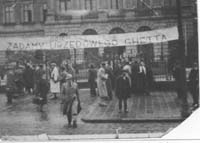
Demonstration of Polish students demanding implementation of ghetto benches at Lwow Polytechnic circa 1937 courtesy https://en.wikipedia.org/wiki/History_of_the_Jews_in_Poland.


Clara Rudder grew up in a devout Jewish family in the Carpathia Mountains in Poland.  Her father owned a store which sold pots and pans.  Her mother raised her and her siblings along with a niece.  The Rudders hailed from Spain where they had lived for four hundred years.  The Polish king encouraged Jews to come to his country in order to build commerce.  

On the Sabbath, someone came to the Rudder's house to warn them that their town was about to undergo a pogrom.  Clara's father warned the congregation at their synagogue to escape, taking their silver menorahs with them.  The Rudder's fled to a Gentile's house where he hid them in his barn. When they returned the following day, all the doors had been broken, all the windows shattered and sacs of flour, which were too heavy to carry, were doused with petrol.  

The only structure left untouched was the Rudder's store, perhaps because Mr. Rudder was such an honest businessman, or perhaps simply because the invaders didn't need any pots and pans.  Mrs. Rudder took the biggest pot they owned and made meals for the community.  Little Clara said they did not sleep for four weeks.

Yet, when Clara returned to school, the children shouted at her:  "Get out of here!"  Vowing never to raise her own children in Poland, Clara planned that day to immigrate when she grew up.  At 20, she suggested Palestine as a destination to her mom, to which she replied:  "You're going to split rocks in Palestine.  I did not bring up a child of mine to go and split rocks."

Clara's brother and sister moved to Antwerp, Belgium and she suggested that she immigrate there.  She encouraged her parents to join her, but they felt like having been born and raised in rural Poland, that's where they should stay.  Clara dated a young Jewish man who studied in Prague, Czechoslovakia.  Only three percent of Jewish Poles were accepted at university, forcing the remainder to study elsewhere.  After Clara and her boyfriend got engaged, she invited him to join her in Belgium and he agreed to continued his studies there.  However, her fiance, rejected at the Brussels university chose to return to Poland rather than immigrate.  Clara returned the ring to him.

After moving to Belgium, Clara met a diamond dealer named Paul.  They married and had a son.  In the meantime, Hitler's panzers started rolling over Europe, forcing the couple to move to France.  When the Nazis reached France, the couple was driven back to Belgium.  Clara was more determined than every to get out of Nazi occupied Europe.  

In 1940, a Paraguay attache offered to drive the couple across France to Spain and then Portugal.  Clara's sister, who had taken the trip first, wrote her a letter:  'Everything is fine, we are across the border.  Take two valises and come..."  Closing up their apartment, the couple took some diamonds and $12,000 in cash for the journey.  Stopping in Perpignan, France to secure visas, the Paraguay attache explained that he could not take them any further as his car had broken down.  The couple, planning to continue their journey by train, realized they had only $1,000 left in their possession.  Their driver had absconded with the bulk of their savings.  


German soldiers march down the Champs Elysees circa June 1940 courtesy https://en.wikipedia.org/wiki/Paris_in_World_War_II.


Reaching Lisbon, Clara and her family booked passage to America on a Greek ship.  However, Germany invaded Greece in the meantime and the ship never sailed.  It took three months for her to find another boat, this time a cattle boat.  On the twelve day voyage Clara, nervous about the mine infested waters, barely ate.  

When the boat finally reached Ellis Island, Clara was asked what she wanted.  "I want a good glass of milk...The milk tasted like cream.  It was delicious."  However, Clara was disappointed with Ellis Island.  She said that the authorities would not let them off the island.  She felt like she was in jail.  What made matters worse, was that Clara could not speak English.  The big room where the immigrates were processed was filled with 300 to 400 people.  "I couldn't breathe," explained Clara.

After seven weeks at Ellis Island, the mystery as to why Clara and her family wasn't released was cleared up.  Clara's brother in law, had given the money for their trans-Atlantic passage to a lawyer.  The lawyer had taken the money and then wrote the ship company a cheque which had bounced.  The family was being detained for the passage money.

After the Second World War, Clara discovered that her parents, her cousins, the entire town had been murdered, gassed in the ovens at Auschwitz.


Inmates forced to carry rocks at Mauthausen Concentration Camp in Austria courtesy https://en.wikipedia.org/wiki/Extermination_through_labour.


Note:  For more information about Jews fleeing the Nazis, during the Second World War, part of the largest motorized evacuation in history, read "The Journey that Saved Curious George" at http://alinefromlinda.blogspot.ca/2012/10/october-21.html.

Thursday, 12 November 2015

Elie Wiesel's The Perils of Indifference

The opposite of love is not hate, but indifference. (Elie Wiesel)


Elie Wiesel was a Romanian Jew who survived imprisonment in Auschwitz and Buchenwald during the Second World War, documented in his book Night.  Like many imprisoned Jews, Elie assumed that the powers that be did not know about the Nazi death camps.  After all, if they did, they would do something to stop the mass killings.

However, Elie eventually discovered that the United States State Department knew about the Nazi death camps; the Pentagon knew, as did President Roosevelt.  In fact, in 1939, when the ship the S.S. St. Louis arrived on the shores of the United States filled with 1000 Jewish refugees requesting asylum, President Roosevelt said no (see http://alinefromlinda.blogspot.ca/2015/09/ss-st-louis-ship-of-jewish-refugees.html).

Why did the Americans (and Canadians in the case of the SS St. Louis) show such indifference to the Jewish condition.  Elie said that the opposite of love is not hate, but indifference.  Such an attitude is dangerous.  "In a way, to be indifferent to suffering is what makes the human being inhuman. Indifference, after all, is more dangerous than anger and hatred.  Anger can at times be creative.  One writes a great poem, a great symphony.  One does something special for the sake of humanity because one is angry at the injustice that one witnesses.  But indifference is never creative."

The Americans, and the rest of the Allies, finally acted when they invaded the Nazi occupied countries and started liberating the Nazi death camps.  There was no indifference in their eyes when they saw the skeletons piled high.  Elie remembers the soldiers rage at what they saw.  He remembers the gratitude that he felt upon his liberation.  Here is an excerpt from the speech he delivered to President Clinton and some dignitaries in Washington DC in 1999:

Fifty four years ago to the day, a young Jewish boy from a small town in the Carpathian Mountains woke up, not far from Goethes beloved Weimar, in a place of eternal infamy called Buchenwald.  He was finally free, but there was no joy in his heart.  He thought there never would be again.  Liberated a day earlier by American soldiers, he remembers their rage at what they saw.  And even if he lives to be a very old man, he will always be grateful to them for that rage, and also for their compassion. Though he did not understand their language, their eyes told him what he needed to know -- that they too would remember and bear witness.


Wednesday, 16 September 2015

Young Italian Girl Pens Letter to Auschwitz Survivor Primo Levi

"The question you ask me about the Germans cruelty has long perplexed historians." (Primo Levi)


In 1982, a young Italian girl penned a letter to Auschwitz survivor Primo Levi, after reading his book If This is a Man.  The letter sat in a treasure box for decades.  Recently it was published in the Italian newspaper La Stampa.

After Monica Perosino read the Primo Levi's 1947 novel, If This is a Man, her head was buzzing with questions.  "Why didn't anyone do somthing to stop the massacre?  Were the Germans evil?"  It was hard to imagine that something as horrific as the Holocaust could happen.  Little Monica got out a piece of stationery and penned a letter to the Italian author posing her poignant questions.  Then she took out a Turin phone book, where she lived, and searched for Levi's address.  She postmarked her letter and waited for a response.

I'm sure no one who went through the gates of Auschwitz would ever forget the horror.  And Levi was no exception.  In his time at the concentration camp, from February of 1944 to January of 1945, Levi saw enough horror stories to fill several books.  Yet somehow he was able to write an eloquent response to Monica.  He explained:

"The question you ask me about the Germans cruelty has long perplexed historians.  In my opinion it would make no sense accusing of cruelty the whole German nation of those days -- let alone pointing the finger at today's Germans... Nevertheless, many Germans must have known directly or indirectly what was going on...I would accuse the Germans of those days of selfishness, of being indifferent and intentionally ignorant..." http://www.haaretz.com/jewish-world/jewish-world-news/.premium-1.639195

On the one hand, many Germans (and non-Germans) aided and abetted the Nazis during the Holocaust.  On the other hand, there were Germans who stepped up to the plate and saved Jewish lives, at great risk to their own lives:  who hid Jewish children; who employed Jews in their factories to prevent them from being deported to concentration camps (Oskar Schlinder); who renounced the Nazis from the pulpit (Dietrich Bonhoeffer for which he was executed); and who even helped Jews from within the walls of the concentrations camps.

Back in Italy, Monica grew up to become a journalist.  For a long time, she forgot about Primo Levi's letter, which sat in a treasure box in her apartment.  Recently, she rediscovered it when she was packing to move.  Her editor at by La Stampa, the same newspaper that Primo Levi had written for. convinced her to publish it.  Monica thought it was an appropriate course of action, explaining:
"I understand his [Primo Levi's] answer wasn't just for me, it was for everybody."

Note:  For more information, read Primo Levi's book Survival in Auschwitz.


Primo Levi circa 1940s courtesy http://www.basisdruck.de/images/primo-levi-1.jpg.