Tuesday, 14 June 2016

Africville: A Ghetto to Some; Home to Us

"They razed Africville; what's the fuss?
A ghetto to some; home to us."
(Africville poem, Linda Jonasson)


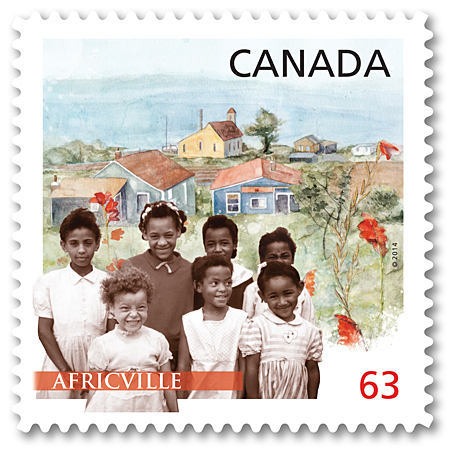
It had a garbage dump, an abattoir and a jail.  It had no street lights, no running water and no paved streets.  But it did have flowers.  It did have small colourful homes.  It did have a church, a school and a post office.  And it had a strong sense of community.  

Africville was a black settlement on the shores of Bedford Basin at the edge of Halifax.  Its residents are descended from Black Loyalists who arrived after the American Revolution.  For close to two hundred years, they lived in Africville, working Monday to Friday and attending Seaview Baptist Church on Sunday.  Their children attended the school, also located in the church.  While they may have been poor in the pocketbook, they were rich in spirit.  

Urban planners who visited Africville in the 1960's "did not see the flowers" (http://alinefromlinda.blogspot.ca/2016/02/africville-he-did-not-see-flowers.html).  They only saw the garbage.  They did not see the quaint church; they only saw the jail.  They did not see a close knit community; they saw a ghetto.

They pressured the home owners into selling and, one by one, the houses were bulldozed.  A resident would go to bed with a neighbour beside him, only to wake up to a pile of dirt.  They even bulldozed the church in the middle of the night.  Africvillians were forced to relocate in Halifax tenements, their land lost, their sense of community destroyed.

In 2010, Seaview Baptist Church was rebuilt to honour the residents of Africville.  In 2014, Canada Post issued a stamp to commemorate Africville.  

Note:  For more information about Africville, watch the National Film Board of Canada presentation "Remember Africville" (https://www.youtube.com/watch?v=28cvg6iD7lA).


Monday, 13 June 2016

Polio: The Most Feared Disease of the 20th Century


American stamp issued circa 1999 courtesy http://www.ur.umich.edu/9899/May24_99/6.htm.


President Franklin D. Roosevelt walked with braces and crutches due to a life threatening battle with polio at age 39.  When I googled "Famous People who Have Had Polio" (http://www.disabled-world.com/artman/publish/famous-polio.shtml).  I was surprised to discover how long the list was:


  • Donald Sutherland (actor)
  • Jack Nicklaus (golfer)
  • Mia Farrow (actress)
  • Neil Young (musician)
  • Paul Martin (former Canadian Prime Minister)
  • Alan Alda (actor)
  • Dinah Shore (actress, singer)
  • Joni Mitchell (singer)
  • Sir Walter Scott (historical novelist)
  • Wilma Randolph (Olympic medallist "La Gazella Nera")
  • Ben Bradlee (Washington Post V.P.)
  • Marion Davies (movie star)
  • Frank Mars (chocolate bar maker)
  • Dorothea Lange (Great Depression-era photographer)
  • J. Robert Oppenheimer (physicist)
  • Tanaquil Le Clercq (ballet dancer)
  • Margarete Steiff (seamstress; founder of Steiff Teddy Bears)
These are just some of the names on the list.  Polio has afflicted millions of people worldwide, killing many, paralyzing others and leaving still others infertile.  


For those of us born after 1955, we have the benefit of the polio vaccine developped by Jonas Salk and a team of researchers at the University of Pittsburgh.  As a precaution, Salk spent three years testing the vaccine on 1.8 million children in 44 different states from Maine to California.  Once considered safe, the vaccine was promoted by the March of Dimes in a massive inoculation campaign.  The annual number of cases decreased from 35,000 in 1953 to 5,600 by 1957.  As of 2014, there were only 359 reported cases of the disease.

Polio vaccine research was also conducted at the University of Toronto.  Canadians also participated in the trial vaccine in 1954.  However, in early 1955, it was discovered that 79 children who had received the vaccine still contracted polio:  Americans temporarily suspended its administration.  Meanwhile, in Canada, the Minister of Health, Paul Martin Sr., was particularly concerned about the lack of action.  He had battled polio back in 1907; his son, Paul Martin Jr., a future Prime Minister, battled the disease in 1946.  Martin Sr. pushed for the continuation of the mass vaccinations.  "Canada's confidence in the Salk vaccine renewed confidence around the world."  (https://www.canadapost.ca/cpo/mc/personal/collecting/stamps/archives/2005/2005_sept_polio.jsf)

In 2005, Canada Post issued a stamp commemorating the 50th Anniversary of Jonas Salk's polio vaccine.


Sunday, 12 June 2016

Oscar Peterson: Maharaja of the Keyboard

Oscar Peterson was born and raised in Montreal to immigrants from the West Indies.  Peterson's father worked as a porter for the Canadian Pacific Railway.  Growing up in an all black neighbourhood and surrounded by the jazz culture, Peterson first learned how to play the trumpet.  However, a bout of tuberculosis forced him to give up the horn for the piano.  His sister, Daisy, was one of his first piano teachers.  Peterson also studied under Hungarian born classical pianist Paul de Marky.  Thanks to his persistent practice of four to six hours per day, Peterson mastered the art.

At the age of fourteen, Peterson won a CBC national music competition and quit school to pursue music fulltime.  Peterson, drawn to jazz, was heavily influenced by Teddy Wilson, Nat King Cole, James P. Johnson and Art Tatum.  The young talent made his first recordings, I Got Rhythm and The Sheik of Araby, for RCA Victor in 1945.

Peterson was introduced to American audience through Jazz at the Philharmonic in 1949.  Peterson's first tour of Europe took place in 1952.  He made more than 200 albums with other bands or artists including "Ella and Oscar" with Ella Fitzgerald.  Peterson left his mark on Duke Ellington who called him the "Maharaja of the Keyboard".  Canadiana Suite, which came out in 1964, was a nod to Peterson's home and native land.  While he was an international success, he would never forget his Canadian roots.


Saturday, 11 June 2016

Sam McLaughlin: One Grade Only and That the Best

Sam McLaughlin, born in Enniskillen, Ontario, began apprenticing as an upholsterer in the family carriage business in 1871, earning only $3 a week.  Within five years, he was an official partner in the business.  He turned the carriage company into a car company and soon merged with GM to form General Motors of Canada.  Sam's motto always remained:  "One grade only and that the best." Under Sam's leadership, GMC became Canada's leading exporter of automobiles.

Sam didn't just contribute to the car business; he was a dedicated philanthropist, donating $200 million to organizations, charities and individuals.  McLaughlin received the Companion of the Order of Canada in 1967.  He passed away five years later.  His home in Oshawa, Ontario was designated a historic site in 1989.  Weddings are held on its beautiful grounds.


Friday, 10 June 2016

Anne of Green Gables' World Wide Appeal

"Despite its distinctly Canadian setting, Anne of Green Gables belongs to the world." (Canada Post)


Every Canadian knows about the flame-haired orphan who warmed her way into the hearts of Marilla and Matthew Cuthbert.  We know about Anne hitting Gilbert over the head with her slate when he teased her about her red hair.  We know about her kindred spirit, Diane, and about her tear felt goodbye to her beloved Matthew.  We remember her academic success and the trials of her first teaching assignment.

"[However] despite its distinctly Canadian setting, Anne of Green Gables belongs to the world."  (https://www.canadapost.ca/cpo/mc/personal/collecting/stamps/2008/2008_june_aogg.jsf).  Who would have thought that a book with such a Canadian flavour would first be published by an American company?  Lucy Maud Montgomery had already been turned down by Canadian publishers and as a last ditch effort, in 1908, approached an American one, the Page Company of Boston  (http://alinefromlinda.blogspot.ca/2014/07/anne-of-green-gables-could-have-sat-in.html).  

It should be no surprise, then, that one of Anne's earliest fans was the famous American author Mark Twain who wrote to Montgomery and praised her for creating "the dearest and most lovable child in fiction since the immortal Alice [in Wonderland]" (http://www.enotes.com/topics/anne-green/critical-essays/anne-green-gables-l-m-montgomery).

It was only a year later that Anne was translated into Swedish, titled Anne pa gronkulla.  It was so well received that two further Swedish translations followed in 1941 and 1962.  

The Swedish edition was followed in 1911 by a Polish translation titled Ania Z Zielonego Wzgorza.  During the Second World War, members of the Polish Resistance were given black market copies of Anne of Green Gables to read at the Front, inspiring them to fight for their principles.  

In 1939, a Canadian missionary visited Japan and left her prized copy of Anne of Green Gables with a friend who secretly translated the text into Japanese, Akage No An (Red-Haired Anne).  After the war, when the Japanese school system was looking for good quality Western literature, Anne of Green Gables was selected for its curriculum.  Today, generations of Japanese celebrate Anne by visiting Green Gables on Prince Edward Island.  Many celebrate Anne-themed weddings at home.  Thousands of Japanese tourists flock to the Island each year, the women often dying their hair red and fashioning it in pigtails.  The Japanese cannot get enough of Anne.  


Thursday, 9 June 2016

The Royal Ontario Museum


https://en.wikipedia.org/wiki/Royal_Ontario_Museum


My Grandad used to go there every year for the Royal Winter Fair where he admired the beautiful horses.  I visited there in Grade 7 for the King Tut Exhibit.  It attracts over one million visitors each year.

The Royal Ontario Museum was officially opened in 1914 by the Governor General of Canada. Situated at the edge of Toronto's built up area, it was deliberately placed near the University of Toronto, the institution which governed it for decades.  The original museum included five buildings representing:  Archeology, Paleontology, Minerology, Zoology and Geology.

The first addition to the ROM, the South Wing, was built during the Great Depression.  In 1968, the ROM opened a Planetarium funded by a generous donor Sam McLaughlin, the head of General Motors of Canada.  The Michael Lee Chin Crystal was added to the front of the ROM in 2007.

Notable exhibits over the years include:


  • King Tut's Tomb (1979)
  • Into the Heart of Africa (1989)
  • Anne of Green Gables manuscript (2007)
  • Pierre Trudeau's birchbark canoe (2007)
  • Avro Arrow Landing Gear (2007)
  • Dead Sea Scrolls (2009)
  • Pompeii (2015)

Wednesday, 8 June 2016

Homer Watson

"There is at the bottom of each artistic conscience a love for the land of their birth." 
(Homer Watson)


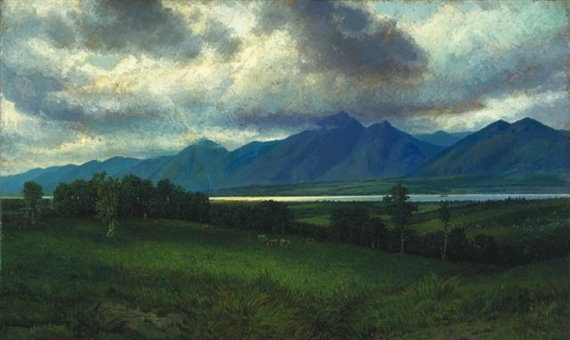
Dawn in the Laurentides courtesy https://en.wikipedia.org/wiki/Homer_Watson.


Homer Watson was given a set of paints by his aunt and decided to become a painter.  Decades later, Oscar Wilde nicknamed Watson the "Canadian Constable", comparing him to the great English landscape artist.

Homer Watson was born in Doon, Ontario (now Kitchener) in 1855.  He showed an interest in art from an early age.  Later moving to Toronto, he copied works from the Toronto Normal School, but was mainly self-taught.  In 1876, Watson moved to New York where he was influenced by the Hudson River School.  He painted along the banks of the Hudson and Susquehanna Rivers.  In 1880, he painted The Old Mill and sold it to the Marquis of Lorne for Queen Victoria's art collection.

The same year Watson married and bought a house in Doon, near the banks of the Grand, which he featured in his newest paintings. In 1887, he moved to England for four years where he painted his most famous piece The Flood Gate.  Watson maintained:  "There is at the bottom of each artistic conscience a love for the land of their birth."  In his later years, Watson campaigned for the preservation of the Waterloo woodlands which he had so lovingly painted.  The Stock Market Crash of 1929 forced him to sell many of his paintings.

In 2005, Canada Post honoured Homer Watson by issuing two stamps, Dawn in the Laurentides and The Flood Gate.  Today, Watson's Doon home has been transformed into a museum, filled with his paintings.