Saturday, 14 May 2016

Frank Lloyd Wright


"The maple wood blocks...are in my fingers to this day." (Frank Lloyd Wright)


When Anna Lloyd Wright was pregnant with her first child, she declared:  "my first child will grow up to build beautiful buildings".  She decorated the nursery with engravings of English cathedrals.  At the Centennial Exhibition in Philadelphia in 1876,  Mrs. Wright, a former teacher, was intrigued with the teachings of Friedrich Wilhelm August Frobel, founder of the Kindergarten movement.  She purchased his geometrical shapes:  a cube, a sphere and a triangle.


Memorial Hall at Centennial Exhibition in Philadelphia circa https://en.wikipedia.org/wiki/Centennial_Exposition.


It was those blocks that Frank Lincoln Wright played with for hours on end.  He never forgot how much his mother believed in him and when his father abandonned the family when he was 11, he dropped the middle name Lincoln and made it Lloyd after his mother.


Frank Lloyd Wright's home in Oak Park, Illinois courtesy https://en.wikipedia.org/wiki/Frank_Lloyd_Wright.

When Frank Lloyd Wright grew up, he apprenticed as a draftsman at Adler & Sullivan.  He built houses in Chicago, including a Tudor style design in the Oak Park suburb.  While at Adler & Sullivan he designed projects on the side.  When Sullivan found it, he considered it a breach of their contract.d  Furious, Wright stormed out of the office never to return.

Wright set up his own practice in Chicago's Schiller Building for a short time.  Later, he moved to the Steinway Building where he shared the space with Spencer, Hunt and Perkins.  The four architects would represent the Prairie School of architecture.  Wright was offered the chance to study at the Ecole de Beaux Arts for four years but he turned it down, choosing instead to embrace a new, more American type of architecture.
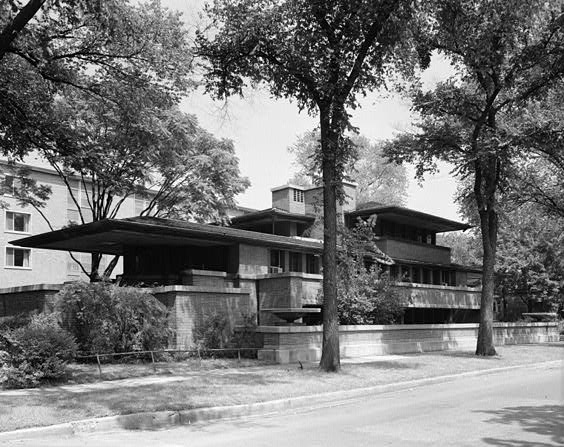


In 1898, married and with an ever growing family, Wright turned his home office into more bedrooms and built a new studio attached to the house.  An increasing influence on the world of architecture, Wright wrote two articles for the Ladies Home Journal:  "A Home in a Prairie Town" and "A small House with Lots of Room in It".

Even though Wright was married, he had a wandering eye.  IN 1903, while designing a house for Edwin Chaney, he fell in love with Chaney's wife.  After a two year exodus in Europe, Chaney was granted a divorce from her husband to marry Wright.  However, Wright's wife refused to grant him a divorce.  In the meantime, tragedy struck in 1914 when the former Mrs. Chaney, living at Wright's resort, was murdered by a mentally ill servant.
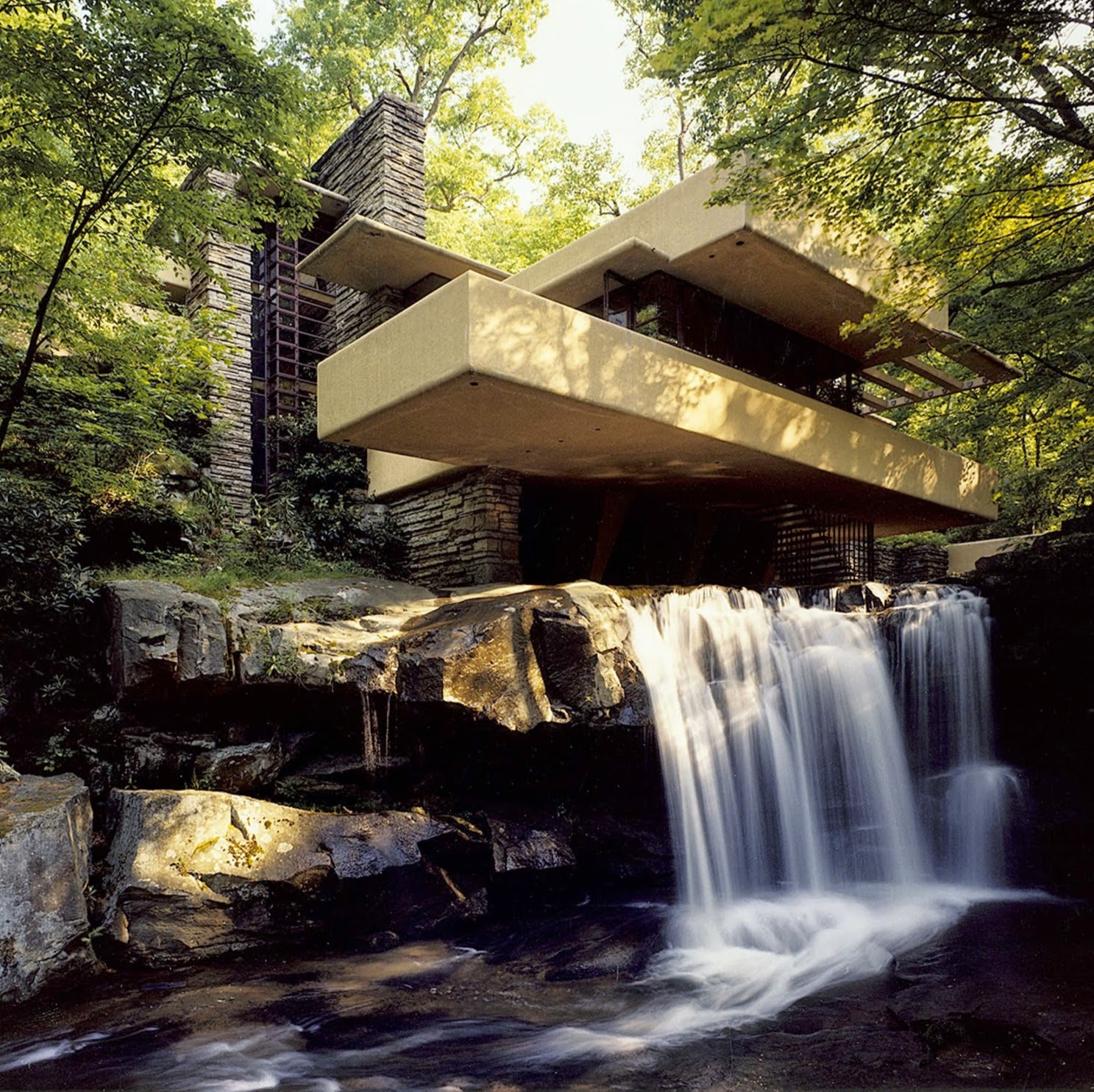

Falling Water in Pennsylvania courtesy 

Famous designs attributed to Wright in the late 1920's and 1930's were :  Falling Water, Graycliff and Taliesin West. He employed the use of glass in his design of the Johnson Wax Headquarters.  Wright's most famous design, however, remains New York City's Guggenheim Museum, one that he worked on for sixteen years and completed in 1959.


The Gugenheim Museum in New York City circa 1959 courtesy https://countoncross.wordpress.com/2011/10/21/the-guggenheim-museum-grand-opening-today/.



Wright is considered to be the most influential American architect in history.  The geometrical blocks that Anna Lloyd Wright bought all those years ago came in handy.  It is appropriate that one of Frank Lloyd Wright's son, John Lloyd Wright, invented Lincoln Logs in 1918.

Friday, 13 May 2016

Lewis & Clark: The Corps of Discovery

"Sent by President Thomas Jefferson to find the fabled Northwest Passage, Meriweather Lewis and William Clark led the most important expedition in American history -- a voyage of danger and discovery from St. Louis to the headwaters of the Missouri River, over the Continental Divide to the Pacific.  It was the United States first exploration of the West, and one of the nation's most enduring adventures." (Ken Burns)


Lewis & Clark's outbound route in red, inbound route in blue courtesy http://www.pbs.org/lewisandclark/inside/.


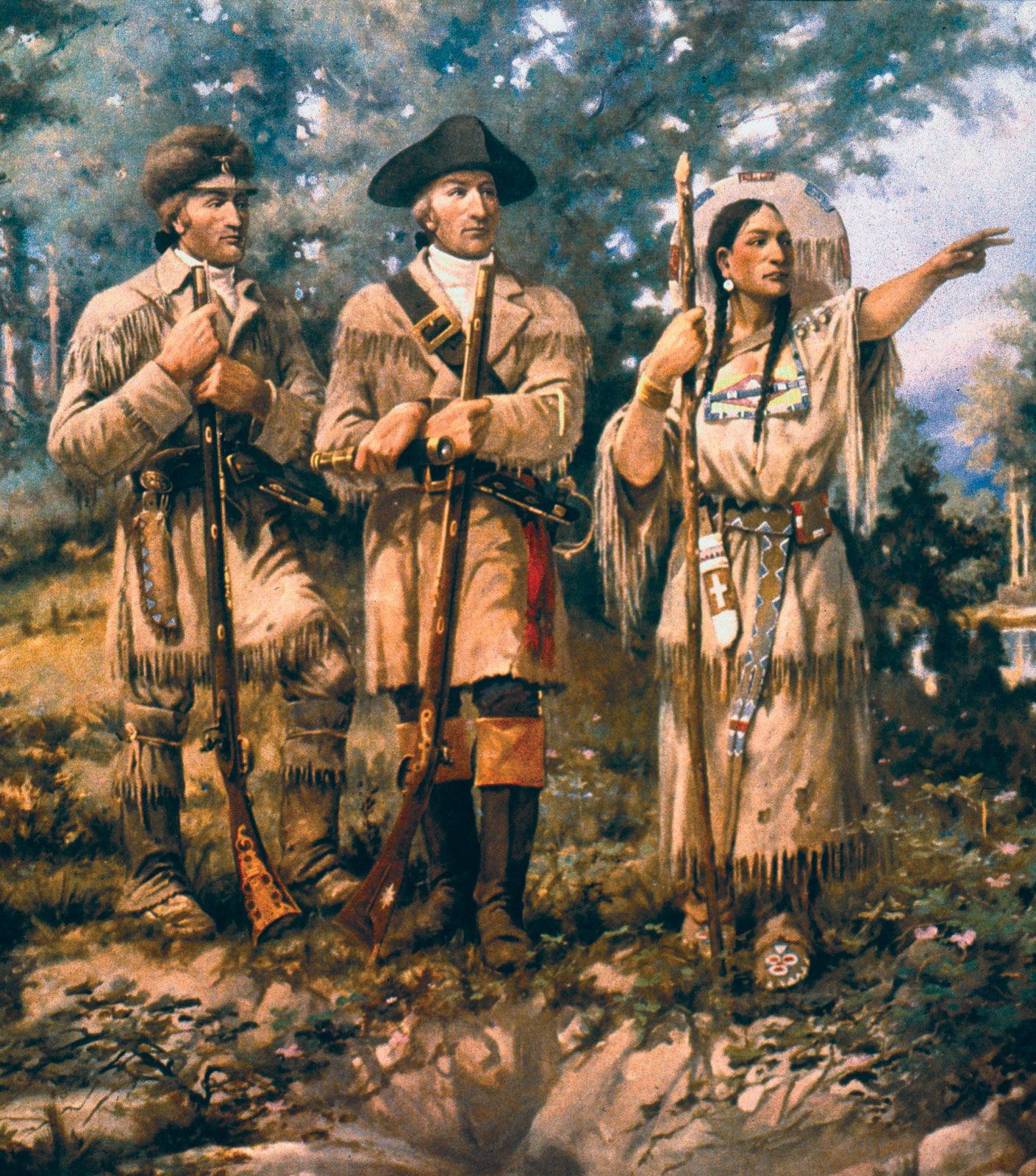
In 1803, only four roads crossed the Appalachian Mountains.  Thomas Jefferson dreamed of a Northwest Passage, what he believed would "break open the wealth of North America" by opening up trade with the Orient.  That year, the United States Congress approved Jefferson's "The Corps of Discovery" to the uncharted West.  Led by Jefferson's secretary, Meriweather Lewis, and Lewis' friend, William Clark, and with $2500 worth of funding, the group set out for the Pacific.  

 The expedition required a lengthy list of supplies including compasses and sextants, rifles and gunpowder, tomahawks and tobacco, forceps and syringes.  For a complete list, visit http://www.pbs.org/lewisandclark/inside/idx_equ.html.

The journey was an adventure for many of the 29 members of the expedition, an opportunity to feast their eyes on breathtaking beauty, on unsurpassed scenery.  The expedition would also dispel many myths about the West.  Jefferson's plethora of books on the subject at his Monticello home stated things like:  the West was "a mass of erupting volcanoes; the Blue Ridge Mountains in Virginia were the continents highest.    Another myth maintained that the West was full of "gargantuan woolly mastodons, seven-foot-tall beavers and friendly, slim-waisted buffalo".  The group would have been disappointed to meet the real beavers.  Maps of the west were equally misleading, depicting California "as an island" and the Rockies as "narrow and undaunting".

While the explorers revelled in the beauty of the West, they weren't prepared for its harsh winters. Privates Moses Reed and John Newman both had changes of heart.  Reed, punished for desertion, was given 100 lashes on his bare back.  Newman also received a court martial for "mutinous acts". When spring arrived, both men were set adrift down a river on a keel boat.  Even so, most of the members of the expedition made it home safely.  

Back in Washington DC, an event transpired which eclipsed the Lewis and Clark Expedition:  the Louisiana Purchase.  Jefferson was able to secure an 820,000 square-mile parcel of land, the Louisiana Territory, for $15 million.  "In a single stroke, the size of the United States was doubled."  America was on its way to becoming a continental nation, from sea to sea.


Sacagawea with Lewis & Clark at Three Forks courtesy 

Thursday, 12 May 2016

Thomas Jefferson

"I think one approaches Thomas Jefferson with the sense that he is, in a biographical sense, the Holy Grail of American History." (Ken Burns)


Thomas Jefferson, a Renaissance man, represented two polar opposite ideas.  As Ken Burn explains, "He may be the man who distilled a century of Enlightenment thought into this sentence that begins:  'all men are created equal.'  But he was also the owner of more than 200 human beings and never saw fit in his lifetime to free them..."

Jefferson believed in education:  when he lost his entire book collection to a fire at his birthplace home, he responded:  "I cannot live without my books."  He spent the next several years re-amassing his literature, which would total 6,500 titles (http://alinefromlinda.blogspot.ca/2015/10/thomas-jefferson-i-cannot-live-without.html).  When the British Army burned the White House in the War of 1812, the retired president sold his beloved collection to replenish the shelves at the Capitol.

While Jefferson was an avid reader, he was also an avid writer; his writings have been condensed into 19 volumes.  His most famous work was the Constitution of the United States, which he penned in 1787:  

"We the people of the United States, in order to form a more perfect Union, establish Justice, insure domestic Tranquility, provide for the common defence, promote the general Welfare, and secure the blessings of Liberty to ourselves and to our Posterity, do ordain and establish this constitution for the United States of America..."

As Ken Burns says, the statement "all men are created equal" is one of the most important, and revolutionary, parts of the Constitution.  However, when it came right down to it, Jefferson didn't "walk the walk".  He kept over 200 slaves, like so many other Americans.  It never occurred to him to free them, even though he pushed for equality among men.  

Even so, Burns believes that Jefferson's influence on America was more positive than negative.  As Burns explains:  While Jefferson's words "gave comfort to the secessionists and the army of Jefferson Davis.... it is more important that his words inspired Abraham Lincoln, a generation of abolitionists, and thousands of runaway slaves."


Wednesday, 11 May 2016

The West: Four-Way Stop Sign of American History

"I return to the West every year with my two daughters to explore some new aspect of it.  I feel like it beckons me.  And while I can't imagine living anywhere else but New England, I still feel like a citizen of the West.  I think that's true of all Americans who are touched by its breathtaking beauty, exhilarated by its vast distances and moved by its often-tragic and heroic story." (Ken Burns)


"I see the West as a four-way stop sign of American history, a place of surprising collisions of culture," explains Stephen Ives, director and co-producer of the PBS series The West (http://www.pbs.org/weta/thewest/program/producers/ives.htm). While the American West was the place where dreams were realized, it was also the place where dreams were destroyed.  In the nation's effort to fulfill Monroe's Manifest Destiny, The West became a land to be conquered.  

As co-producer Ken Burns explains, you cannot separate the United States from the West.  It is an integral part of American history.  "I return to the West every year with my two daughters to explore some new aspect of it.  I feel like it beckons me.  And while I can't imagine living anywhere else but New England, I still feel like a citizen of the West.  I think that's true of all Americans who are touched by its breathtaking beauty, exhilarated by its vast distances and moved by its often-tragic and heroic story." (http://www.pbs.org/weta/thewest/program/producers/burns.htm)
)


The PBS series The West is divided into eight sections.  Section One, The People, focusses on explorers Lewis and Clark, at a time when the West was largely undiscovered.  

Section Two, Empire Upon the Trails, examines the fur trade, the battle for Texas, the flight of the Mormons to Utah, and the endless line of Conestoga wagons rolling down the Oregon Trail.  It also highlights the expulsion of the Cherokee Indians east of the Mississippi to Oklahoma along the famous "Trail of Tears". 


                                                               Oregon Trail courtesy 
        http://news.discovery.com/adventure/travel/traveling-the-oregon-trail-photos-150725.htm.


Episode Three, Speck of the Future, tells the story of the California Gold Rush of 1849, "littering the hills with mining towns and creating the West's first metropolis".  

In Episode Four, Death Runs Riot, Burns explains how the Civil War comes early to the West. Abolitionists fight for free soil in Kansas; Mexican Americans rebel along the Rio Grande; and in Utah, federal troops march against Mormon polygamy.

In Episode Five, The Grandest Enterprise Under God, the opening of the transcontinental railroad transforms the West, bringing with it cowboys, buffalo hunters and suffragists.  


Buffalo skull pile circa 1870 courtesy 


In Episode Six, Fight No More Forever, the federal government imposes its authority over the West. However, three individuals protest:  Sitting Bull, Brigham Young and Chief Joseph. 

Episode Seven, The Geography of Hope, speaks of the many newcomers to the West, including Chinese Americans, the first of which came to build the railroad.  "For every Indian in the West, there were nearly 40 whites."  Native Indian children are encouraged to forsake their heritage.  The legend of the Wild West is embodied by the greatest showman of the age, Buffalo Bill. 

In Episode Eight, One Sky Above Us, settlers race to grab tribal lands, as in the "Oklahoma Land Rush".  Native Indians perform ghost dances, hoping to reclaim a lost way of life.

As Stephen Ives explains:  "I hope they [the viewers] will come away with a clear eyed sense of what it took for this country to become the United States we know today, both good and bad.  I don't think we can every look at The West without feeling what Tom Watkins...describes as a 'mixture of both pride and shame.'  I think that's a fundamentally healthy way to look at the history of our nation."


Oklahoma Land Rush circa 1889 courtesy 
                                         https://en.wikipedia.org/wiki/Land_Rush_of_1889.

Tuesday, 10 May 2016

Baseball : Where Memory Gathers

"Baseball, because of its continuity over the space of America and the time of America, is a place where memory gathers." (Donald Hall)


Apart from the two years that the Toronto Blue Jays won the Major League championship, I have not been a baseball fan.  However, in recent years, I have discovered a handful of picture books which not only bring baseball, but history, to life (Jackie's Gift, All Star!  Honus Wagner and the Most Famous Baseball Card Ever, Campy:  The Story of Roy Campanella, Willie and the All Stars).  I have realized that the two are interchangeable.  As Donald Hall explains:  "Baseball, because of its continuity over the space of America and the time of America, is a place where memory gathers." (http://www.pbs.org/kenburns/baseball/)


Ebbets Field circa 1912 courtesy http://www.oldnycphotos.com/bbm311.html.


Back in 1909, Charles Hercules Ebbetts bought an old garbage dump called Pigtown.  Three years later he constructed a ball park, Ebbetts Field, the future home of the Trolley Dodgers.  The team had been named for its loyal fans who dodged trolleys on Brooklyn's busy streets.  As Walt Whitman explained, the sport had permeated the city:  "In our sundown of perambulators of late, through the outer parts of Brooklyn, we have observed several parties of youngsters, playing base, a certain game of ball...Let us go forth awhile and get better air in our lungs.  Let us leave our close rooms...The game of ball is glorious." (http://www.pbs.org/kenburns/baseball/)

As Ken Burns says, "baseball is a powerful metaphor for America".  The changes that the Brooklyn Dodgers have undergone are indicative of the changes the nation has undergone.  Burns points out that baseball touches on:  race, immigration, labor and management, pop culture and advertising, heroes and villains.  

Firstly, let's talk about immigration.  "In the 1930's and 1940's, Brooklyn was a melting pot of immigrants trying to make a buck." (https://books.google.ca/books?isbn=0595314287)  
Roy Campanella, the son of an Italian immigrant, played for the Brooklyn Dodgers.  His father used to pedal fruits and vegetables out of his truck.

Baseball is also the history of race.  Number 42, Jackie Robinson, broke the colour barrier when he signed with the Brooklyn Dodgers in 1947 (http://alinefromlinda.blogspot.ca/2013/04/april-15.html).

Former Brooklyn manager Leo Durocher was suspended in 1947 for "association with known gamblers" after being involved in a rigged crap game.

The Brooklyn Dodgers produced its share of heroes including Roy Campanella, who after suffering a terrible car accident, was paralyzed and wheel chair ridden for the rest of his life.  He never gave up, however, and continued to lead a productive life off of the baseball field.

The Brooklyn Dodgers' history culminated with the winning of the World Series in 1955.  However, the joy for Brooklynites was shortlived for the team moved to Los Angeles only two years later.

It's hard to believe the influence that baseball has had on pop culture.  The Glossary of English Idioms Derived from Baseball (https://en.wikipedia.org/wiki/Glossary_of_English-language_idioms_derived_from_baseball) includes dozens of expressions such as:

  • Play ball!
  • grand slam
  • ballpark figure
  • to knock it out of the park\batting a thousand
  • you're in the big leagues now
  • charley horse (1887)
  • cover one's bases
  • throw someone a curveball
  • extra innings
  • grandstanding
  • step up to the plate

Ken Burns Baseball series proves that baseball truly is "America's pastime".  Comprised of nine "innings", the series includes photographs, drawings, paintings, lithographs and newsreels.  Just as the Civil War series has the "Ashokan Farewell", the Baseball series has "Take Me Out to the Ballgame" a song dating back to 1908.


Monday, 9 May 2016

Empire of the Air: The Romance of Radio

"Sound itself attracts -- ask any eavesdropper.  Sound is the first stirring of the infant.  He hears sound -- he puts them together -- they cohere.  Sounds have a romance.  The sound of a cricket at night to establish a mood in a radio drama:  a very simple effect.  The sound of thunder.  The sound of rain.  There is no sound on the moon because it takes air to support it; the vibrations of air create the sound.  And radio was a medium which employed that magic." (Norman Corwin)


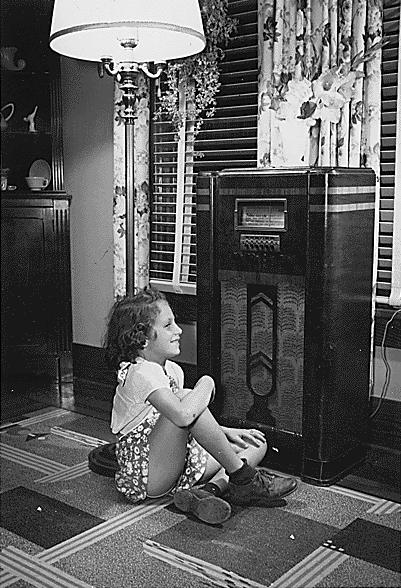
An American girl listening to the radio circa 1937 courtesy 


Long before televisions filled American parlours, the radio was the centre piece for the living room. For fifty years,  radio was the dominant medium.  As CBS radio director and producer Norman Corwin explained:  "There was a kind of romance to radio that has not been extended by its successor medium, television.  The listener was a blind audience, and he collaborated with what he heard.  He could construct the sets, and dress the cast in his own mind and fill in the gaps.  Radio was to a marked degree the medium for poetry and heightened language." (http://www.pbs.org/kenburns/empire/radio/)


Dylan Thomas' reciting his poetry circa 1940's or 1950's courtesy http://www.bbc.co.uk/programmes/profiles/1m22kf8TT3jJqjyww5LPWpD/on-radio

Ken Burns points out that radio had "a way of bringing people together -- through language, politics, music, news, literature, drama and humour".  Whether it was Franklin D. Roosevelt's fire side chats during the Great Depression, or Bing Crosby's Radio Hour of the 1940's or CBC's Hockey Night in Canada (north of the border), much of the nation had its ears glued to that cathedral like contraption, hanging on every word, united in a common interest.  Here are some monumental events broadcast live via radio:

  • wireless distress signals save many lives on the sinking Titanic in 1912
  • Charles Lindbergh's return from Paris after his trans-Atlantic flight in 1927
  • Orson Welles' War of the Worlds sci-fi broadcast convinces many Americans that New Jersey is truly being invaded by aliens in 1938
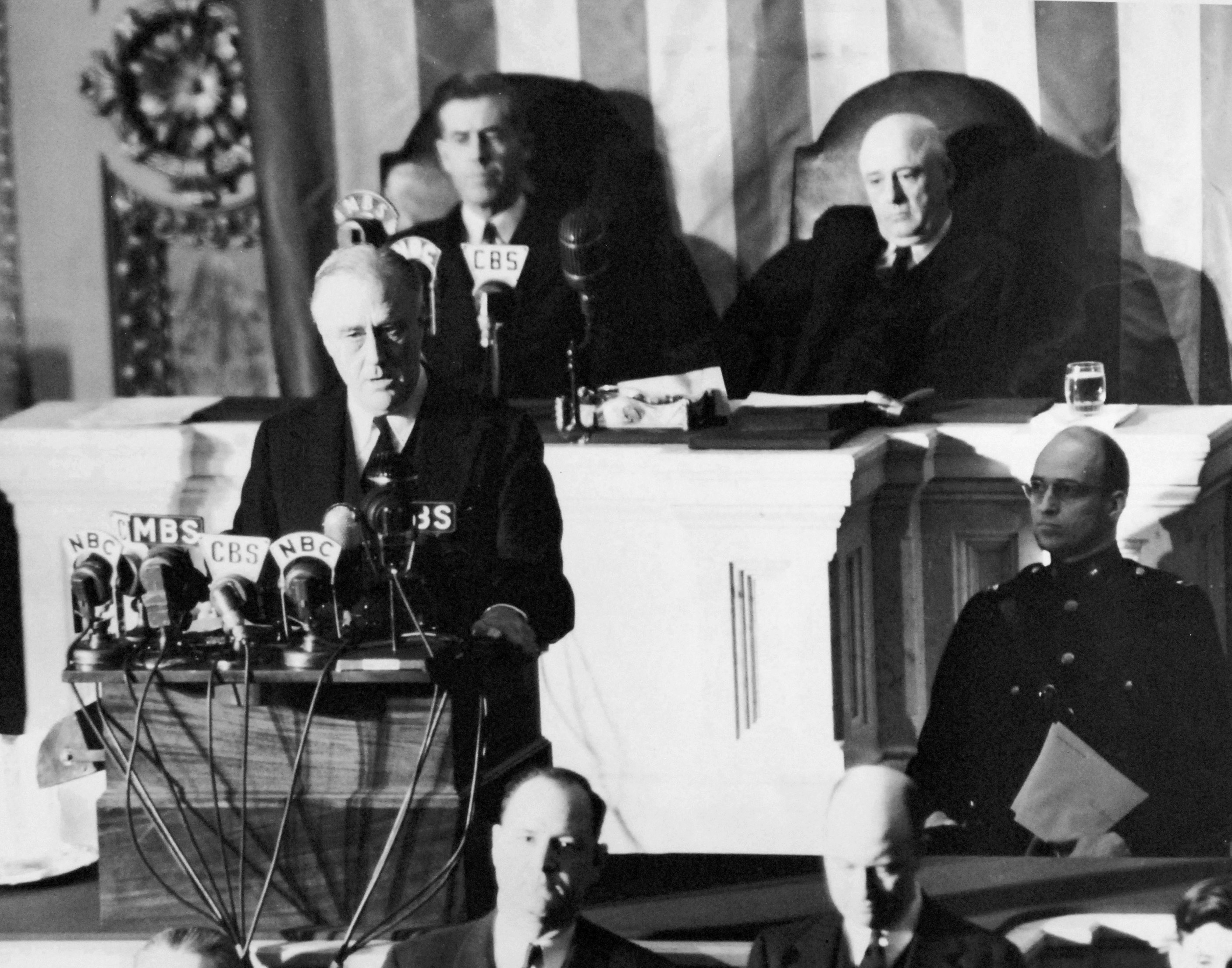
  • President Franklin D. Roosevelt delivers his speech after Pearl Harbor attack in 1941

Franklin D. Roosevelt's "A Day Which Will Live in Infamy" speech circa December 8, 1941 courtesy https://en.wikipedia.org/wiki/Infamy_Speech.


In his documentary, Empire of the Air:  The Men Who Made Radio, Ken Burns focusses on three pioneers in the field of radio:  Lee DeForest, Edwin Armstrong and David Sarnoff.  Lee DeForest, a clergyman's flamboyant son, invented the audion tube and formed the wireless telegraph company in 1902.  Edwin Armstrong, a brilliant inventor, pioneered FM technology.  David Sarnoff, a hard driving Russian immigrant, created the most powerful communications company on earth.


David Sarnoff, the Father of Broadcasting, circa 1930's 


"By 1950, there were 90 million radio sets in American homes.  There were also 10 million examples of a new medium:  "As for the picture box that kicked the radio out of the parlor (and into such remote niches as the basement, garage, shower, car, jogging path, virtually everywhere but the living room), Corwin says 'television has a far greater hold on the person who wants to sit and have things come to him pre-digested...There were no couch-potatoes in radio." (http://www.pbs.org/kenburns/empire/radio/


For a clip from Ken Burns' documentary, Empire of the Air;  The Men Who Made Radio, visit http://www.pbs.org/kenburns/empire/film/.

For more information, read Tom Lewis' book Empire of the Air:  The Men Who Made Radio (1991).


Sunday, 8 May 2016

The Civil War

"The Civil War was history running on all four cylinders.  It was the most important event in the history of our nation, and its importance continues today.  The blueprint of the America we know was drawn up then, and whether we know it or not, we are still walking around in the shadow of that war." (Ken Burns)


It had all the makings of a hit:  Matthew Brady's stirring photographs; tear jerking letters penned by soldiers on the battlefield; star power narratives; and a haunting Scottish lament.  Ken Burns Civil War series, which debuted in 1990, would reach 40 million viewers.  It would make documentary maker Ken Burns a household name and commentator Shelby Foote, a millionaire https://en.wikipedia.org/wiki/The_Civil_War_(TV_series).


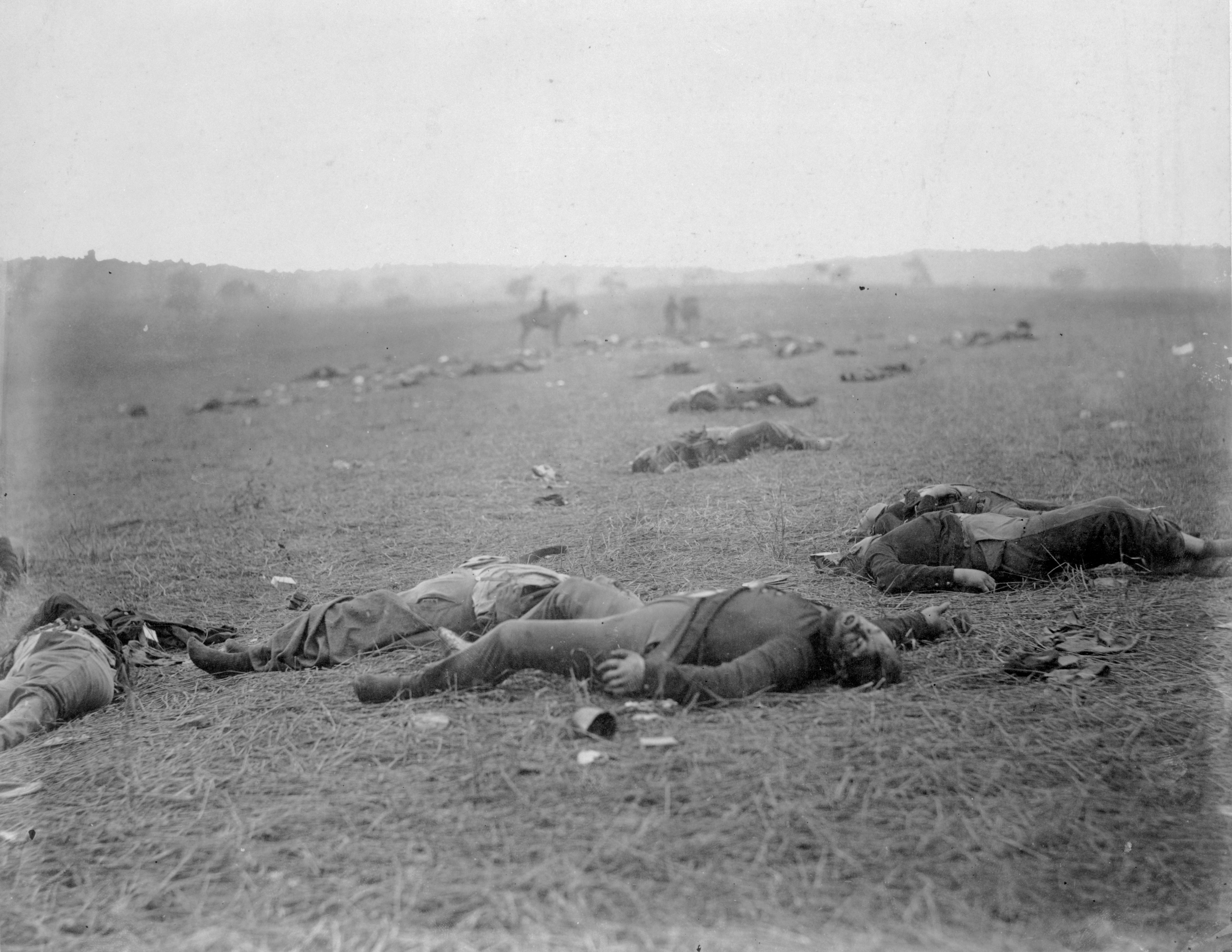
"Dead at Gettysburg 1863" courtesy https://en.wikipedia.org/wiki/Battle_of_Gettysburg.


Ken Burns was inspired to create the Civil War series after discovering Matthew Brady's massive collection of photographs.  Brady studied under Samuel Morse, who had learned about the daguerrotype from Louis DaGuerre himself.  Brady, along with three associates, was able to capture 16,000 images on the battlefield.  His secret to success was his portable darkroom which travelled with him wherever he went.  His very first photographs were taken at the Battle of Bull Run (https://en.wikipedia.org/wiki/Mathew_Brady).


Battle of Bull Run courtesy 


Ken Burns other discovery was the Civil War correspondence.  In 1986, someone sent him the Sullivan Ballou letter which was penned at Bull Run by a 32 year old major from Rhode Island.  Burns read it to his wife, brother and a staff member; when he looked up from the page, they all had tears welling up in their eyes.  Burns explained:  "It's the most beautiful letter I've ever read in my life.  It's a Grand Canyon of a letter.  You can read the strata of meaning.  It's all about love.  First and foremost is love of country...It's about love of government...It's a love of cause...It's a love of family." (https://www.washingtonpost.com/lifestyle/style/civil-war-soldiers-heartbreaking-farewell-letter-was-written-before-death-at-bull-run/2011/07/11/gIQAFe3MQI_story.html).  The Sullivan Ballou letter became the crux of all the soldiers' letter, so eloquently written, by Civil War soldiers and so eloquently read by star power narrators for the series.  The now famous letter has since been read a weddings, funerals and memorial services.


Sullivan Ballou letter circa 1861 courtesy 


No Ken Burns series is complete without an expert commentator.  For the civil war series, Burns chose a historian and author named Shelby Foote.  With his Southern drawl and his erudition, Foote hooked the audience.  Foote had penned by hand a 3000 page trilogy called The Civil War:  A Narrative (Fort Sumter to Perryville in 1958; Fredericksburg to Meridian in 1963; and Red River to Appomattox in 1974).  A relative unknown before the Ken Burns series, by late September of 1990, his trilogy was selling 1000 copies per day; by mid-1991, the trilogy had sold 400,000 copies.  "Ken, you've made me a millionaire," said Foote (https://en.wikipedia.org/wiki/Shelby_Foote).


Shelby Foote.jpg


Ken Burns knew the importance of music.  He chose a haunting Scottish lament to play during his series.  Ashokan Farewell, played at the end of the Fiddle and Dance Camps at the Ashokan Reservoir in New York State, conveyed a "sense of loss and longing" appropriate to the Civil War.  The tune, played 25 times during the series, comprises an hour's play time.  Viewers started to associate the haunting melody with the Civil War period although the tune was only composed in 1982 (https://en.wikipedia.org/wiki/Ashokan_Reservoir).


Confederate soldiers plays the fiddle courtesy https://brandonraykirk.wordpress.com/2013/02/.


The Civil War became the most watched program ever aired on PBS.  It resonated with Americans.  Ken Burns explained:  "The Civil War was history running on all four cylinders.  It was the most important event in the history of our nation, and its importance continues today.  The blueprint of the America we know was drawn up then, and whether we know it or not, we are still walking around in the shadow of that war." (http://www.pbs.org/kenburns/civil-war/about/about-overview/)