"The Civil War was history running on all four cylinders. It was the most important event in the history of our nation, and its importance continues today. The blueprint of the America we know was drawn up then, and whether we know it or not, we are still walking around in the shadow of that war." (Ken Burns)

It had all the makings of a hit: Matthew Brady's stirring photographs; tear jerking letters penned by soldiers on the battlefield; star power narratives; and a haunting Scottish lament. Ken Burns Civil War series, which debuted in 1990, would reach 40 million viewers. It would make documentary maker Ken Burns a household name and commentator Shelby Foote, a millionaire https://en.wikipedia.org/wiki/The_Civil_War_(TV_series).
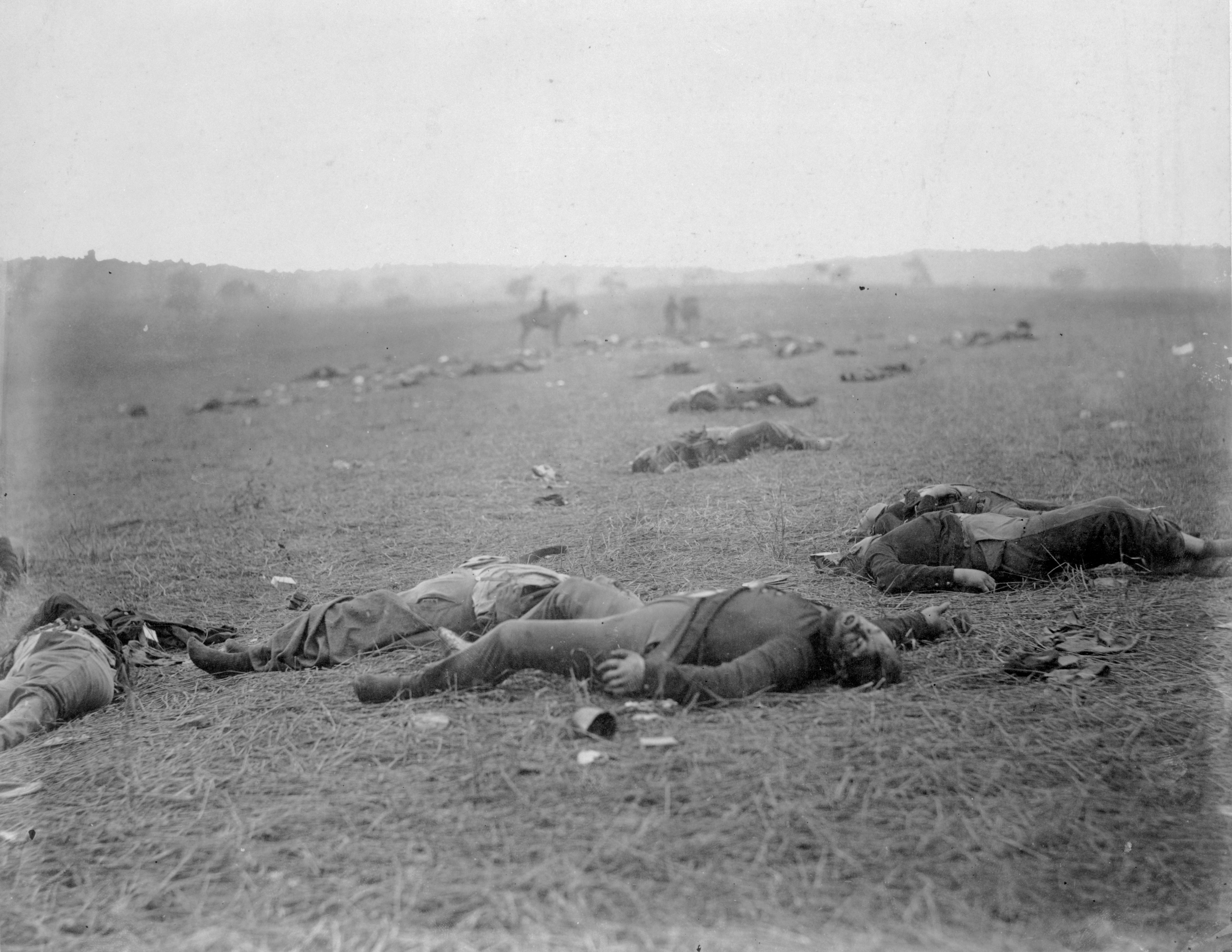
"Dead at Gettysburg 1863" courtesy https://en.wikipedia.org/wiki/Battle_of_Gettysburg.
Ken Burns was inspired to create the Civil War series after discovering Matthew Brady's massive collection of photographs. Brady studied under Samuel Morse, who had learned about the daguerrotype from Louis DaGuerre himself. Brady, along with three associates, was able to capture 16,000 images on the battlefield. His secret to success was his portable darkroom which travelled with him wherever he went. His very first photographs were taken at the Battle of Bull Run (https://en.wikipedia.org/wiki/Mathew_Brady).

Battle of Bull Run courtesy
Ken Burns other discovery was the Civil War correspondence. In 1986, someone sent him the Sullivan Ballou letter which was penned at Bull Run by a 32 year old major from Rhode Island. Burns read it to his wife, brother and a staff member; when he looked up from the page, they all had tears welling up in their eyes. Burns explained: "It's the most beautiful letter I've ever read in my life. It's a Grand Canyon of a letter. You can read the strata of meaning. It's all about love. First and foremost is love of country...It's about love of government...It's a love of cause...It's a love of family." (https://www.washingtonpost.com/lifestyle/style/civil-war-soldiers-heartbreaking-farewell-letter-was-written-before-death-at-bull-run/2011/07/11/gIQAFe3MQI_story.html). The Sullivan Ballou letter became the crux of all the soldiers' letter, so eloquently written, by Civil War soldiers and so eloquently read by star power narrators for the series. The now famous letter has since been read a weddings, funerals and memorial services.

Sullivan Ballou letter circa 1861 courtesy
No Ken Burns series is complete without an expert commentator. For the civil war series, Burns chose a historian and author named Shelby Foote. With his Southern drawl and his erudition, Foote hooked the audience. Foote had penned by hand a 3000 page trilogy called The Civil War: A Narrative (Fort Sumter to Perryville in 1958; Fredericksburg to Meridian in 1963; and Red River to Appomattox in 1974). A relative unknown before the Ken Burns series, by late September of 1990, his trilogy was selling 1000 copies per day; by mid-1991, the trilogy had sold 400,000 copies. "Ken, you've made me a millionaire," said Foote (https://en.wikipedia.org/wiki/Shelby_Foote).

Shelby Foote courtesy https://en.wikipedia.org/wiki/Shelby_Foote#/media/File:Shelby_Foote.jpg.
Ken Burns knew the importance of music. He chose a haunting Scottish lament to play during his series. Ashokan Farewell, played at the end of the Fiddle and Dance Camps at the Ashokan Reservoir in New York State, conveyed a "sense of loss and longing" appropriate to the Civil War. The tune, played 25 times during the series, comprises an hour's play time. Viewers started to associate the haunting melody with the Civil War period although the tune was only composed in 1982 (https://en.wikipedia.org/wiki/Ashokan_Reservoir).

Confederate soldiers plays the fiddle courtesy https://brandonraykirk.wordpress.com/2013/02/.
The Civil War became the most watched program ever aired on PBS. It resonated with Americans. Ken Burns explained: "The Civil War was history running on all four cylinders. It was the most important event in the history of our nation, and its importance continues today. The blueprint of the America we know was drawn up then, and whether we know it or not, we are still walking around in the shadow of that war." (http://www.pbs.org/kenburns/civil-war/about/about-overview/)


