Showing posts with label Ernest Hemingway. Show all posts

Saturday, 14 November 2015

Elizabeth Gilbert's Your Elusive Creative Genius

Elizabeth Gilbert, author of Eat, Pray, Love, delivered a speech about how a creative genius resides in all of us; we just have to tap into it.  After the success of her memoir, people approached her and asked if she was worried about topping the success she had just experienced.  However, Elizabeth pointed out that, over twenty years before, people had the same reaction when she first announced that she wanted to become a writer.

Elizabeth goes on to mention how writers, and creative people in general, tend to be tortured souls who suffer from depression (Ernest Hemingway committed suicide; Norman Mailer was a raging alcoholic; Stephen King was addicted to drugs).  A writer's career is tied directly to his or her creative success.  Something like writer's block can spell the end of a literary career.

The author mentions how the Romans and the Greeks believed that creativity came from a separate spirit, something the Greeks called a "daemon", that lived in an artist's studio.  However, during the Renaissance, people started to believe that genius came from the self, rather than from a separate entity.  Elizabeth believes that such a belief puts too much of a burden on the shoulders of the artist.  "[I think] the pressure of that has been killing off our artists fort he past 500 years," she explains.

Elizabeth gives the example of poet Ruth Stone who used to work in the fields of rural Virginia.  All of a sudden, she would fell a poem coming on:  "it was like a thunderous train of air".  She would race to the farmhouse for a piece of paper and a pen before she forgot the poem, furiously scribbling the words down from end to beginning, the way she had remembered it.  Elizabeth says that is how the creative process works for her as well.  It is elusive:  she must catch it when it's whizzing by.
Elizabeth compares herself to a mule:  she must sweat and labour every day to get to her destination. The road is not easy.  It is full of bumps and twists.  But her stubbornness allows her to persevere.

Elizabeth drives home her point with the following paragraph:

And what I have to sort of keep telling myself when I get really psyched out about that {duplicating her initial success] is don't be afraid.  Don't be daunted.  Just do your job.  Continue to show up for your piece of it, whatever that may be.  If your job is to dance, do your dance.  If the divine, cockeyed genius assigned to your case decides to let some sort of wonderment be glimpsed for just one moment through your efforts, then Ole! And if not, do your dance anyhow.  And Ole! to you nonetheless.I believe this and I feel that we must teach it.  Ole! to you, nonetheless, just for having the sheer human love and stubbornness to keep showing up.(https://www.ted.com/talks/elizabeth_gilbert_on_genius/transcript?language=en)



Wednesday, 21 October 2015

Nobel Prize Winner Ernest Hemingway Read A Great Number of Books

"He read everything around the house, all the books, all the magazines, even the AMA journals from dad's office downstairs.  Ernie also took out a great number of books from the public library." (Marcelline, sister of Ernest Hemingway)


Growing up in Oak Park, Illinois, Ernest Hemingway used to read everything he could get his hands on.  His older sister, Marcelline, said that their bookshelf was filled with authors like Shakespeare, Scott, Stevenson, Dickens and Thackeray.  Periodicals such as National Geographic, Atlantic Monthly and Harper's were on the bookshelf at the family cottage on Walloon Lake in Upper Michigan.  

Hemingway also visited the public library on a regular basis.  By the turn of the last century, libraries had sprung up in many towns and cities across the United States, thanks in large part to the generosity of Andrew Carnegie.  Books were starting to come down in price with Little Leather Library, the book of the month clubs and paperback publications.  

Hemingway translated his long hours of reading into a successful writing career, penning seven novels, six short collections, two non fiction works and endless articles.  He was awarded the Nobel Prize for Literature in 1954.  

The year before, on the occasion of the 50th anniversary of the Oak Park Library, he wrote:  "I was at sea or I would have sent you a message telling you how much I owe to the Library and how much it meant to me all my life."    


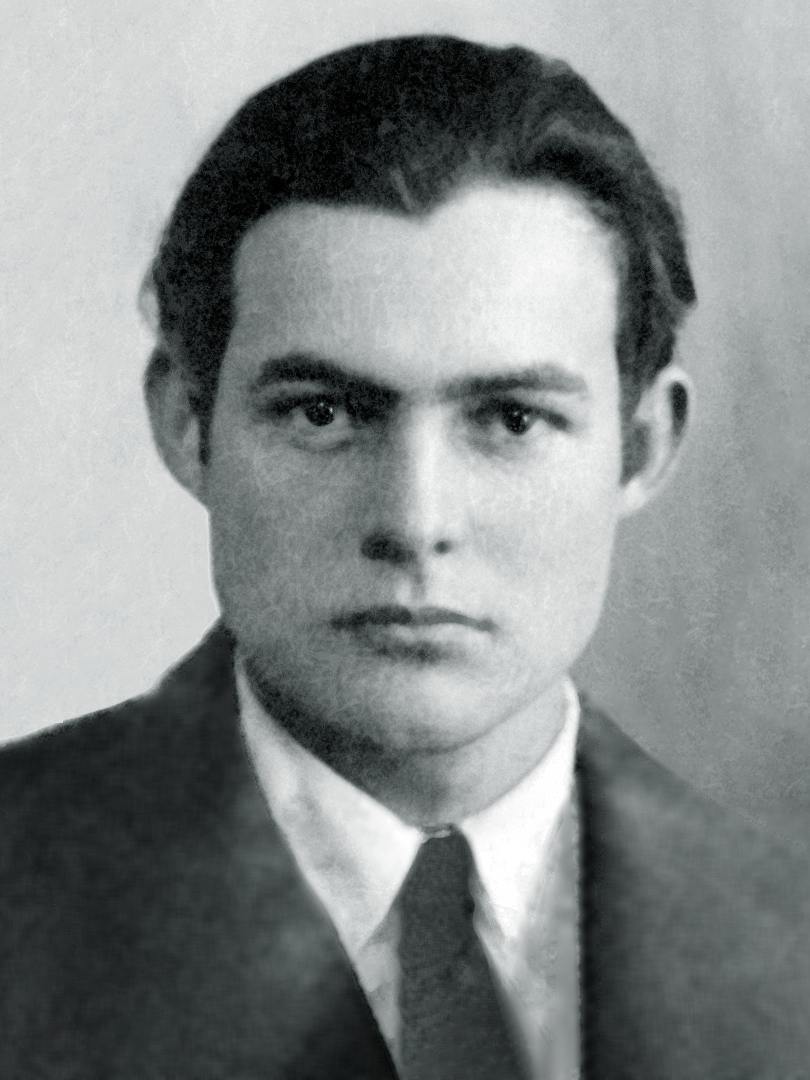
Passport photograph

Hemingway worked as a correspondent for the Toronto Star Weekly at the time of this photograph courtesy https://en.wikipedia.org/wiki/Ernest_Hemingway#Cuba_and_the_Nobel_Prize.

Friday, 12 June 2015

Ernest Hemingway's "Pamplona in July"


A tranquil, sun baked town for 51 weeks of the year, tourists descend on Pamplona in July.  Hotels are booked, the cobblestone streets are filled, the restaurants are ready.  Every morning for seven days, six bulls, urged on by thousands of adults, will run half a mile through Pamplona's streets on their way to the bullfighting ring.

The Running of the Bulls is a tradition which dates back to 1592 when the locals would honour Saint Fermin by herding six bulls through the narrow streets from the corral to the bullfighting ring.  The local tradition became global when writer Ernest Hemingway visited the town in 1926 and wrote a famous essay about the experience "World's Series of Bullfighting:  A Mad, Whirling Carnival".  Three years later, the essay was published in The Sun Also Rises.

Americans, and others, became curious about "Europe's most dangerous tradition".  They flocked to the Spanish town to participate in the party.  They wanted to know all about the festival that Ernest Hemingway described in such detail in his essay.  They wanted to experience the thrill of running with the bulls; the thrill of the mass of humanity spilling through the streets of the Spanish town.  The less adventurous tourists could stand on the balconies above the streets, at a safe distance from the snarling beasts.

A 2011 survey estimated that over 20,000 people ran with the bulls in Pamplona.  To date, thirteen people have been gored by the bulls and one person was trampled.  But tourists continue to fill Pamplona's streets every July.

Here is an excerpt from Hemingway's essay (https://engl114.files.wordpress.com/2011/01/hemingway-readings.pdf).

"Really beautiful girls, gorgeous, bright shawls over their shoulders, dark, dark-eyed black laced mantillas over their hair walk with their escorts in the crowds that pass from morning until night along the narrow walk that runs between inner and outer belts of the cafe tables under the shade of the arcade out of the white glare of the Plaza de la Constitucion.  All day and all night there is dancing in the streets.  Bands of blue shirted peasants whirl and lift and swing behind a drum, fife and reed instruments in the ancient Basque Riau-Riau dances.  And at night there is the throb of the big drums and the military band as the whole town dances in the great open square of the plaza."