Showing posts with label East Prussian refugees. Show all posts

Saturday, 26 March 2016

Frauenburg: East Prussian Town Rebuilt by Boy Scouts for Copernicus' 500th Birthday


Frauenberg Cathedral with Vistula Lagoon in the background courtesy https://en.wikipedia.org/wiki/Frombork.


Frauenburg was founded as a stronghold on the Vistula Lagoon, off of the Baltic Sea.  The area was conquered by the Teutonic Knights in 1224 and became known as East Prussia. Emperor Frederick the Second declared the stronghold subordinate to the Catholic Church and appointed Bishop William of Modena to oversee it.  When the stronghold's lord died, his wife offered the town to the bishop, who named it Frauenburg in her honour (frau means lady in German).

In 1414 the town was plundered and burned in a war between Poland and the Teutonic Order.  In 1454, during the Thirteen Years War its hill and cathedral were occupied by Jan Skalski.  During the middle ages, most of Frauenburg's citizens were either merchants, farmers or fishermen.  Its most famous resident was Nicolaus Copernicus.  While he worked as a priest in the town for many years (1512-1516; 1522-1343) he was known for his work as an astronomer and mathematician. It was in the Baltic town that Copernicus wrote his famous De revolutionibus orbium coelestium.


The Red Army invades Frauenberg circa 1945 courtesy https://en.wikipedia.org/wiki/Heiligenbeil_Pocket.


In 1871, the region became part of the German Empire.  In 1899, the railway came to town connecting Elbing and Braunsberg through Frauenburg.  In 1945, war came to Frauenberg.  Many German residents fled the city via the frozen Vistula Lagoon, some drowning en route (see "Death on the Baltic" at http://alinefromlinda.blogspot.ca/2013/11/death-on-baltic.html).  A vicious battle ensued between the Red Army and the Wehrmacht and 70% of the city was destroyed.  After the Second World War came to a close, most Germans were expelled from the area as part of the Potsdam Agreement. Frauenberg, now renamed Frombork, became part of Poland; it was resettled by Poles, many of whom were expelled from other parts of Poland by the Soviets (http://alinefromlinda.blogspot.ca/2016/03/orderly-and-humane-expulsion-of-germans.html).


Frauenberg was not unlike many German cities which were reduced to rubble by the Allied bombings during World War II.  However, whereas cities like Berlin, Cologne and Dresden were rebuilt by the rubble women (see "Trummerfrauen" http://alinefromlinda.blogspot.ca/2011/10/trummerfrauen.html) Frauenberg was rebuilt by Polish Boy Scouts.  The project, which lasted seven years, was named Operation 1001.  The impetus was the 500th birthday of Copernicus in 1973 (see newspaper article about the occasion at https://news.google.com/newspapers?nid=2512&dat=19730221&id=6OVcAAAAIBAJ&sjid=slkNAAAAIBAJ&pg=4784,2704730&hl=en).


Frombork monument to Nicolaus Copernicus, whose revolutionary thinking at the time led to his discovery that the earth orbits around the sun (not the reverse as was previously thought) courtesy https://en.wikipedia.org/wiki/Nicolaus_Copernicus_Monument,_Toru%C5%84.


Thursday, 17 March 2016

Nemesis at Nemmersdorf

"Kill!  Kill!  In the German race there is nothing but evil.  Stamp out the beast once and for all in its lair!  Use force and break the racial pride of German women.  Take them as your lawful booty.  Kill!  As you storm forward.  Kill!  You gallant soldiers of the Red Army." 
(Ilya Ehrenburg, Russian journalist)


The small town of Nemmersdorf was caught sleeping in the fall of 1944.  Hitler had declared that "No Bolshevik will ever set foot on German soil," and many civilians believed him.  So when the Red Army crossed over the German border and descended on Nemmersdorf on October 22, 1944, no one was prepared.  Bent on revenge after three years of occupation by the Nazis, Red Army soldiers raped 72 women, nailing some of them to barn doors cruciform style.  They smashed the skulls of babies and summarily executed 50 French and Belgian POWs at close range.  When some townspeople fled, they mowed them down with tanks.

The Germany Army regained control of Nemmersdorf within 48 hours and witnessed the horror. The Nazis invited reporters from the neutral countries of Switzerland, Sweden and Spain to observe the atrocities committed by the Red Army.  The Nazi propaganda machine made newsreels which they replayed over and over.  They inflated the numbers in hopes that Germans would dig their heels in and fight even harder for Deutschland. Some joined the Volksstrum in answer to the massacre.  It would be another three months before the Red Army regained control of the area.  Nemmersdorf would remain a symbol of war crimes committed by the Russians during World War II.


Wednesday, 16 March 2016

Hell on Earth: Koenigsberg 1945


Bitter fighting Koenigsburg

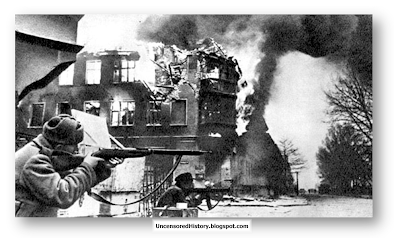
Fighting in Koenigsberg circa 1945 courtesy 


While Koenigsberg had survived the vicious fire bombing of August 1944, the assault on East Prussia was not over yet.  From January to April of 1945, East Prussia fought the Russians.  It came down to a vicious street battle from April 6 to 9.  Here are the final days of that beautiful city.

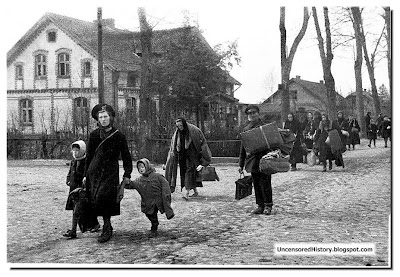
As 1945 dawned in East Prussia, there were still many who believed Goebbels' propaganda machine that there was nothing to fear.  However, on January 24, 1945, the Red Army severed all railroad and roadways to the West, essentially trapping the East Prussians.  The Germans could no longer pretend.  During a frigid winter, hundreds of thousands of refugees headed north to the Baltic Sea, part of The Big Trek, hoping for a marine escape.

At the end of January 1945, Koenigsberg was packed with 300,000 East Prussian refugees who had fled to the city hoping that it would be the first stop on their flight to freedom.  Unable to get any further, they parked their prams, sledges and carts along the roadsides, crowded into the bombed and damaged buildings and released the horses which had drawn their carts since they left their villages.  Many of these animals died of starvation and others were shot.  Werner Terpitz recalls how the once beautiful streets were strewn with the carcasses of dead horses from which all edible meat had been taken (http://uncensoredhistory.blogspot.ca/2012/08/east-prussia-koenigsberg-1945-hell.html),

For ten weeks, the Red Army encircled Koenigsberg.  Russian loudspeakers blared propaganda.  The city was under constant fire, the Soviet aircraft now unchallenged by the Luftwaffe.  Families were forced to take refuge underground.  Men as old as 60 and boys as young as 12 were drafted into the Volksstrum to help defend the city.


A German soldier's look of despair tells the story in East Prussia courtesy http://uncensoredhistory.blogspot.ca/2012/08/east-prussia-koenigsberg-1945-hell.html.


On February 10, the siege was broken when the German Army retook the Samland Peninsula as well as the Koenigsberg suburb of Metgethen.  ONe hundred thousand citizens took the opportunikty to flee the city via Metgethen.  A temporary refugee camp was set up on the Koenigsberg canal where sickness and disease ran rampant.  Some refugees even returned to the city hoping to find food and shelter.  The frigid temperatures dropped and things started to retune to normal in Koenigsberg where restaurants and cinemas reopened.  THe young people felt a sense of renewed hope while the elderly were pessimistic, fearing banishment to the Gulag when the Russians returned.  "Many took refuge in alcohol..as they tried to ignore the deterioration of the city, the rubble, the rubbish, the dead horses, the abandoned trams."  

The inevitable came in early April with the drone of the Russian aircraft over the city.  Koenigsbergers heard radio broadcasts for the last tine on April 4 when the electricity went out.  On April 5, over 100 Russian planes flew over the city undisturbed; Koenigsberg was indefensible.  The barrage on the capital city was unparalleled; veteran officers had never seen anything like it. The streets crawled with Russian soldiers.  Stalin organs, rocket launchers mounted on the backs of trucks, fired off rapid barrages.  The young kids of the Volksstrum streamed "Help!" and "Mum!" as they hid in the trenches.  Under clouds of smoke, buildings blew apart and automobiles were riddled with bullets.

When the smoke cleared in Koenisberg, the landscape looked lunar. Gone with the great avenues and magnificent buildings.Ninety percent of the city sat in ruins.  Koenigsberg surrendered on April 9.


Sunday, 13 March 2016

The Big Trek


Gridlock on the roads in East Prussia as refugees escape and the Germany Army retreats from the Red Army courtesy https://upload.wikimedia.org/wikipedia/commons/c/c6/Bundesarchiv_Bild_146-1976-072-09,_Ostpreu%C3%9Fen,_Fl%C3%BCchtlingtreck.jpg.


It was the winter of 1945.  The Red Army was knocking at the gate of East Prussia.  After the atrocities committed by the Germany Army over the previous four years (including the siege of Leningrad where almost 1 million civilians starved to death) the Red Army was bent on revenge.  

Hitler proclaimed that "No Bolshevik would set foot on German soil."  Yet, Russian soldiers had already invaded the town of Nemmersdorf the previous October where they had nailed the elderly to barn doors and murdered innocent women and children.  Even though the German Army repelled them, it would not be for long.  Hitler's orders remained firm:  the German population must stay put and to fight until the last man.

By January of 1945, Germans began to break this decree:  almost 8.5 million Germans began the Big Trek out of the Eastern Provinces.  The trains had ceased operation.  Many travelled by Conestoga wagons, pulled by the great Trakhener horses, some of which had won medals at the Berlin Olympics; some travelled on foot.  Like a line of ants on an anthill, they slowly made their way west.  Many headed for the Baltic Sea to board ships as part of Operation Hannibal, a last minute evacuation organized by Admiral Donitz.

During the coldest winter in twenty years, the German refugees commenced The Big Trek to the Baltic.  Anyone on the main roads risked being mowed down by army tanks.  They found alternate routes to travel.  Laden down with their possessions, the going was tough.  In order to reach the Baltic seaports, the refugees first had to cross the Frisches Haff.  An inland sea lagoon, the Frisches Haff, froze in the winter, allowing horses and wagons to cross, but not heavy tanks.

While the refugees were temporarily safe from the Red Army tanks, they were not safe from the enemy planes, which targetted them like sitting ducks on the ice.  Women, children and the elderly fell to the ground in a hail of bullets each time an aircraft droned overhead.  With the ice riddled with bullets, some of the wagons started to break through it, taking their passengers with them.

Once the refugees reached the Baltic seaports, many boarded ships which took them to safety in Denmark and other countries.  It is estimated that 800,000 to 900,000 refugees were saved by the sea evacuation.  However, thousands more drowned when their ships were torpedoed by Russian submarines like the Wilhelm Gustloff (see my previous post, Death on the Baltic, at http://alinefromlinda.blogspot.ca/2013/11/death-on-baltic.html).


The Big Trek across the Frozen Frisches Haff circa January/February 1945 courtesy 


Tuesday, 1 March 2016

East Prussia: An Early Example of Ethnic Cleansing


Growing up in a family of British background, I knew very little about German history, other than what I had seen in movies and on television.  The German was usually the villain.  I knew that Nazi Germany had been the aggressor during the Second World War and I knew that the Allies had defeated Germany.  I knew that Nazi Germany had committed many atrocities during the war, above all, the Holocaust.  Many people suffered under the Nazis and were angry, justifiably so.  Many were bent on revenge.

It wasn't until I married a German-Canadian and started delving into his family history that I started to learn about those Germans who were caught in the crossfire.  While many Germans loved Hitler, not all of them did.  While some volunteered for service in the army, others did not go willingly. While some joined the Nazi Party, others spoke out against Hitler.

That was my husband's Oma's family.  His Opa, Otto Neumann, just wanted to be an East Prussian farmer.  He was not cut out to be a soldier.  His Oma, Elfriede Neumann, just wanted to raise a family.  The Neumann's were excellent farmers.  They had a self-sufficient farm on the rolling hills of East Prussia where they grew crops and raised cattle.

But when war came to East Prussia in 1939, their dream escaped them.  Otto was drafted into the German Army.  Elfriede became a fulltime farmer as she worked the land with baby in a basket by her side.  What every soldier's wife dreads became reality in 1944 when Elfriede's husband didn't come home, declared MIA.  Elfriede became both mother and father to her two young children.

While the Allies saw the end in sight by the beginning of 1945, the year marked just the beginning of Elfriede's troubles.  The Red Army, bent on revenge after the German atrocities committed in Russia, ran roughshod over East Prussia.  Elfriede attempted to flee on a ship called the Wilhelm Gustloff on a frigid January night, but her horse, spooked by nearby gunfire, refused to go any further.  Even so, the ship sunk on the Baltic, nine-tenths of its passengers drowning in the sea's icy depths. Back on her farm, Elfriede was confronted by the Red Army.  They seized everything:  her land, her house, her belongings, her source of food, even her wedding band.

The next two years saw Elfriede, holding her two children by the hand, wandering through East Prussia, desperately searching for food, shelter and work.  After six months on the road, they settled in a work camp.  Elfriede was only spared death because she was such a hard worker, something the Russians rewarded her for with an extra shovelful of flour.

While in the work camp, Elfriede survived both malaria and typhus, the latter running rampant through Eastern Europe after the war.  Her parents were not as fortunate, succumbing to starvation, followed by her sister.  Elfriede buried all three with her own hands.  Fearing that her children might starve to death too, Elfriede gave her son to her in-laws temporarily to scavenge for food in Lithuania.  Elfriede would remain in East Prussia with her daughter searching for sustenance.  It would be a full year before she would see her son again due to an unexpected journey.

A document called the Potsdam Agreement would have a direct bearing on Elfriede.  In an early example of ethnic cleansing, two million Germans were purged from East Prussia.  Despite the recommendation to authorities to use "humane treatment", the refugees were ordered into cattle cars at gunpoint and transported across the Polish Corridor to the rest of Germany. The weeklong trip saw many expellees, already malnourished and diseased, starve to death.  Their bodies were stacked in piles at the side of the railroad tracks.  Only Elfriede's quick thinking saved the occupants of her car:  she brought along a pot which everyone used to go to the washroom, then dumped the waste out the window.  She arrived in Ruhla, East Germany, aching for her son, homesick for her homeland.  She would never return, however.  East Prussia now belonged to Russia and Poland.

Note:  For more information, read the excellent Spiegel magazine article
A Time of Retribution:  Paying with Life and Limb for the Crimes of Nazi Germany http://www.spiegel.de/international/germany/a-time-of-retribution-paying-with-life-and-limb-for-the-crimes-of-nazi-germany-a-759737-5.html.


East Prussian refugees flee the Red Army circa 1945 courtesy http://uncensoredhistory.blogspot.ca/2012/08/east-prussia-koenigsberg-1945-hell.html.