Showing posts with label Teutonic Knights. Show all posts

Saturday, 26 March 2016

Frauenburg: East Prussian Town Rebuilt by Boy Scouts for Copernicus' 500th Birthday


Frauenberg Cathedral with Vistula Lagoon in the background courtesy https://en.wikipedia.org/wiki/Frombork.


Frauenburg was founded as a stronghold on the Vistula Lagoon, off of the Baltic Sea.  The area was conquered by the Teutonic Knights in 1224 and became known as East Prussia. Emperor Frederick the Second declared the stronghold subordinate to the Catholic Church and appointed Bishop William of Modena to oversee it.  When the stronghold's lord died, his wife offered the town to the bishop, who named it Frauenburg in her honour (frau means lady in German).

In 1414 the town was plundered and burned in a war between Poland and the Teutonic Order.  In 1454, during the Thirteen Years War its hill and cathedral were occupied by Jan Skalski.  During the middle ages, most of Frauenburg's citizens were either merchants, farmers or fishermen.  Its most famous resident was Nicolaus Copernicus.  While he worked as a priest in the town for many years (1512-1516; 1522-1343) he was known for his work as an astronomer and mathematician. It was in the Baltic town that Copernicus wrote his famous De revolutionibus orbium coelestium.


The Red Army invades Frauenberg circa 1945 courtesy https://en.wikipedia.org/wiki/Heiligenbeil_Pocket.


In 1871, the region became part of the German Empire.  In 1899, the railway came to town connecting Elbing and Braunsberg through Frauenburg.  In 1945, war came to Frauenberg.  Many German residents fled the city via the frozen Vistula Lagoon, some drowning en route (see "Death on the Baltic" at http://alinefromlinda.blogspot.ca/2013/11/death-on-baltic.html).  A vicious battle ensued between the Red Army and the Wehrmacht and 70% of the city was destroyed.  After the Second World War came to a close, most Germans were expelled from the area as part of the Potsdam Agreement. Frauenberg, now renamed Frombork, became part of Poland; it was resettled by Poles, many of whom were expelled from other parts of Poland by the Soviets (http://alinefromlinda.blogspot.ca/2016/03/orderly-and-humane-expulsion-of-germans.html).


Frauenberg was not unlike many German cities which were reduced to rubble by the Allied bombings during World War II.  However, whereas cities like Berlin, Cologne and Dresden were rebuilt by the rubble women (see "Trummerfrauen" http://alinefromlinda.blogspot.ca/2011/10/trummerfrauen.html) Frauenberg was rebuilt by Polish Boy Scouts.  The project, which lasted seven years, was named Operation 1001.  The impetus was the 500th birthday of Copernicus in 1973 (see newspaper article about the occasion at https://news.google.com/newspapers?nid=2512&dat=19730221&id=6OVcAAAAIBAJ&sjid=slkNAAAAIBAJ&pg=4784,2704730&hl=en).


Frombork monument to Nicolaus Copernicus, whose revolutionary thinking at the time led to his discovery that the earth orbits around the sun (not the reverse as was previously thought) courtesy https://en.wikipedia.org/wiki/Nicolaus_Copernicus_Monument,_Toru%C5%84.


Monday, 7 March 2016

East Prussia: A Fourth Baltic State?

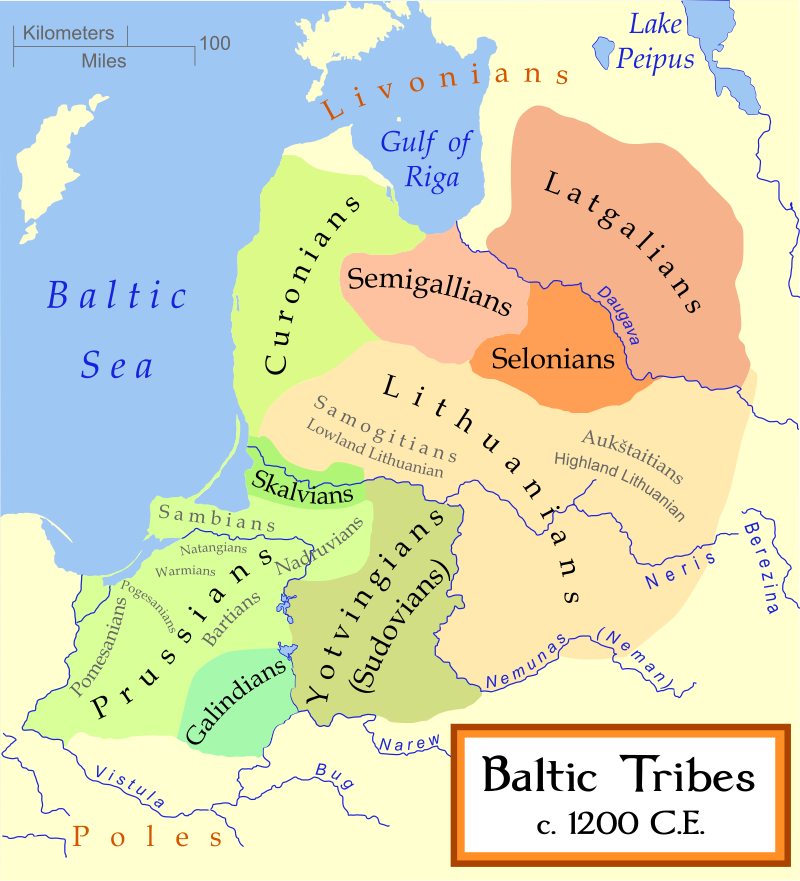
After the Second World War, under the Communist occupation, Rob's Oma, a war widow, was struggling to feed her two children.  Her in-laws offered to take first her daughter, Irmgard, and then her son, Manfred to scavenge for food in Lithuania.  The Lithuanians were sympathetic to the East Prussian's cause, I assumed because the Lithuanians had also suffered under the Communists as part of the U.S.S.R.  However, there may have been a second reason that the Lithuanians were sympathetic:  the original Prussians were related to the Lithuanians and Latvians (Estonians comprised the third Baltic state).

East Prussia was originally inhabited by Pruzzen, not a Germanic tribe, but a Baltic one.  In 1262, the Pruzzen united with the Kashubians, a Slavic Pomerian tribe also living in the Baltic region, to fight the invading Teutonic Knights.  The Teutons won the war and Christianized the region.  While the Pruzzens largely merged with the German settlers brought in from the west, the Kashubians managed to retain their language, Kashubian, and their religion, Catholicism.  The Pruzzens were largely Germanized by the Teutonic Knights:  their religion, formerly pagan, became Protestant;  their language was rendered extinct by 1600; their surnames, some of which sounded Slavic, took on a Germanic flavour.  Martin Luther's break with the Catholic church, and formation of the Lutheran Church, helped solidify the region as a Lutheran enclave.

The Pruzzen and the Kashubians did influence one another.  As I blogged about the other day, Oma's childhood tradition was to spank her brothers and sisters on Easter morning to wake them up.  The Kashubians used to gently whip each other with pussy willows on Easter Monday.  Kashubian boys used to gently whip the girls with juniper twigs.

Note:  Here is an interesting Christian Science article, "A Fourth Baltic State Emerges", a result of the break up of the Soviet Union in 1991 at http://www.csmonitor.com/1990/0620/efink.html.


https://en.wikipedia.org/wiki/Prussian_Crusade#/media/File:Baltic_Tribes_c_1200.svg

Sunday, 6 March 2016

The Historical Geography of East Prussia

East Prussia, a state in Germany, existed for about 800 years.  The region was widely forested before the Teutonic Knights arrived around 1300.  It was also composed of bogs and marshes.  Certain sections, like the area where my husband's Oma lived, featured rolling hills.  Others were dotted with small likes, like Masuria.  Several rivers ran through the province including the Nieman and Pregel. The annual temperature was 20 degrees Celsius in the summer; their winters were extremely cold, although it was milder near the sea. 

The six geographical areas in East Prussia were:

1.  Memel Lowlands
2.  Plains of Northern East Prussia
3.  Isolated Heights
4.  Central Depression
5.  Baltic Heights
6.  Southern Sand Plains

East Prussian land was excellent for growing crops or raising cattle due to its grassy pastures.  It was known as the Breadbasket of Germany.  This is why Mennonites moved to the area in the 1500's and farmed the land.