
Saturday, 6 August 2016
Canadian Prairie Street Scene
In 1978, 75% of Canadians lived in or near cities. Projections indicated that the figure would rise to 90% by 2000. Communities were changing as they were being designed to accommodate cars rather than people. Concrete was replacing grass. Glass was replacing wood. Air and water pollution were on the rise. Solid waste disposal was an issue. Canada was losing its traditional landscape. Canada Post issued a series of stamps devoted to the communities of the past. Arthur Ponting and Yves Baril engraved a Prairie town scene which harkens back to a simpler time.


Friday, 5 August 2016
Champlain Statue in Old Quebec

Sculpture honouring "The Father of New France", with Chateau Frontenac in the background, courtesy https://en.wikipedia.org/wiki/Samuel_de_Champlain.
French explorer Samuel de Champlain founded Quebec City in 1608. Near the present day Chateau Frontenac, he built the Habitation, consisting of a Compagnie des Marchands (trading post) and a wooden building, Fort Saint Louis, where he resided and built a successful settlement. Champlain established a good relationship with the local Native tribes including the Huron, Algonquin and Montagnais. For all intents and purposes, the explorer became the first governor of New France. Champlain went on to explore and map the Great Lakes, the first European to do so.
In a political move, Champlain married a 12 year old bride Helen Boulle, whose father Nicolas Boulle had influence in the royal court. While the couple did not have any biological children, Champlain adopted three Montagnais girls named Faith, Hope and Charity.
In the 1850's, the St. Jean Baptiste Society of Quebec talked about erecting a monument of Champlain, but did not have the funds to do so. Finally, in 1890, the group decided to act. Out of 11 designs and 14 models, a jury chose the one created by the young French sculptor Paul-Romain Chevre. To the tune of $30,000 Chevre designed a 16 metre high sculpture of Champlain which was erected in 1896. One Quebec newspaper said it resembled "un gros mousquetaire triste".

Canada Post issued Champlain Statue stamp in 1935 courtesy https://fr.wikipedia.org/wiki/Monument_de_Samuel_de_Champlain.
Thursday, 4 August 2016
Point Pelee Sits on Same Latitude as Rome

It's on the latitude of Rome, Italy. It grows trees native to Florida. It contains swamps and marshes. It boasts 27 species of reptiles and 50 species of amphibians. Acadian flycatchers, Carolina wrens and red-bellied woodpeckers are at the northern limit of their habitat. Monarch butterflies stop here on their fall migration to Mexico (http://www.pc.gc.ca/eng/pn-np/on/pelee/natcul/natcul1.aspx).

During peak season, as many as 10,000 monarch butterflies per day land at Point Pelee courtesy http://www.learner.org/jnorth/www/critters/monarch/833382137.html.
You might think it's a tropical area. Yet, come autumn, the trees lose their leaves. The lake freezes over. The clouds open up and the snow falls. After all, it's Canada -- the southernmost point, Point Pelee. Unlike Rome, which is surrounded by the moderating effect of the Mediterranean Sea, Point Pelee sits on Lake Erie, the shallowest of the Great Lakes which freezes over in the winter. Unlike Rome, which is protected by the mountains, Point Pelee gets the full brunt of the westerly winds.
 \
The Point Pelee boardwalk in winter courtesy http://pointpeleenationalpark5.weebly.com/climate.html.
Point Pelee is one of Canada's treasures, commemorated by Canada Post in 1983 by a stamp. For more information, visit http://alinefromlinda.blogspot.ca/2011/09/point-pelee.html or http://alinefromlinda.blogspot.ca/2014/08/preserving-point-pelee.html.

Wednesday, 3 August 2016
A. Y. Jackson: Alaska Highway Between Watson Lake and Nelson
"Schools and 'isms' do not trouble us -- individual expression is our chief concern." (A. Y. Jackson)

As a young man, A. Y. Jackson, from Montreal, Quebec, stowed away on a cattle boat heading to Europe. The boat returned via Chicago where the stow away took classes at the Chicago Art Institute. Two years later, A. Y. Jackson travelled again to Europe where he settled in Paris, studying Impressionism at the Academie Julian. One of his early paintings, Paysage Embrumee was accepted by the Paris Salon. After returning to Canada, A. Y. Jackson's Autumn in Picardy was purchased by the Art Gallery of Canada in 1913.

Autumn in Picardy courtesy https://www.gallery.ca/en/see/collections/artwork.php?mkey=4011.
Jackson returned to Europe to fight in the First World War in 1915. Injured at the Battle of sanctuary Wood in 1916, Jackson convalesced at a hospital in Etaples. It was there that he was discovered by Lord Beaverbrook who secured for him the assignment of official war artist, a job lasting from 1917 to 1919.
After the war, Jackson relocated from Montreal to Toronto where he took up residence in the Studio Building, financed by Massey Harris heir and fellow artist, Lawren Harris, and Dr. James MacCallum. The latter agreed to buy all of Jackson's paintings for the first year to make the move worthwhile. The Group of Seven officially came into being.

A. Y. Jackson at work in the Studio Building courtesy https://en.wikipedia.org/wiki/A._Y._Jackson#/media/File:Alexander_Young_Jackson.jpg.

In 1955, Jackson moved out of the Studio Building. In 1967, on the occasion of Canada's Centennial, Canada Post issued a series of stamps commemorating Canadian paintings including four completed by the Group of Seven. The 8 cent stamp features The Alaska Highway Between Watson Lake and Nelson (1943), painted by A. Y. Jackson. The same year, the painter received the Companion of the Order of Canada.

Tuesday, 2 August 2016
Halifax Citadel & Old Town Clock

Halifax Old Town clock in 1949 courtesy http://www.toromagazine.com/nytimes-canadian-photo-archive/photo-of-the-day/gallery/555445a8-f8bd-6a54-2d3a-7350b67e2fae/May-1949-Halifax-Town-Clock.
Prince Edward, the Commander in Chief of the British military, was obsessed with punctuality. As a parting gift to the people of Halifax, he gave them the Old Town Clock in 1800. The timepiece was built in 1801 in London England by the royal clock makers at the House of Vulliamy. The clock is a three tier octagonal shaped tower sitting on a Palladium-style building. Inside, three weights on drums suspended by cables power the clock. The landmark was installed on Brunswick Street in 1803, sitting high atop a hill overlooking Halifax Harbour (http://www.pc.gc.ca/eng/lhn-nhs/ns/halifax/natcul/natcul2.aspx).

Halifax Explosion of 1917 courtesy https://en.wikipedia.org/wiki/Halifax_Explosion.
Note: Perhaps Prince Edward's biggest claim to fame is he is the father of Queen Victoria.

Canadian stamp courtesy http://www.nsstampclub.ca/NSStamps/halifax.htm.
Monday, 1 August 2016
Winston Churchill: Only Thing to Fear are German U-boats
"Winston Churchill once wrote that the only thing that ever 'really frightened him' during the Second World War was the threat presented by Germany's U-boats." (Canada Post)

German U-boats in Loch Ryan circa 1945 courtesy http://www.dailymail.co.uk/news/article-3072281/Wartime-navy-captain-blamed-letting-Nazi-U-boat-away-failed-attack-hailed-hero-oceanographer-Titanic-locates-wreck-discovers-DID-hit-all.html.
England and France owe a great debt to Canada and the United States for the supplies that they sent overseas during the Second World War. Lend Lease, an "Act to Promote the defense of the United States", provided the Allies with warships, warplanes, trucks, material, oil and food from 1941 to 1945. While Canada did not have a Lend Lease program, it did give Britain "gifts totalling $3.5 million during the war" (https://en.wikipedia.org/wiki/Lend-Lease).

Lend Lease Convoy circa 1941 courtesy https://seanmunger.com/2015/09/03/the-winds-of-war-live-blogged-8-honeymoon-in-lisbon-wine-in-boston/.
The problem for Canada and the United States was not producing the goods, but transporting them across the Atlantic. "Winston Churchill once wrote that the only thing that ever 'really frightened him' during the Second World War was the threat presented by Germany's U-boats." (http://www.communitywire.ca/en/2005-04-28/longest-battle-second-world-war-honoured-new-canadian-postage-stamp) The Battle of the Atlantic, according to Winston Churchill, "was the dominating factor all through the war. Never for one moment could we forget that everything happening elsewhere, on land, at sea or in the air, depended ultimately on its outcome." It remains the longest continuous battle of the Second World War, lasting from 1939 to 1945 (https://en.wikipedia.org/wiki/Battle_of_the_AtlanticT).

Allied tanker Dixie Arrow torpedoed in 1942 courtesy https://en.wikipedia.org/wiki/Battle_of_the_Atlantic.
Canadian forces played a crucial role in protecting Allied merchant ships as they crossed the Atlantic in convoys. Marauding German U-boats were often lurking beneath the depths of the ocean, ready to strike. By V-E Day, 22 Canadian ships had been lost and more than 4,000 Canadians had died, including 2,000 sailors,750 airmen and 650 seamen from the merchant fleet.

Canadian artist Sarty assembled several images to create a stamp design honouring The Battle of the Atlantic including a convoy of vessels, a torpedoed supply ship, a Canadian navy corvette and a German U-boat.

Sunday, 31 July 2016
Eleanor Roosevelt: My Day Column Addresses the Nation

Eleanor Roosevelt stamp courtesy
Just as her husband, President Franklin D. Roosevelt, calmed the nation with his fireside chats in the midst of the Second World War, Eleanor Roosevelt calmed the nation with her wise advice laid out in her column "My Day". Six days a week, from 1935 to 1962, Eleanor Roosevelt typed the column on her typewriter, reaching millions of readers across America. At the height of its popularity, "My Day" appeared in over 90 papers nation wide.
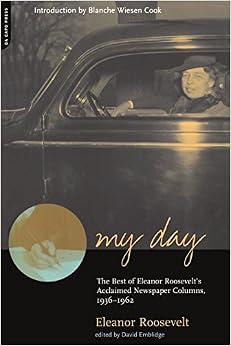
My Day: The Best of Eleanor Roosevelt's Acclaimed Newspaper Columns, 1936 to 1962 courtesy https://www.amazon.com/Day-Roosevelts-Acclaimed-Newspaper-1936-1962/dp/0306810107.
In June of 1943, the First Lady tackled controversial issues like Civil Rights, commenting: By the 1940's, Detroit already had a history of racial conflict. Race riots had occurred in 1863 and as recently as 1941. By the 1920's the city had become a stronghold of the Ku Klux Klan...The industrial plants provided jobs but no housing. White communities militantly guarded the dividing lines imposed by segregation throughout Detroit's history. As a result, the city's 200,000 black residents were cramped into 60 square blocks on the East Side and forced to live under deplorable sanitary conditions. Ironically, the ghetto was called Paradise Valley."

Detroit Race Riots on Woodward in 1943 courtesy https://www.mtholyoke.edu/courses/rschwart/clio/detroit_riot/DetroitNewsRiots1943.htm.
On July 14, 1939, Eleanor Roosevelt expressed her views on Prohibition, stating: "I was one of those who was very happy when the original prohibition amendment passed...But I came gradually to see that laws are only observed with the consent of the individuals..."
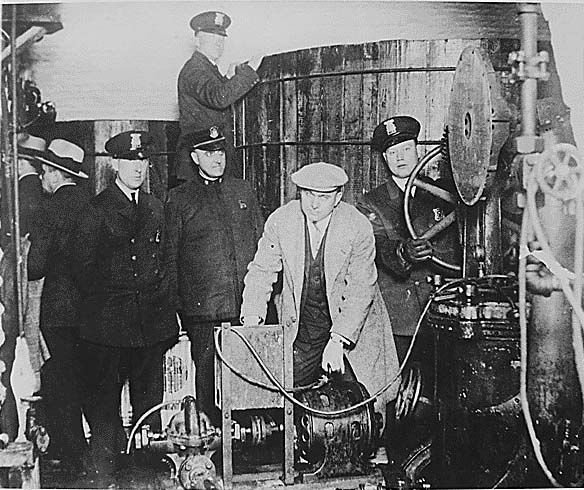
Detroit Police inspect a brewery during Prohibition courtesy https://en.wikipedia.org/wiki/Prohibition_in_the_United_States.
On December 8, 1941, the First Lady, reeling from the attack on Pearl Harbor, commented: "The clouds of uncertainty and anxiety have been hanging over us for a long time. The work for those who are at home seems to me to be obvious. First, to do our own job, whatever it is, as well as we can possibly do it. Second, to add to it, everything we can do in the way of civilian defense. Now, at last. every community must go to work to build up protection from attack."

President Roosevelt's "A Date That Will Live Infamy" Speech courtesy http://likesuccess.com/52034.
On October 29, 1947, regarding HUAC (The House on Un-American Activites Committee) investigating Hollywood, Eleanor Roosevelt said: "One thing is for sure -- none of the arts flourishes under censorship and repression. And by this time it should be evident that the American public is capable of doing its own censoring. Certainly, the Thomas Committee is growing more ludicrous daily. The picture of six officers ejecting a writer from the witness stand because he refused to say whether he is a Communist or not is pretty funny and I think before long we are all going to see how hysterical and foolish we have become."
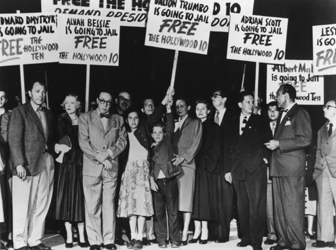
Protesters march against impending incarceration of the Hollywood Ten circa 1950 courtesy https://en.wikipedia.org/wiki/Hollywood_blacklist.
During the Second World War, the First Lady, a champion of childhood literacy, "urged parents to read aloud to their children as a way of bolstering family morale and maintaining an atmosphere of normality on the home front." The advent of Little Golden books helped this come to fruition (see How a Poky Puppy Brought the Picture Book to the Masses at http://alinefromlinda.blogspot.ca/2013/07/how-poky-puppy-brought-picture-book-to.html).

Golden Legacy courtesy
Subscribe to:
Posts (Atom)