Showing posts with label ballad. Show all posts

Friday, 15 May 2015

The Ballad: From Samuel Taylor Coleridge to B. B. King

A ballad is a narrative poem, often of folk origin and intended to be sung, consisting of simple stanzas and usually having a refrain. (http://www.thefreedictionary.com/ballad)


The ballad, based on the French word "ballade", has been around for a millenium.  The poetry form has a rhythmic 4-3-4-3 line beat and is divided into quatrains.  Religion, love, tragedy and politics were all early subjects for ballads.  The "ballade" first appeared in Provencal folk music in France. Troubadour poets developped the cadence of the poetic form.  Later the ballad spread to Spain, Italy and post-Norman England.


Medieval troubadours set the rhythm for the ballade courtesy 


The French form of the ballade, based on three rhyming sounds, follows the following pattern:

A
B
A
B
B
C
B
C2

Note:  First stanza is repeated three times.

Envoy (4 line version)
B
C
B
C2

Envoy (5 line version)
B
C
B
C2

There are variations on this format, but the cadence of the poem is the same.

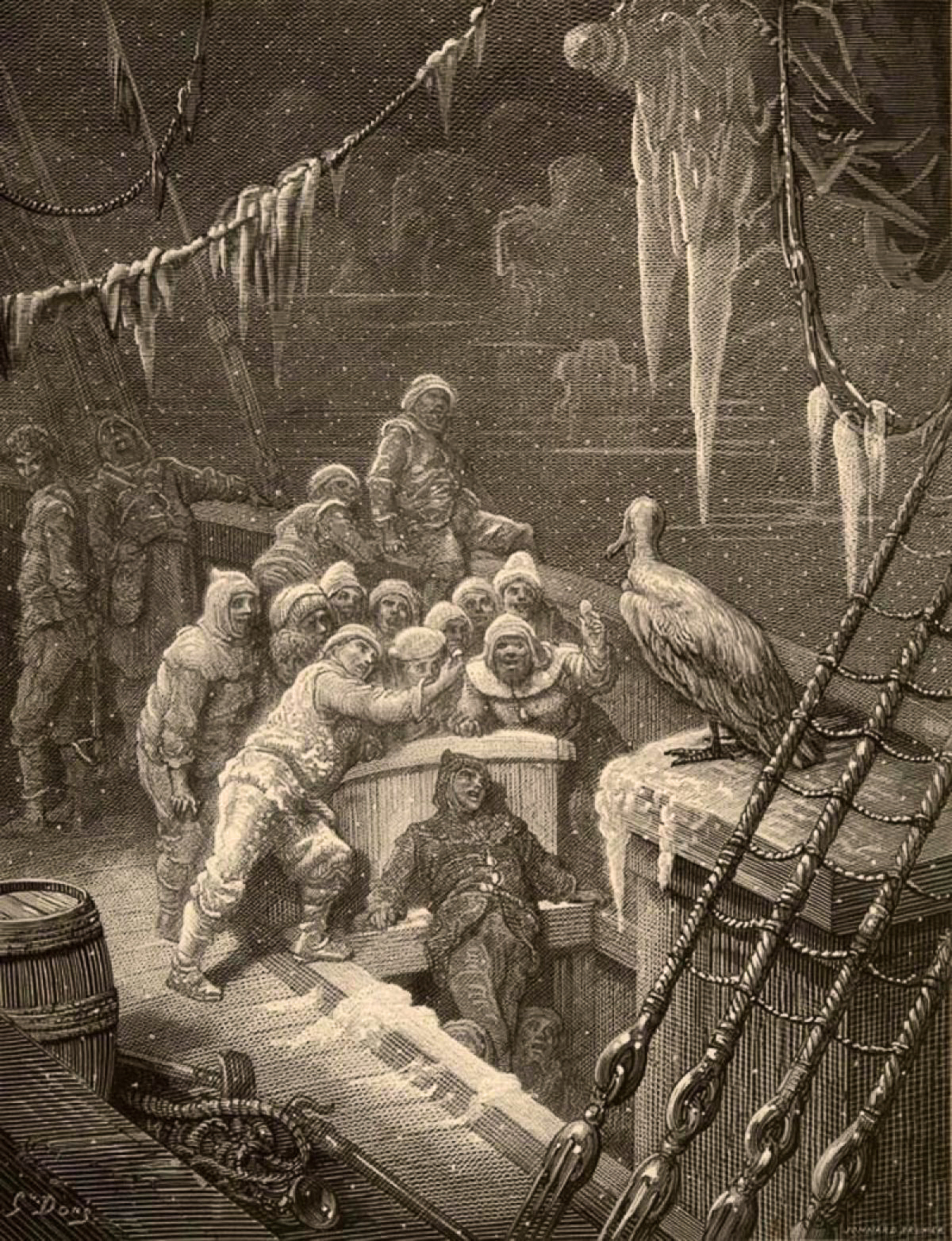
Romantic poets like Lord Byron, John Keats and Percy Bysshe Shelley all wrote ballads, but the form wasn't immortalized until the next generation of poets which included William Wordsworth, Thomas Percy and Samuel Taylor Coleridge.  Perhaps the most famous ballad, "The Rime of the Ancient Mariner", was penned by the latter in 1834 (http://www.poetryfoundation.org/poem/173253).


Gustave Dore etching for Rime of the Ancient Mariner published in 1798, courtesy http://upload.wikimedia.org/wikipedia/commons/2/26/Rime_of_the_Ancient_Mariner-Albatross-Dore.jpg.


British street ballads were popular during the Victorian era.  Printed on thin sheets of paper, they were sold on the streets for a penny or half penny.  Besides the traditional subjects, street ballads centred on humorous anecdotes, social reform and crime (http://www.library.kent.edu/street-ballads-victorian-england).

Not all ballads have adult like themes; some are geared for children.  Because of the ballad's strong rhythm, repetition and rhyme, it does appeal to young minds (http://en.wikipedia.org/wiki/List_of_the_Child_Ballads).


The Three Ravens circa 1919 courtesy 

English folk and American blues musicians popularized the music ballad.  B. B. King's blues ballad, Sneakin Around can be viewed at http://www.metrolyrics.com/sneakin-around-lyrics-bb-king.html.

Dudley Randall's Ballad of Birmingham was written during the Civil Rights Movement. Visit http://www.poetryfoundation.org/poem/175900 to view the poem.


Four black girls perished in the bombing of a Baptist Church circa 1963 prompting Dudley Randall to write Ballad of Birmingham courtesy http://thyblackman.com/2013/09/13/thy-racial-ghosts-of-the-birmingham-church-bombing-still-haunt-america/.




Friday, 1 May 2015

If You Want to Be a Poet...

"Poetry is when an emotion has found its thought and the thought has found words." (Robert Frost)


For the month of May, I will be blogging about poetry.  When I took an online college poetry writing course eight years ago, I was struck by how difficult it is to write poems.  The process is not only artistic but also mathematical.  I really enjoyed measuring my words, counting the syllables, trying to follow a framework for each different type of poem.  It gave my brain quite a workout!  Here are some tips to becoming a poet.

If you want to be a poet, you need to be proficient.  "Painters paint, teachers teach, poets 'poem'", according to blogger Robert Lee Brewer (http://www.writersdigest.com/writing-articles/by-writing-genre/poetry/10-essential-rules-of-poetry).  Our writing instructor had us write thirty poems during the twelve week course (that's almost three per week).  I appreciated the momentum that I built by following a strict writing schedule.

If you want to be a poet, you need ideas.  Keep your mind open and nimble.  Read Julia Cameron's The Artists Way to find ways to get the creative juices flowing (http://juliacameronlive.com/). "Become sensitive to life," says John Timpane.  He recommends keeping a poetry journal in which you will store:

  • ideas
  • images
  • topics
  • drafts
  • other poems
  • inspirational objects (ex. a grocery list you found on the ground; a feather on the beach)
A poet's journal is the "office where the work of poetry takes place," explains John Timpane.  

If you want to be a poet, read as much poetry as possible.  Borrow poetry anthologies from the library.  Read poetry online (http://www.poetryfoundation.org/browse).  Subscribe to a poetry magazine (http://www.poetryfoundation.org/poetrymagazine/).  Participate in events for National Poetry Month held every April (http://www.poets.org/national-poetry-month/home).

Study poetic forms.  The form is the "skeleton that holds the content together," says Robert Lee Brewer.  Experiment with a variety of types of poetry.  Do you prefer rhyming or free verse, long or short poems?  Here is a partial list:

  • ballad
  • blank verse
  • diamant
  • epic
  • ode
  • free verse
  • limerick
  • pantoum
  • rondeau
  • sonnet
  • villanelle

If you want to be a poet, connect with other poets.  Attend poetry readings and open mics.  Poetry is just as much an oral as it is a written genre.  Take poetry workshops and classes.  Find a mentor. Becoming a part of a poetry community will keep you writing and submitting your work.  

Which brings me to my last point:  Showcase your work.  Enter poetry contests.  I entered a Haiku contest held by the Grand Erie Board of Education and won first prize ("My blue-eyed beauty/Full of innocence and grace/Just broke my last vase.")  Join a poetry club.  Assemble a collection of your work.  At the end of my online poetry course, we all selected two pieces to be shared in a collection of work which we named Measured Moments.  Submit your poetry to anthologies for publication.  Just beware of the vanity anthologies.  Anthologies publishers often push for you to buy their anthology once it's published.  You should not have to pay to have your work published.