Showing posts with label Chicago World's Fair. Show all posts

Saturday, 22 April 2017

Kansas City's The Paseo Modelled After Paseo de la Reforma

"Kessler's imprint on Kansas City is unmistakable..." (William S. Worley)


Kessler, a German immigrant, and brothers Wright were instrumental in planning Kansas City in the early 1900's.  Influenced by the Chicago World's Fair of 1893, the team worked on the planning for the St. Louis Fair of 1904.  They tried to incorporate the grand boulevards and sprawling parks of both fairs in their planning of Kansas City.  Among the dozens of projects under construction during the collaboration of Kessler and the Wright brothers were:  Admiral Boulevard, Karnes Boulevard and Harrison Boulevard as well as Grove Park, Spring Valley Park, Parade Park and The Paseo (https://www.kshs.org/publicat/history/1997autumn_worley.pdf).


The Paseo, named after The Paseo de la Reforma in Mexico City, is a 19 mile avenue in the heart of Kansas City, punctuated by a series of parks.  One intersection features the Public Bath House, reminiscent of Roman times. 


A Spanish Cannon sits at 12th Street.  The Meyer Monument, honouring the parks commissioner who had a hand in its planning, sits at 10th Street.  


The Pergola, an archway in a garden consisting of a framework to allow for vines to grow, was a highlight of the Paseo.  


The Sunken Garden, sitting at 12th Street, is surrounded by the Paseo Terrace. 


The Paseo Pool used to attract area children.  The 9th Street Fountain is now called The Women's Leadership Fountain.  The Paseo Spanish Cannon is in keeping with the park's name.


Saturday, 15 April 2017

Robert Speer's Denver Design Inspired by World's Fair


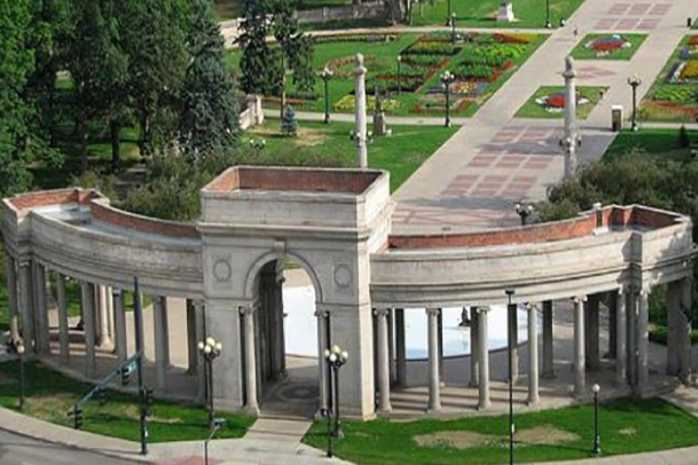
Denver Civic Center Park courtesy https://www.denver.org/listing/civic-center-park/6823/.


Mayor Robert Speer came to Denver as a tuberculosis patient in 1878.  While the city was thriving it was also ugly.  Speer visited the White City at Chicago's World Fair in 1893.  During Speer's three terms as mayor, 300 miles of streets were paved, sandstone sidewalks were installed along with granite curbs.  A 12000 seat auditorium, at the cost of $650,000, was opened where free Sunday concerts were held.  The auditorium hosted the 1908 Democratic National Convention.  In 1909. Denver Municipal Facts started publication announcing the newest improvements to the city.

Speer especially loved the parks system developped during his terms in office.  The parks were landscaped; benches, playgrounds, fountains and drinking fountains were installed, the latter part of the temperance movement.  Children were encouraged to play in the fountains and there were no Keep Off the Grass signs like in New York City's Central Park.

Speer patterned Denver's Civic Center after the Chicago World Fair's Court of Honor.  While the Civic Center became a seedy area by the 1940's, surrounded by bars and strip joints, it was cleaned up by the 1950's when the Denver Public Library and Denver Art Museum were built there.


Wednesday, 17 June 2015

Nelson Algren's "Chicago: City on the Make"

"Chicago.  City on the make.  A tangle of hustlers, gangsters, corrupt politicians.  A city of nobodies nobody knows, the ginsoaks, stew bums and shell shocked veterans who lurk in the alleys and linger in the weedy wastes underneath the L tracks and a town that sells out its dreams and disappoints its dreamers, but once you've become a part of this particular patch, you'll never love another.  Like loving a woman with a broken nose, you may well find lovelier lovelies, but never a lovely so real."


Nelson Algren's 12,000 word lyrical essay, written in 1951, captures "an aspect of Chicago that still applies today" (https://en.wikipedia.org/wiki/Chicago:_City_on_the_Make).  He touches on major events which have shaped the city's 120-year history:  the Great Fire of 1871, the Chicago World's Fair of 1894, the White Sox Scandal of 1919, the political corruption of the 1920s and Prohibition of the 1930's.  In fact, in the 1920's and 1930's, "many Chicago policemen earned more money from pay-offs than from the city" (https://en.wikipedia.org/wiki/Political_history_of_Chicago).

Author A. J. Liebling takes credit for dubbing Chicago "The Second City" in 1952.  The Windy City always felt like it was in the shadow of New York City.  Carl Sandburg, in his famous poem "Chicago", asks "who are those who sneer at my city?", referring to New Yorkers.  What a coup it was for Chicago to win the bid to host the World's Fair in 1894, outbidding New York City.  That's how it acquired the name "Windy City", after the long-winded representatives from Chicago who made the fair bid.  The competition between the two cities persisted.  In the 20th Century, Chicago and New York City outraced each other to the sky, building the biggest and the best skyscrapers.

While Nelson Algren's Chicago may have been full of corruption and suffered from an inferiority complex, Algren "did indeed love the city and held high hopes for it, not in spite of its imperfections but because of them." (http://www.dwrl.utexas.edu/orgs/e3w/volume-12-spring-2012/contested-cities/susan-quesal-on-chicago-city-on-the-make)  For example, the Great Fire which struck Chicago led to its rebuilding, bringing in the country's best architects and leading to a city now known for its beautiful buildings.  Algren's "second hand sea", now much less polluted since the rerouting of the Chicago River, has become a playground for Chicagoans; it's one of the most beautiful waterfronts in America.  The White Sox scandal was taxing, but the team, and the fans, remain.  Algren was a diehard fan until his death.  Prohibition was repealed, slowing down, although not eliminating, the criminal activity in the Windy City.  In the 1920's and 1930's, the Chicago Police Force was known for its corruption.  Forty percent of police officers were killed in the line of duty.  In 1942, the force   established the first Human Relations Section in the nation, and in time, its image improved.

Algren could see the potential that his hometown had.  That is the undercurrent of the "definitive prose portrait of the city of Chicago" (https://en.wikipedia.org/wiki/Chicago:_City_on_the_Make).