Showing posts with label news. Show all posts

Wednesday, 11 March 2015

Fourteen Feature Article Formats

The feature article comes in many shapes and sizes.  Here are fourteen different types accompanied by examples.

1.  Profile

The profile, or interview, is a staple of the feature articles.  It is a behind the scenes look at an individual, including his or her age, hometown, education, residence and family.  It also touches on the subject's influences and choice of profession or vocation.  Ideally, if you write a profile article, you should conduct the interview face to face so as to know the interviewee's appearance and mannerisms.  It adds legitimacy to the piece.  However, if a face to face interview is impossible, you can always conduct an interview over the phone or via e-mail.  If you can see your subject in action (ex. a doctor at the hospital, a cop on his beat) then you get a better sense of what he or she is all about. These piece often take a question and answer format.

For example, read about the German leader Angela Merkel here:  http://www.newyorker.com/magazine/2014/12/01/quiet-german

2.  News

News stories focus on a topic of interest, using similar subjects to a deadline hard news story, but in greater depth and detail.  Whereas a deadline story focuses on numbers and stats, a news story often focuses on an individual.  For instance, a deadline story about heart disease would focus on the stats; a news story about the same topic would focus on a heart patient.  News stories "tackle big, newsy topics while still telling very human stories" (http://journalism.about.com/od/writing/a/kindsoffeatures.htm).

For example, read about the Ebola Outbreak here:  http://www.independent.co.uk/voices/comment/ebola-outbreaks-i-discovered-this-virus-in-1976-its-frustrating-that-we-still-know-too-little-to-treat-it-effectively-9218620.html

3.  Spot

A spot feature article is a breaking news event with a deadline.  Often it takes the form of a sidebar to accompany the deadline news story in the mainbar.  For instance, the mainbar might feature an article about a tornado, covering the five W's of the story.  Sidebars, or spots, could cover emergency shelters, past tornadoes and pre-tornado weather conditions.

For example, read about the effect of Hurricane Katrina on the Louisiana Superdome at http://en.wikipedia.org/wiki/Effect_of_Hurricane_Katrina_on_the_Louisiana_Superdome.


4.  Trend

This type of feature "takes the pulse of the culture",highlighting topics such as art, fashion, film, music and technology.  Such articles are light, quick and easy to read.  Possible subjects include women's spring fashions, the newest technological gadget or the hottest indy band.

For example, read about Disc-o-Rama Dresses at
http://www.vogue.com/slideshow/12175429/trends-fall-2015-paco-rabanne-francois-hardy/.

5.  Live In

This is an in depth magazine-length article describing a particular place and the people who live there ex. a homeless shelter, an emergency room, a battlefield encampment or a police precinct.  It's name is derived from the fact that reporters spend a large chunk of time at the site; they immerse themselves in the story.  The reporter gets a sense of rhythm and atmosphere by spending so much time at the site.  Reporting can take days, weeks or even months.  Some live in articles serve as launching pads for books.

For example, Amy Ellis Nutt was a Pulitzer Prize finalist for her in depth article "The Accidental Artist", about a chiropractor who had a sudden urge to create art after he had a severe stroke, which turned into the book Shadows Bright as Glass.  Read the article at
http://www.nj.com/news/index.ssf/2008/12/sarkin_chapter_1.html.

6.  How To

This feature article is about the process of how things came about ex. a product, a service or an activity.  It is written with easy to follow instructions and includes the shortcomings of the product or service and possible warnings.  Mention where to locate supplies and refer to other sources.

For example, read about how to prepare a holiday dinner for a diabetic at
http://usatoday30.usatoday.com/yourlife/food/cooking-recipes/2010-11-17-diabetescookbooks17_St_N.htm.

7.  Personal Experience

This feature article highlights a unusual event in the life of a writer.

Example:  https://vicrosaliotahud.wordpress.com/2011/02/21/my-lifes-journey-personal-experience-fetauring-my-self/

8.  Humour or Satire

The purpose of this article is to entertain.  It's often geared towards a specific audience.  These types of articles are often written "on spec" which means you must submit the entire article when you pitch it.

For a funny take on Christmas, read http://www.cnn.com/2010/LIVING/11/15/cheap.christmas.romans/index.html.

9.  Expose

The aim of this article is to shock or surprise the reader.  The subject is often controversial.  It includes statistics, quotes and anecdotes.

For example, read about The Do's and Don'ts of Extension Cords at http://www.ismyhomesafe.ca/dos-and-donts-of-extension-cords/.


10.  Human Interest

This feature article often starts with an anecdote and is written in chronological order.

For example, read about a little boy who lost his mother in 1986 and recently found her thanks to Google Earth at https://bruneljournalism.wordpress.com/2012/04/15/thi-is-a-really-good-example-of-a-human-interest-story/.

11.  Essay or Opinion

This article is often written about an important or timely subject. It is harder to sell if written by an unknown or unpublished writer.  Blogs are full of this type of article.

For example, read a pro-gun control article at http://www.newyorker.com/magazine/2012/04/23/battleground-america?currentPage=all.

12.  Inspirational

This article focusses on how to feel good about something, offering a moral message to its readers.

For example, read about the accomplishments of autistic teenager at http://www.indianapolismonthly.com/features/one-in-a-million-an-inspirational-story/.

13.  Historical

This article reveals events of interest to millions of people.  It focusses on a single aspect of a subject, often something new,  and is told in chronological order.  It goes beyond history, revealing a new connection to an old subject.

For example, learn about the Christmas Truce of World War I at http://www.firstworldwar.com/features/christmastruce.htm.

14.  Round Up

The author of a round up gathers a collection of information from many sources based on a common theme.  It can be filled with quotes, opinions, statistics, research, anecdotes and even recipes.

Read about Fiction Writing Tips at http://theadventurouswriter.com/blogwriting/12-fiction-writing-tips-from-published-authors-and-editors/.

Sources:

1.  http://journalism.about.com/od/writing/a/kindsoffeatures.htm
2.  http://theadventurouswriter.com/blogwriting/12-fiction-writing-tips-from-published-authors-and-editors/


Germany Reacts To Wulff Resignation - Adam Berry/Stringer/Getty Images News/Getty Images


Saturday, 7 March 2015

You Had Me at the Hook

Remember the movie Jerry McGuire starring Tom Cruise and Renee Zellwegger?  They had dated for a few months, but broke up.  Afterwards, Tom's character experienced success as a football player's agent, but realized it was empty if he had no one to share it with.  So he went back to Renee's character with a humble heart, begging her to come back to him.  Tom's character delivered a long drawn out speech to which Renee's character responded:  "You had me at hello."  When you write, try to have the same effect on your readers.  Give them a hook that is powerful enough to reel them in.

While your hook is found at the beginning of your newspaper article, Dawn Copeman recommends that you write it at the end.  After your first draft, you will have a better idea of the focus of your piece.  Dawn Copeman recommends that your write both a hook and a lead for your article.  The lead introduces the story.

"When my daughter Eleanor was eight months old, I gave her some scrambled eggs to eat.  Within minutes she was screaming, her eyes and nose were running, she had a rash all over and was having difficulty breathing.  This was my introduction to food allergy."

The hook, on the other hand, answers the reader's question:  "Why should I keep reading?"   Here is Dawn Copeman's hook for her food allergy article:

"What neither of us knew then was that egg is the most common form of food allergy in babies...It is considered so dangerous that doctors recommend that you don't give eggs to babies until they are one year old.  While you might think this is an over reaction, the fact is that food allergies are on the increase.  Approximately 8% of all children under five have a food allergy; twenty five years ago, it was only 4%."

Dawn Copeman recommends that at the end of your article, you either answer the question posed or resolve the issue presented in the hook.

ex.  "Yes, food allergies are on the rise.  Statistics show that they have doubled in the past ten years and scientists fear that this increase shows no signs of abating.  But now you know how to reduce the risk of your child developping a food allergy; hopefully your child will not be one of the statistics."

Below are some strategies to hook the reader.

1.  Use the news

ex.  "The Star's Wednesday editorial by Juliet Guichon and Dr. Rupert Kaul calls the Gardasil story troubling and disappointing, and the editorial's headline 'Science shows HPV vaccine has no dark side' challenges the original article's suggestion that Gardasil is linked to complications in young women." Visit http://www.cbc.ca/news/canada/manitoba/the-gardasil-girls-how-toronto-star-story-on-young-women-hurt-public-trust-in-vaccine-1.2957524 for the full article.

2.  Tell a dramatic anecdote

"The first sign of trouble was powder in the baby's urine.  Then there was blood.  By the time the parents took their son to the hospital, he had no urine at all."  For the article in its entirety, visit http://www.nytimes.com/2008/10/17/world/asia/17milk.html?em.

3.  Reference popular culture

ex.  "My 14 year old niece Jennie just got her first smart phone in December...But you'll never see Jennie and her BFFs on Facebook.  They don't even have accounts.  They'd rather swap silly pictures and texts using smart phone apps like Instagram and Snapchat." Read the remainder of the article here http://michellerafter.com/2014/07/14/writing-basics-the-lead/.

4.  Paint a picture

ex. "They young Egyptian professional could pass for any New York bachelor.  Dressed in a crisp polo shirt and swathed in cologne, he races his Nissan Maxima through the rain slicked streets of Manhattan, late for a date with a tall brunette." For the rest of the Pulitzer prize winning article, see
http://www.pulitzer.org/archives/7140.

5.  Use wit and irony to point out a contradiction

"Environmentalists Drive Gas Guzzler from Protest Site" (http://www.freedomworks.org/content/environmentalists-drive-gas-guzzler-protest-site).

6.  Commemorate an anniversary

ex. "On the 50th anniversary of the Bloody Sunday march that erupted in police violence on Selma's Edmund Pettus Bridge, President Barack Obama praised the figures of a civil rights era he was too young to know." See the full article at http://www.thestar.com/news/world/2015/03/07/obama-to-join-in-50th-anniversary-of-bloody-sunday-in-selma.html.

7.  Cite a major new study

ex. New evidence puts into doubt the long standing belief that a deficiency in seratonin -- a chemical messenger in the brain -- plays a central role in depression.  For the entire article, visit http://www.acs.org/content/acs/en/pressroom/presspacs/2014/acs-presspac-august-27-2014/new-study-throws-into-question-long-held-belief-about-depression.html.

8.  Use a personal example

ex. "The day had come.  I'd lasted as long as I could in my marriage.  Once my husband, Bill, left for work, I packed a bag for myself and my fourteen month old son and left our home." For more, read
http://www.todayschristianwoman.com/articles/2008/september/list-that-saved-my-marriage.html.

9.  Include a famous quote

ex. "In a coffee shop not long ago I saw a mug with an inspiration from Henry David Thoreau:  'Go confidently in the direction of your dreams!  Live the life you've imagined.'" See
http://www.nytimes.com/2011/08/30/opinion/falser-words-were-never-spoken.html.


Monday, 2 March 2015

American Public's Insatiable Appetite for News: Early Abolitionists Lead the Way

"One of the peculiar traits [of the public] is the insatiable appetite which exists in all classes of people in this country for news.  It is thirst so universal that it has given rise to a general and habitual form of salutation on the meeting of friends and strangers of 'What's the news?'" 
(Nathan Hale, publisher of the Boston Daily Advertiser, 1817)


Four men in front of a tent which advertises the Boston Daily Advertiser courtesy 


Before the advent of the radio and the television and the computer, the newspaper was the public's main source for news.  Newspapers first appeared in the Thirteen Colonies in the 1700's.  However, America's population was small and it hadn't yet broken off from Britain.  

Reporters on the Eastern seaboard used to wait for ships to arrive from Britain, row out to meet them, climb aboard and record the latest news.  Then they would typeset back at the office, print it on the printing press, and share it with the locals.  The process was slow and tedious and expensive.  Only a small number of Americans subscribed to newspapers for a hefty sum. 


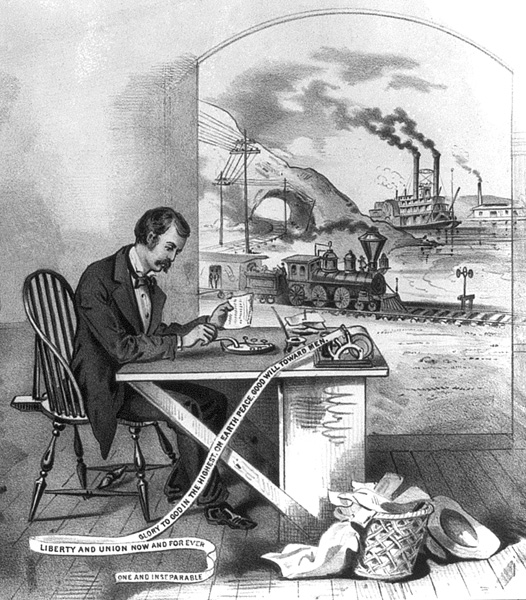
The telegraph was the first device to separate transport and communication courtesy http://ushistoryimages.com/images/morse-telegraph/fullsize/morse-telegraph-4.jpg.


Three inventions changed the course of the newspaper:  the printing press, the telegraph and the railroad, all of which made the dissemination of news much faster and more efficient.  In the early 1800's, the United States only had 376 newspapers in distribution.  However, by 1835, that number had shot up to 1200.  

In his book Fanatics and Fire Eaters:  Newspapers and the Coming of the Civil War (http://www.amazon.com/Fanatics-Fire-eaters-Newspapers-History-Communication/dp/B005IUWPDW) Lorman Ratner calls the sudden increase in readership a "newspaper revolution" and compares it to the transportation revolution.  With printing presses becoming faster, and the population exploding, newspapers became cheaper and more readily available. 


The Liberator masthead courtesy 


Newspaper editors and reporters influenced public opinion by the images they evoked.  Abolition was one major issue that used the newspaper as its forum, driving up its sales.  The Boston paper, the Liberator, advocated the abolition of slavery.  With an ever-increasing circulation, the paper helped open the eyes of the public to the evils of slavery.  In its first issue, the editor appealed to the public, reminding them of the famous line in the Declaration of Independence that:

"'...all men are created equal, and endowed by their Creator, with certain inalienable rights -- among which are life, liberty and the pursuit of happiness.'  I shall strenuously contend for the enfranchisement of our slave population."   


When the Civil War broke out, it was the newspaper reporters who reported from the battle front.  It was the newspapers that reported on the issue of emancipation which divided the country.  The public's thirst for news was insatiable.  They wanted blow by blow accounts of the battles.  They wanted to know who was winning the war.  

Whereas in Andrew Jackson's years in the White House, only a small elite read the newspaper, by the time Abraham Lincoln took office, the lower classes were reading the paper as well.  In the end, the slavery issue was fought on the battlefield, and resolved with the ratification of the Thirteenth Amendment, thanks in part to the eye-opening headlines of the early abolitionists.


Tuesday, 10 February 2015

Types of Blog Posts

You've set up a blog, you've found your niche and now you want to start blogging.  What types of blogs will you post?  Run through the list below and see which one suits you best; or maybe you would like to choose three or four and rotate your posts.

1.  News

One blogger calls it a "newsjacking".  Find an online article and mix your own opinion with the existing story.

Visit http://www.davidmeermanscott.com/books/newsjacking/.

2.  Instructional

These are very popular among readers.  People are searching for solutions.  Write a step by step how to article about an area of expertise.  Include reference material and diagrams.

Visit my Childhood Literacy post at http://alinefromlinda.blogspot.ca/2011/05/reading-magic.html.

3.  Interview

Put on a reporter's cap for the day.  Grab a pen and pad of paper and interview an employee of your company or someone you admire.  Use a question and answer format.  Include photos if possible.

Visit http://www.incomediary.com/10-tips-creating-awesome-interviews-blog.

4.  Cheat Sheet

Summarize a vast amount of information in a top ten list.

Visit http://time.com/collection/top-10-everything-of-2014/.

5.  Media

We are all visual learners to some extent.  A picture is worth a thousand words.  Include a post with high quality images, infographics, short videos or slide share presentations.

Visit http://www.coolinfographics.com/.

6.  Entertainment

Post something for the pure amusement of your readers.  For example, if you post something humorous, it has more of a chance of being shared and being remembered.

Go to http://www.buzzfeed.com/jackdaniels/ugly-holiday-sweaters-that-are-almost-too-ugly-to-wear?sub=2780348_2072688#.sbyX8d6j4.

7.  Narrative

Post a personal story.  I think of the post I wrote about my Grandad and how he received an F on his math test as a child, but how, as an adult, he turned his weakness into a strength, by becoming a beloved math teacher of thousands of Toronto high school students.

Visit http://alinefromlinda.blogspot.ca/2011/06/worlds-greatest-grandad.html.

8.  Review

Review a book, restaurant or product.  Include an excerpt from the book or a link to the restaurant's home page.

Visit my post "Unbroken" at http://alinefromlinda.blogspot.ca/2012/07/july-26.html.

9.  Gratitude

An attitude of gratitude makes a happy heart.  Devote a post to thanking someone or a group of people.

Check out Ron Edmondson's blog at http://www.ronedmondson.com/?s=gratitude&submit=Search.

10.  Research

Research a topic and present your findings.  Share your opinion about the topic.  Include charts, infographics, diagrams, etc.

Visit http://researchblogging.org/.

11.  Roundup

Select your top ten posts of all time and write about them.

Visit http://www.cornerstonecontent.com/how-to-write-a-great-roundup-post/.

12.  Series

Pick a topic that you know a lot about or one that you would like to learn about and write a multi-day, week or month long series on it.

Here is the first of my month long series on setting and achieving goals at http://alinefromlinda.blogspot.ca/2015/01/conceive-believe-achieve.html.

13.  Travel

If you go on a trip, bring along a laptop (or use the hotel computer if you have free access) and blog about it.

Here is one of a series of blog posts I wrote about my trip to Chicago last summer at http://alinefromlinda.blogspot.ca/2014/07/pizzeria-uno_4.html.


Sunday, 1 February 2015

Blogging: Choosing a Niche

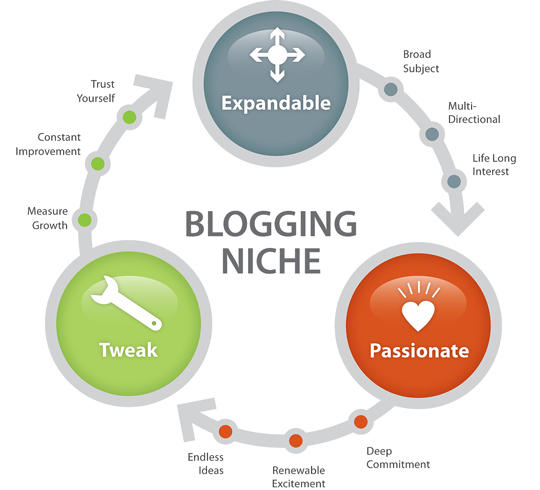
You have decided that you want to enter the blogosphere.  You have come to the right place.  I am devoting the month of February to blogging.

The first question you have to answer is:  "What would I like my blog to be about?"  Here were some popular blog topics for 2014.

1.  parenting:  Mommy blogs are all the rage on the Internet.  Check out my friend's blog Three Kids (A Husband) and a Teabag at threekidsandateabag.wordpress.com.

2.  hobbies:  Maybe you collect hockey cards like my husband.  Maybe you are a knitting expert.  Join a network of people who share your hobby.  Check out myhockeycardobsession.blogspot.ca.

3.  technology:  Learn about the latest and greatest in the field of technology.  Check out mashable.com.

4.  politics:  Engage in intense debate.  Be prepared to answer questions.  Grow your readership quickly.  Check out Ordinary Times:  On Culture & Politics at ordinary-gentlemen.com.

5.  news:  Share new ideas or put a new spin on an old idea.  Check out huffingtonpost.com.

6.  journaling:  Declare your hopes and dreams to the world.  Share reflections on life which resonate with readers.  Check out www.livejournal.com.

7.  deals/frugal living:  Maybe you are a coupon queen.  Perhaps you have tricks to stretch your budget.  Check out www.thefrugalgirl.com.

8.  DIY & design:  Bring your creative skills to the Internet so that others can be inspired.  Check out House Tweaking at www.housetweaking.com.

9.  fitness:  Help readers get fit.  Check out www.irunnerblog.com.

10.  food:  This theme is so popular that it has its own book Food Blogging for Dummies.  Check out Top with Cinnamon at www.topwithcinnamon.com.

11.  history:  Check sites like thisdayinhistory.com for inspiration.  Check out Civil Warriors at civilwarriors.net.

12.  fashion:  Maybe you are a fashion design student at college.  What a great forum a blog could be for your ideas!  Check out Brooklyn Blonde at www.brooklynblonde.com.

13.  travel:  If you are a frequent traveller, blog about your trips.  Check out The Traveling Type at blog.travelchannel.com.

14.  books:  A strong reader makes a strong writer.  Post book reviews.  Check out The Book Wheel at www.thebookwheelblog.com.

15.  marriage:  My writer friend shares her ideas about marriage at www.sheilawraygregoire.com.

16.  photography:  My Grandad Stroud was an amateur photographer who even won contests for some of his photos including one of my doe-eyed sister Lisa as a baby and one of a close up of a blue jay.  What better way to share your prize photos than through blogging?  Check out www.robertkruh.com.

17,  antiques:  Maybe you're addicted to the Antiques Road Show.  Check out antiquesdiva.com.

18.  gardening:  My Grandad Tufts, a teacher, used to spend his summers gardening; in fact, his backyard was simply one big garden.  Check out reddirtramblings.com voted one of the top ten gardening blogs by Better Homes & Gardens.

19.  sports:  If you like football, check out www.yardbarker.com.

20.  music:  If you like country music check out theboot.com.


Note:  For more tips, check out "All of the Good Ideas are Already Taken:  Tips to Help You Pick a Niche" at http://www.smartpassiveincome.com/niche-selection-tips/.