Wednesday, 15 January 2014

Miracle on the Hudson

"It was very quiet as we worked, my co-pilot and I.  We were a team.  But to have zero thrust coming out of those engines was shocking...the silence." (Captain Sully Sullenberger)


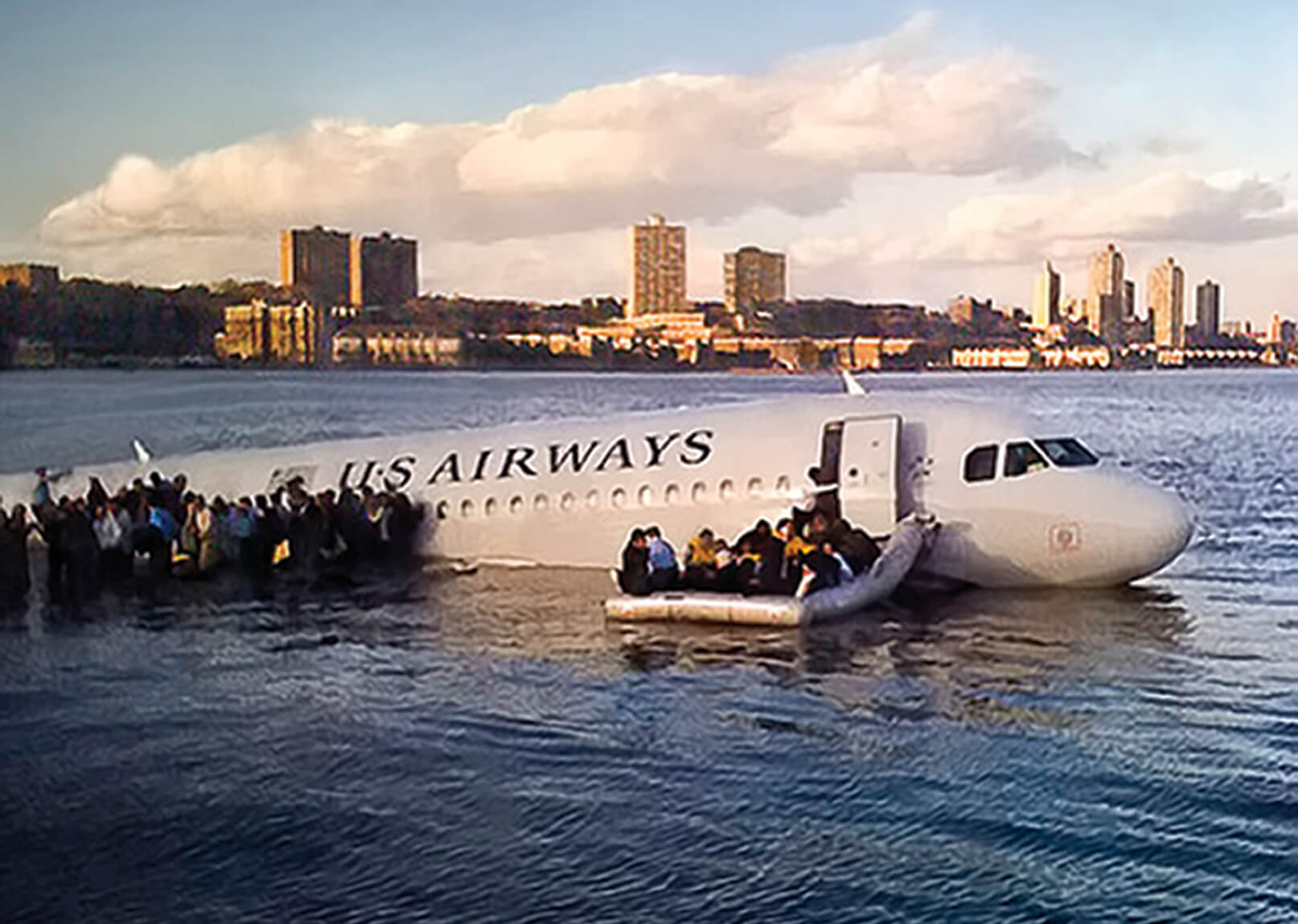
We will never forget the TV images of five years ago today:  a plane sat on the chilly Hudson River, passengers spilled out onto its wings, partly submerged in the water, waiting to be rescued. 

Captain Chesley Bunetter (Sully) Sullenberger was a former fighter pilot in the U.S. Air Force.  He had worked for U.S. Airways for 30 years.  He had logged 20,000 hours in the air.  On January 15, 2009, he took off from LaGuardia Airport on what appeared to be a normal day.  However, a minute after takeoff, his plane collided with a flock of Canada geese, wreaking havoc with the aircraft.  Passengers saw flames coming from one of the engines.  Captain Sullenberger heard not a sound coming from either engine.  He radioed the control tower of his predicament.  They radioed back that he should land at the closest airport, Teterboro.  His response was:  "We're gonna be in the Hudson."  

Sullenberger guided U.S. Airways Flight 1549 onto the surface of the Hudson River on that frosty day.  The plane floated down to the river, an eerie silence accompanied its approach.  One by one, the air flight attendants ushered the passengers onto the plane's wings.  Commuter boats, sightseeing ferries and rescue vessels raced to the scene, ready to pick up the stranded passengers.  Photographers snapped photos of the aircraft, resting in the Hudson, New York's skyscrapers gracing the background.  The captain was the last two evacuate the airplane, after checking its aisle, not once but twice to make sure everyone had exitted.  Not one person died that day; the worst injury was two broken legs.  Passengers returned to their anxious families and Captain Sullenberg flew home to his wife and daughters in California.

"Sully" Sullenberger became a hero overnight.  He was invited to the inauguration of Barack Obama at the White House.  He signed a book deal for HIghest Duty:  My Search for What Really Matters.  He retired in 2010 from flying and became a consultant and public speaker.  No one will ever forget what New York City Governor Paterson would dub "The Miracle on the Hudson".


\
news.un.purdue.edu

Tuesday, 14 January 2014

Ice Master Prevented Disaster

"If I had it to do over again, I should be a sailor just the same.  There is nothing so satisfying as the sea." (Bob Bartlett)


Bob Bartlett courtesy en.wikipedia.org.


Robert Bartlett, the eldest of ten children, was born and raised in Newfoundland.  Given his parents were strong Catholics, they hoped that he would become a priest.  However, by the age of 17, Bob knew his passion was for the sea, not for the seminary.  He accompanied Commander Robert Peary on three attempts to reach the North Pole without success.  But the trip that he would make him a hero, was the ill-fated voyage of the Karluk.

Canadian anthropologist Vilhjalmur Stefansson wished to survey the flora, fauna and minerals on Herschel island north of the Yukon.  Robert Bartlett agreed to go along as the captain of the ship, the Karluk.  Once they were in the Arctic, Stefansson left the ship with a party to hunt caribou, never to be heard from again.  That left Bartlett in charge.  

Soon the Karluk crew was trapped in the ice.  Anticipating the worst, Captain Bartlett had his crew build igloos on the nearby ice.  Sure enough, the Karluk drifted across the sea and got trapped again in the ice which punched a hole in its side, leading to its sinking.  


Map courtesy en.wikipedia.org.


The crew set out on an 80 mile march to Wrangel Island where they set up camp.  Two parties of four men were lost but the remainder of the crew survived the journey.  Captain Bartlett and his Inuk companion set off for Siberia to seek help for the stranded crew.  They trudged 700 miles over the frozen Chukchi Sea before reaching Alaska.  Back on Wrangel Island, two more died of illness and one of violence.  But the others persevered.

Because of their captain's heroic efforts, the crew of the Karluk was finally rescued in September 1914, a full eight months after they were first stranded.  Hailed as a hero by his crew and by the public, Bartlett was given the Roayl Geographical Society's highest medal as well as the Honorary Boy Scout medal, an honour also bestowed on Charles Lindbergh.  Numerous National Geographic articles were written about Captain Bartlett as well as a book called The Karluk's Last Voyage.  

Captain Bartlett was shipwrecked a total of twelve times.  But the "Ice Master" always made it home, usually loaded down with photographs, film reels and scientific data from his journey.  


Karluk expedition courtesy upload.wikimedia.org.


Note:  Read The Ice Master:  The Doomed 1913Voyage of the Karluk by Jennifer Niven.  

Monday, 13 January 2014

Johns Hopkins: Furthering the Cause of Medicine


upload.wikimedia.org


Johns Hopkins, a Quaker, was the second of eleven children.  He fell in love with his cousin Elizabeth when he was young but they never married due to the social taboo.  In 1832, Johns Hopkins saw his hometown of Baltimore, Maryland devastated by yellow fever and cholera.  Almost 1000 townsfolk died that summer.  Again, Hopkins saw his hometown hit hard during the Civil War.  While the country was divided by the issue of slavery so too was the state of Maryland.  Many were supporters of the South; however, Hopkins, "an abolitionist before the word was even invented"supported the North.  He offered his summer estate as a meeting place for Union sympathizers.  With his countrymen dying from disease on the battlefield, or coming home maimed, Hopkins saw the need for more and better hospitals.  He made out his will, offering 17 million dollars to further the cause of medicine.  In the end, he built a hospital, medical college, nursing college, orphanage and university, all which bear his name.


Johns Hopkins Hospital opened in 1889 courtesy doc.med.yale.edu.


Sunday, 12 January 2014

John D. Rockefeller: Abstainer, Abolitionist, Altruist

John D. Rockefeller made his fortune in the oil industry.  In fact, by the 1870's, his company, Standard Oil had 90% of the shares in the U.S. oil industry.  By 1937, his Rockefeller accounted for 1.5% of the U.S. GDP.  And yet, he would give much of his fortune away.

Following Wesley's motto to "gain all you can, save all you can and give all you can", Rockefeller spent most of his life supporting worthy causes.  He heavily financed research to eradicate the diseases of hookworm and yellow fever.  

A strong proponent of higher education, Rockefeller founded the University of Chicago, Rockefeller University.  An abolitionist who voted for Lincoln, Rockefeller supported many black schools in the South including Spelman College, which was named after the Rockefeller's wife Laura Spelman, an ardent abolitionist.  

Rockefeller belonged to a Baptist church in Cleveland where he tithed and taught Sunday School.  In the Baptist tradition, he abstained from consuming alcohol or using tobacco.

Rockefeller was known for his habit of handing out dimes to adults and nickels to children wherever he went. The Rockefeller Foundation was established in 1913 to help worthy causes.  To date, the foundation has given away more than $14 billion.    


John D. Rockefeller courtesy upload.wikimedia.org.

Saturday, 11 January 2014

Andrew Carnegie's Library Legacy

Andrew Carnegie's philosophy on life was to spend the first third of one's life getting as much as education as possible, spend the second third of one's life making as much money as possible and spend the final third of one's life giving as much of one's treasure to worthy causes as possible.  Born in Scotland, Mr. Carnegie immigrated to America where he founded a steel company in Pittsburgh, Pennsylvania.  He would later sell his company to J. P. Morgan who would rename it U.S. Steel.

Andrew Carnegie spent the last 20 years of his life as a philanthropist.  He gave away over $350 million ($4.8 billion today) of the fortune he amassed.  Here are some of the libraries built in North America with his money.


1.  Macomb, Illinois Library courtesy upload.wikimedia.org.


2.  Carnegie Free Library in Braddock, Pennsylvania was the first such library in the United States courtesy upload.wikimedia.org.

File:Houston Carnegie Library 1904.jpg

3.  Carnegie Library, Houston Texas circa 1904 courtesy en.wikipedia.org.


File:Carnegie Library, San Antonio, Texas.jpg

4.  San Antonio, Texas Carnegie Library courtesy en.wikipedia.org.


File:IronMountainCarnegieLibraryFront.jpg

5.  Iron Mountain Michigan courtesy en.wikipedia.org.


File:Yorkville Library.jpg

6.  Yorkville Library, Toronto, Ontario courtesy en.wikipedia.org.


Historic Image of the Carnegie Library

7.  Brantford, Ontario Library courtesy www.historicplaces.ca.


8.  Hamilton, Ontario Library courtesy www.mtc.gov.on.ca.


9.  Chatham, Ontario Library, first Carnegie Library in Canada, courtesy www.uoguelph.ca.


Tower, Goderich Public Library, 2007

10.  Goderich, Ontario Library courtesy www.historicplaces.ca.


Friday, 10 January 2014

Spindletop

Patillo Higgins, a one-armed mechanic and self-taught geologist, was convinced that oil lay under the salt dome near Beaumont, Texas.  In the early 1890's, he started drilling there, but without success.  In 1899, he leased the land to Austrian Navy Captain Anthony Lucas.  Two years later, Anthony Lucas struck gold, black gold.  

Previous to 1901, the most oil rich state had been Pennsylvania.  However, all that changed in 1901 when Lucas's drilling derrick discovered crude oil 1000 feet below the surface.  The "Lucas Gusher" lasted nine days and produced 100,000 barrels of oil per day.  

Petroleum, which had previously been used as a lubricant or in kerosene lamps, would become North America's main fuel.  The oil was produced by hundreds of hydrocarbons.  Tiny aquatic plants and animals died and settled on the bottom of ancient waterways forming a thick layer of organic material.  

Texas businessman Patillo Higgins wanted to capitalize on the crude oil he suspected was under the salt dome.  He fomred the Gladys City Oil and Manufacturing Company and went to work drilling.  But as his money dwindled, so too did his prospects.  By the time Anthony Lucas struck black gold a few years later, Mr. Higgins had already lost his stake in the land.  

Spindletop, as the surrounding town came to be known, formed almost overnight, with its population tripling in a three month period.  Within a year, the area boasted 285 active wells and 500 oil and land companies, including Humble (Exxon), Texas Company (Texaco) and Magnolia Petroleum Company (Mobil).  

Arriving on the heels of the oil drillers were the wheelers and dealers.  Everyone wanted to make a buck.  In time, Spindletop became "Swindletop".

Wednesday, 8 January 2014

Thrifty Billionaires

I noticed that on this day last year I blogged about Pinching Pennies.  I remember that my Mom used to say that her Uncle Ernest knew how to pinch a penny.  He was also a very hard worker.  When he died, he was a multimillionaire.  Other than the Cadillac that he drove, you would have never known that he was wealthy. He lived in a modest, primitive stone farmhouse.  He dressed in overalls, shirts and work boots like any other farmer would.

Here are ten current day billionaires who practise thrifty lifestyles.

1.  John Caudwell

A cellphone billionaire, John cuts his own hair and buys suits off the rack.


2.  Warren Buffett

Billionaire Buffett lives in the same 1958 home that he purchased for $31, 500.  He drives a Cadillac and prefers ordering burgers and Cherry Cokes to pricey steaks.

3.  Azim Premji

An East Indian tycoon, his cooking oil business is worth 12.7 billion.  And yet Azim recently traded in his Ford Escort of 8 years for a Toyota Corolla.  He flies economy class and stays at budget hotels.

4.  Ingvar Kamprad

The IKEA founder, worth $31 billion, wears denim shirts and drives a 1993 Volvo.

5.  Carlos Slim

Worth $53 billion, he has lived in the same house for 40 years.  He does not own a yacht or a plane.

6.  Check Feeney

Much of his Duty Free Shoppers fortune he has donated to Atlantic Philanthropies.  He flies economy class, frequents retail stores for clothes and made his teenage children earn their keep by getting summer jobs.


atlantic.jpg


7.  Frederik Meijer

His grocery store chain is valued at $5 billion and yet he drives reasonably priced cars and stays at affordable motels.  Like Feeney, Meijer gives a lot back to his community.

8.  David Cheriton

He owns a chunk of Google stock and yet he bikes to work and drives a Volkswagen or Honda for longer trips.  He also cuts his own hair.

9.  Jim Walton

The Walmart owner is worth $16 billion and yet he drives a Dodge truck.


10.  Richard Kinder

The former Enron President is worth $3.5 billion and yet he flies coach on business trips.