Showing posts with label five senses. Show all posts

Wednesday, 6 May 2015

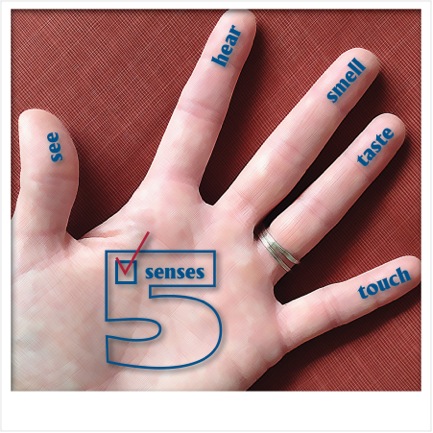
Learning to Write Poetry Using the Five Senses

"When sensory details are used, your readers can personally experience whatever you're trying to describe, reminding them of their own experiences, giving your writing a universal feel." 
(Amy Anderson)


As a poet,  you need to get in touch with your emotions.  You need to employ all five senses to transport the reader to where you want him to be.  Darien Gee recommends doing exercises to strengthen your writing muscles.  Go to the beach and write about the texture of the sand.  Pretend that your reader has never touched it before.  Stand in line at the supermarket and listen to the customers' voices; describe the squeaky grocery cart, the crispness of the paper bags, the flipping of the magazine pages, the beep of the register.  Visit a Hawaiian restaurant and try poi. Describe its taste, smell, texture.  Visit www.dariengee.com/wp-content/uploads/2013/05/NHN-20120614.pdf for the entire post.

Amy Anderson maintains that:  "The writer's ability to create a gripping and memorable story [or poem] has much to do with engaging our five senses.  When sensory details are used, your readers can personally experience whatever you're trying to describe, reminding them of their own experiences, giving your writing a universal feel." (http://study.com/academy/lesson/sensory-details-in-writing-definition-examples.html)  They say that music is the universal language. Regardless of what culture we come from, we can all "feel" music; it moves us.  Just as musicians move their audience, poets need to move their readers.  

There is a hearing impaired man at my gym.  He says that something good has come out of him being hard of hearing.  He has experienced a heightening of all the other senses.  He picks up clues that others don't:  a person's gestures and facial expressions.  In the last 30 years he has become an excellent judge of character.  He can read a person like a book.  He doesn't take his senses for granted like the rest of us do.

Get your senses ready to record what you observe.  You have a poem in there just bursting to come out.  Visit http://www.familyfriendpoems.com/poem/article-5-senses-in-poetry for examples of poems which use all five senses.


Tuesday, 5 May 2015

How to Exercise Your Poetic Muscles

Just as a weight lifter exercises his muscles daily, so too must a writer.  John Hewitt lists several ways to get the creative juices flowing.  Here are ten of them:

1.  Make a list of poems with memorable lines.  Re-read them and determine why they stand out.


Far from the madding crowd's ignoble strife
Their sober wishes never learned to stray
Along the cool sequestered veil of life
They kept the noiseless tenor of their ways.
(Elegy Written in a Country Churchyard, Thomas Gray)

Note:  Far From the Madding Crowd is also a novel by Thomas Hardy.

2.  Every poet has written a bad poem, if not several.  Write the worst poem possible filled with cliches, pretentious words and a "beat the reader over the head" theme.  Write several if you have to.  Get it out of your system.  Now you are mind is free to write your "masterpiece".

You stood in the classroom
lean and lanky
and told us your genius poem
"Roses are red
Violets are blue"
I like tractors.
(The Coffee Shop Times, Starr)

3.  "Listen to criticism and try to learn from it, but don't live or die by it."  Everyone is a critic.  Sometimes people have constructive criticism.  Others are simply nitpicking.  Try to distinguish one type from the other.  Learn from the constructive advice and then move on.  Read the following blog: http://positivewriter.com/how-to-give-constructive-writing-criticism-that-actually-helps/.

4.  The bigger the theme, the more important the details are.  Use vivid language.  Employ all five senses.


5.  Write a poem that is the opposite of what you believe.  Suspend your belief system, just for one day.


6.  Listen to talk radio.  Great characters emerge from such sessions.


7.  Every line of your poem should be important.  If your poem has three great lines, it should be three lines long.


Whitecaps on the bay
A broken sign board banging
In the April wind.
(Richard Wright)


8.  When your write a great poem, immediately write another one.  Go with the momentum.


9.  Write in different places to gather inspiration ex. park, street corner, alley.


10.  Publish a poetry journal or website.  Get the word out about your writing.


*To read all of John Hewitts' suggestions, visit http://www.poewar.com/poetry-writing-tips/.

*For a list of creative writing prompts for poetry, visit http://www.creative-writing-now.com/creative-writing-prompts.html.

Sunday, 4 January 2015

Nurture Your Creativity

"The grass is always greener when you water it." (Unknown)


Just as grass needs watering, our creativity needs nurturing.  If we neglect grass, it could become dry and brown.  If we neglect our creativity, our creative juices can also dry up.  Here are ten ways to stimulate our imagination.  

1.  Simplicity and creativity go hand in hand.  De-clutter your life.  If you surround yourself with clutter, your mind might also feel cluttered.  Clear the mind for optimum creativity.  

2.  Relax.  Go for a walk or take a long shower.  

3.  Meditate or pray to focus the mind.    

4.  Set up a supportive space to create.  Artists like lofts.  Find a room where you feel comfortable and where you can find the tools you need to be creative.

5.  Exercise your creativity by getting the creative juices flowing.  Brainstorm.  Keep your internal editor at bay.  Embrace your imperfection.  Don't be too quick to veto your ideas.  Write them down. What might seem silly might actually work with a little tweaking.  

6.  Find a hobby.  Pursuing a hobby helps clear the mind and get the creative juices flowing.

7.  Visit nature.  Beautiful scenery and fresh air can also stimulate the brain.

8.  Read every day.  Be inspired by other people's ideas.  

9.  Be curious.  Be observant.  Employ the five senses.    

10.  Have a purpose for your writing, painting, sculpture.

Note:  Read The Artist's Way by Julia Cameron.  For more information, read my post at http://alinefromlinda.blogspot.ca/2013/06/june-18.html.