Showing posts with label protagonist. Show all posts

Monday, 20 April 2015

Scenes: The Building Blocks of Your Story

"Scenes are what allow writers to abide by the timeless saying 'show, don't tell,"  (Justine Schofield)  


Scenes give us the opportunity to "create, exploit and flesh out" our characters.  "Scenes are just as important as the characters that inhabit them," according to blogger Justine Schofield (http://www.helpingwritersbecomeauthors.com/scenes-building-blocks-of-your-story/).  Each scene is composed of dialogue, action, interior speculation or monologue and narration.  Scenes should advance the plot forward.  If not, cut them out.  You only need just enough blocks to build the scene, no more, no less.

What constitutes a scene?  Justine Schofield says that three things call for a scene change when a new character is introduced, a current character exits or the setting changes.

Author of The Plot Whisperer Workbook, Martha Alderson (http://janefriedman.com/2012/08/29/7-elements-scene) recommends that you generate a scene list.  What does the main character want?  What steps will she take to get it?  What is stopping her at every turn?  Is the protagonist moving the scene forward?  Title each scene, or chapter if its a book, to keep track of them.

Ms. Alderson maintains that scenes have different layers, each which has a function.  The first layer establishes the setting of the story.  Justine Schofield mentions an exercise:  write down ten items in a room.  See how you can use those items to advance the scene.  For example, the main character might be so worried, he eats a whole loaf of bread.  He might push his desk chair out from under him because he is so frustrated.  He might, in a rage, throw a cup of coffee at his sibling.

The second layer of the scene allows the dramatic action to unfold.  This scene should be filled with conflict, tension and suspense.  The conflict doesn't have to be overt, but it should be there.  Setbacks and failure experienced by the protagonist lead to suspense.  Will or will he not succeed?  A change in emotional development in the main character is the third layer of the scene.  The main character should have a emotional reaction to the dramatic action in each scene.  A fourth layer should ensure that the details in the scene support the dominant theme of the story.

So what are you waiting for?  Get out your building blocks and start building.


Friday, 17 April 2015

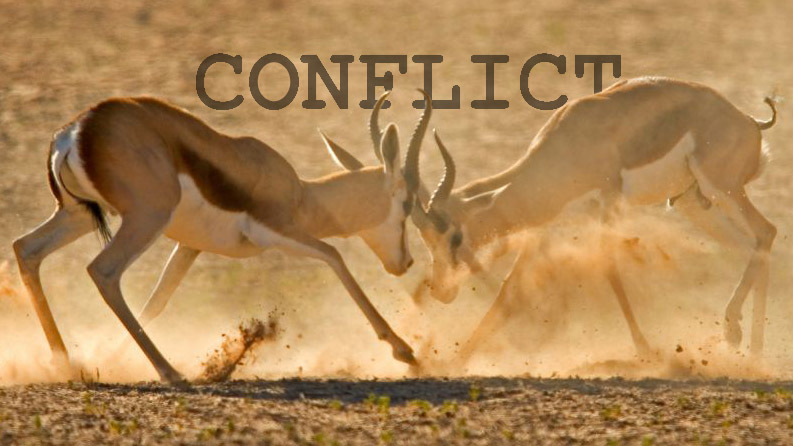
How Conflict Fuels Your Story

"Conflict is denying the character his or her goal." (Rebecca Talley)


According to blogger Francis Reid Roland (https://www.standoutbooks.com/5-essential-story-elements/) , each scene needs a main character.  Each main character needs a goal. Without a goal, without a villain or circumstance preventing the protagonist from reaching that goal, there is no conflict.  The reader wants to route for the protagonist to reach his goal. Give the reader what he wants.  

Ms. Roland recommends writing out each scene on an index card with three things:  a goal, a conflict (someone or something preventing the protagonist from reaching his goal) and a result (the regression or even disaster that ensues).  Lay the index cards out in order enabling you to see where in your story there is little or no conflict.  

Blogger Rebecca Talley lists seven types of conflict.  They are:

1.  person vs fate

The Odyssey is a good example of a book exemplifying this type of conflict.  Slaughterhouse Five, by Kurt Vonnegut is another example.

2.  person vs self

The protagonist is fighting against his own prejudices, doubts or inner conflict.  Koala Lou by Mem Fox is a good example of this conflict.  Shakespeare's Hamlet is another example of person vs. self. The Bell Jar by Sylvia Plath is yet another.

3.  person vs person

My Rotten Red Headed Older Brother by Patricia Polacco is one example.  The hero fights the villain in The Hundred Penny Box by Sharon Mathis.  The Nedley Papers by Scott Zibsendale is another example.

4.  person vs society

a.  triumph over corruption ex. Lewis R. Foster's The Gentleman from Montana (unpublished) which was adapted as the film Mr. Smith Goes to Washington.  Number the Stars by Lois Lowry is another example.

b.  reject society ex. Ray Bradbury's Fahrenheit 451

c.  succumb to corruption ex. George Orwell's 1984; Diary of Anne Frank; Suzanne Lieurance's The Lucky Baseball 

5.  person vs technology

The protagonist uses technology to gain power.  Technology becomes a bad influence on society as in Dr. Seuss' The Lorax.  Isaac Asimov's I, Robot is another example.  

6.  person vs nature

Robinson Crusoe features a family trapped on a desert island.  Moby Dick features a captain battling a whale.  Coyote Cry by Balor Byrd features the main character fighting a coyote.  Into Thin Air tells the story of a group of mountain climbers tackling Everest.

7.  person vs supernatural

Dr. Jekyll and Mr. Hyde is a good example of this type of conflict.

Layer the conflict into your story the way a scout layers his fire with twigs and brush.  Let the conflict fuel your story.  If you're lucky, a strong wind will pick up and before you know, you'll have a roaring fire -- the kind that everyone will pull up a chair and roast marshmallows at.


Sunday, 12 April 2015

Fall in Love with Your Characters

"Maybe the plot is the number one reason people keep reading, but characters essentially are what make them stay." 


"Good characters make you fall in love with a story.   Maybe the plot is the number one reason people keep reading, but characters essentially are what make them stay," according to blogger Tori (http://theweirdworder-awritersworld.blogspot.ca/2013/07/the-importance-of-characters.html). Picture books tend to have only a few, basic characters.  Chapter books have room for more characters and more character development.  Some chapter books are plot driven, like Harry Potter, while others are character driven, like Catcher in the Rye.

Characters create conflict and resolution in a story.  You want characters to bring your plot to life.  Start by giving your main character, or protagonist, a motivation or desire.  Roz Morris recommends:  "Make the character want something badly enough to step outside of his comfort zone," (https://www.writersandartists.co.uk/writers/advice/410/a-writers-toolkit/story-and-plot/).  The character should keep working towards his goal, even when things go from bad to worse.  

Get your readers emotionally involved with your characters.  "Until the writer reveals the character's humanity, he's just a name on a page," explains Roz Morris.  Reveal your character's history and relationships through his thoughts, feelings and actions.  Is your character static, like a brilliant detective or a cruel stepmother?  Or is he developping, a character who grows throughout the story? Ideally you want three dimensional characters rather than stereotypes.  

Do you have a villain or antagonist in your book?  An antagonist's interests oppose those of the protagonist.  However, a villain "intends evil", has different moral rules and brushes with the dark side, according to Roz Morris.  


                                http://www.best-childrens-books.com/picture-book-series.html


Picture Books with Well-Developped Characters

1.  Chrysanthemum (Kevin Henkes

2.  Thomas' Snowsuit (Michael Martchenko)

3.  Martha Speaks (Susan Medaugh)

4.  The Polar Express (Chris Van Allsburg)

5.  The Lemonade Club (Patricia Polacco)

6.  Harold and the Purple Crayon (Crockett Johnson)


Chapter Books

1.  Little House on the Prairie (Laura Ingalls Wilder)

2.  Flat Stanley (Jeff Brown)

3.  Amelia Bedelia (Peggy Parish)

4.  Stuart Little (E. B. White)

5.  Charlotte's Web (E. B. White)

6.  Big Nate (Lincoln Peirce)