Showing posts with label Stock Market Crash. Show all posts

Wednesday, 8 June 2016

Homer Watson

"There is at the bottom of each artistic conscience a love for the land of their birth." 
(Homer Watson)
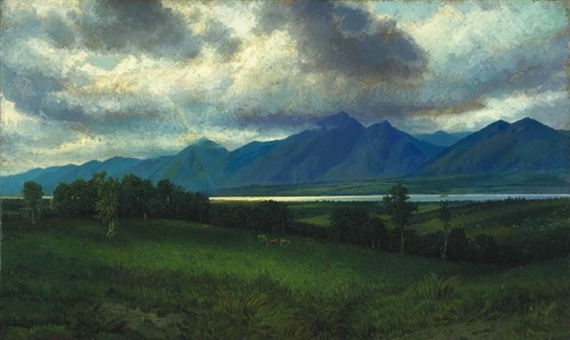


Dawn in the Laurentides courtesy https://en.wikipedia.org/wiki/Homer_Watson.


Homer Watson was given a set of paints by his aunt and decided to become a painter.  Decades later, Oscar Wilde nicknamed Watson the "Canadian Constable", comparing him to the great English landscape artist.

Homer Watson was born in Doon, Ontario (now Kitchener) in 1855.  He showed an interest in art from an early age.  Later moving to Toronto, he copied works from the Toronto Normal School, but was mainly self-taught.  In 1876, Watson moved to New York where he was influenced by the Hudson River School.  He painted along the banks of the Hudson and Susquehanna Rivers.  In 1880, he painted The Old Mill and sold it to the Marquis of Lorne for Queen Victoria's art collection.

The same year Watson married and bought a house in Doon, near the banks of the Grand, which he featured in his newest paintings. In 1887, he moved to England for four years where he painted his most famous piece The Flood Gate.  Watson maintained:  "There is at the bottom of each artistic conscience a love for the land of their birth."  In his later years, Watson campaigned for the preservation of the Waterloo woodlands which he had so lovingly painted.  The Stock Market Crash of 1929 forced him to sell many of his paintings.

In 2005, Canada Post honoured Homer Watson by issuing two stamps, Dawn in the Laurentides and The Flood Gate.  Today, Watson's Doon home has been transformed into a museum, filled with his paintings.


Monday, 23 May 2016

The Dust Bowl


Abandoned farm north of Dalhart, Texas circa 1938 courtesy http://www.pbs.org/kenburns/dustbowl/photos/.


John Steinbeck wrote books about it.  Dorothy Lange photographed it.  Woody Guthrie wrote ballads about it.  It was the Great American Dust Bowl.  In the 1930's, the American west was struck by Black Blizzards. Dust choked people's lungs and blinded their eyes.  It invaded people's houses and destroyed their crops. It stopped automobiles and derailed freight trains.   The resulting drought drove tens of thousands of families from their farms.  You can read about the Dirty Thirties in Don Brown's picture book The Great American Dust Bowl (https://www.amazon.ca/Great-American-Dust-Bowl/dp/0547815506).

Famous photo by Dorothea Lange courtesy http://www.pbs.org/kenburns/dustbowl/photos/.


Ken Burns "The Dust Bowl chronicles the worst man made ecological disaster in American history in which the frenzied Wheat Boom of the Great Plow Up, followed by a decade long drought during the 1930's nearly swept away the breadbasket of the nation" (http://www.pbs.org/kenburns/dustbowl/about/overview/).  


At the turn of the last century, European immigrants, as well as Americans, settled the Great Plains, a grasslands area that had not previously been farmed.  In the 1920's, these farmers enjoyed a wheat boom thanks to advanced technology and the thriving economy in the United States.  However, prices plummeted after the Stock Market Crash of 1929.  Rather than harvesting less wheat, farmers harvested more in an attempt to counteract the effects of the Great Depression.  Fields were left exposed and vulnerable to drought, which hit in 1932 (http://www.livinghistoryfarm.org/farminginthe30s/water_01.html).


Panic sets in on Wall Street in New York City after Stock Market Crash of 1929 courtesy 


The previously fertile soil turned into dirt.  The wind stirred it up and it accumulated into massive clouds called "black blizzards" (http://alinefromlinda.blogspot.ca/2012/05/black-blizzard.html). The dust lodged itself in people's homes and in their lungs.  Many developped "dust pneumonia".  No longer able to farm, they joined the mass exodus of Okies headed to California to pick fruit, a journey so aptly illustrated by Steinbeck in his novel The Grapes of Wrath (http://alinefromlinda.blogspot.ca/2015/11/tom-joads-ill-be-there-speech.html).


Black Blizzard approaches Elkhart, Kansas circa 1937 courtesy https://prairieskies.files.wordpress.com/2011/07/31.jpg.

Ken Burns says that The Dust Bowl is also a story of perseverance. Burns interviewed 26 survivors and shared their stories.  His documentary chronicles the families who struggled to hold onto their land, New Deal programs which kept families afloat, and attempts by government and farmers to develop new strategies of farming and land conservation (http://americanhistory.about.com/od/greatdepression/tp/new_deal_programs.htm).


FDR talks to farmer and his son circa 1936 courtesy http://www.pbs.org/kenburns/dustbowl/photos/.