Showing posts with label Pearl Harbor. Show all posts

Sunday, 9 October 2016

The Four Freedoms

"As men do not live by bread alone, they do not fight by armaments alone." (Franklin D. Roosevelt)


In January of 1941, President Franklin D. Roosevelt delivered a State of the Union Address called The Four Freedoms.  The world was at war and President Roosevelt was drafting his Lend Lease bill which would help the Allies in their fight against the Nazis.  

"Every realist knows that the democratic way of life is at this moment being directly assailed in every part of the world... the need of the moment is that our actions and our policy should be devoted primarily -- almost exclusively -- to meeting this foreign peril..." (https://en.wikipedia.org/wiki/Four_Freedoms)

While Roosevelt was convinced that the world needed America's help, Congress was not convinced. As the war raged on in Europe, America held an isolationist stance.  Anti-war advocates argued that Roosevelt's Four Freedom's message was just rhetoric to prop up his New Deal reforms.  


Freedom of Speech.jpg


Congress remained unconvinced until December 7, 1941, when the Japanese attacked Pearl Harbor and decimated the United States naval fleet.  The following day, President Roosevelt made his famous speech to Congress "A Date Which Will Live in Infamy". (http://alinefromlinda.blogspot.ca/2015/11/franklin-d-roosevelts-great-arsenal-of.html)


"With confidence in our armed forces, with the unbounding determination of our people we will gain the inevitable triumph, so help us God.  I ask that Congress declare that since the unprovoked and dastardly attack by Japan on Sunday, December 7, 1941, a state of war has existed between the United States and the Japanese empire."
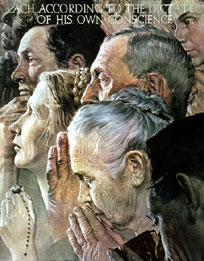


The Four Freedoms were warmly received by the American public.  The Four Freedoms Monument, commissioned by President Roosevelt and sculpted by Walter Russell, was erected before Pearl Harbor.  It was commissioned at Madison Square Garden in 1943.  The Four Freedoms were encapsulated in the minds of Americans by Norman Rockwell series of paintings by the same name, published in the Saturday Evening Post in 1943.


  A large family gathered at a table for a holiday meal as the Turkey arrives at the table.


Sunday, 31 July 2016

Eleanor Roosevelt: My Day Column Addresses the Nation


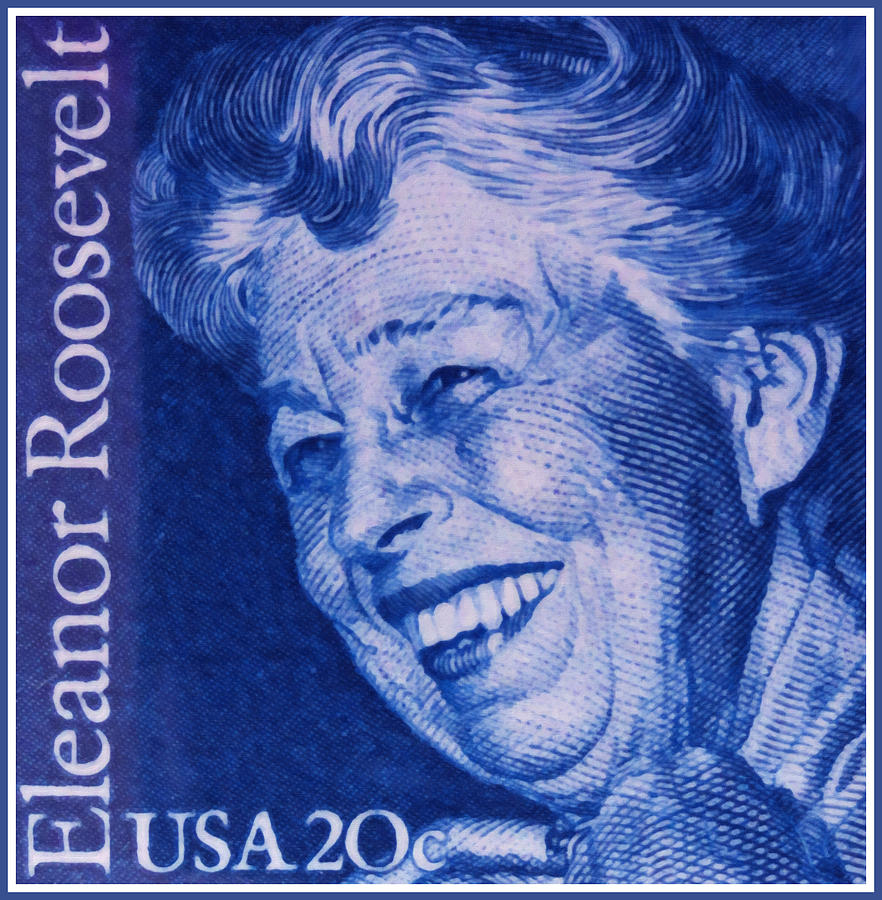
Eleanor Roosevelt stamp courtesy 


Just as her husband, President Franklin D. Roosevelt, calmed the nation with his fireside chats in the midst of the Second World War, Eleanor Roosevelt calmed the nation with her wise advice laid out in her column "My Day".  Six days a week, from 1935 to 1962, Eleanor Roosevelt typed the column on her typewriter, reaching millions of readers across America.  At the height of its popularity, "My Day" appeared in over 90 papers nation wide.


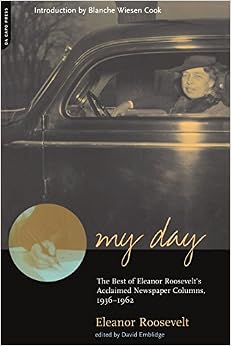
My Day:  The Best of Eleanor Roosevelt's Acclaimed Newspaper Columns, 1936 to 1962 courtesy https://www.amazon.com/Day-Roosevelts-Acclaimed-Newspaper-1936-1962/dp/0306810107.

In June of 1943, the First Lady tackled controversial issues like Civil Rights, commenting:  By the 1940's, Detroit already had a history of racial conflict.  Race riots had occurred in 1863 and as recently as 1941.  By the 1920's the city had become a stronghold of the Ku Klux Klan...The industrial plants provided jobs but no housing.  White communities militantly guarded the dividing lines imposed by segregation throughout Detroit's history.  As a result, the city's 200,000 black residents were cramped into 60 square blocks on the East Side and forced to live under deplorable sanitary conditions.  Ironically, the ghetto was called Paradise Valley."


On July 14, 1939, Eleanor Roosevelt expressed her views on Prohibition, stating:  "I was one of those who was very happy when the original prohibition amendment passed...But I came gradually to see that laws are only observed with the consent of the individuals..."


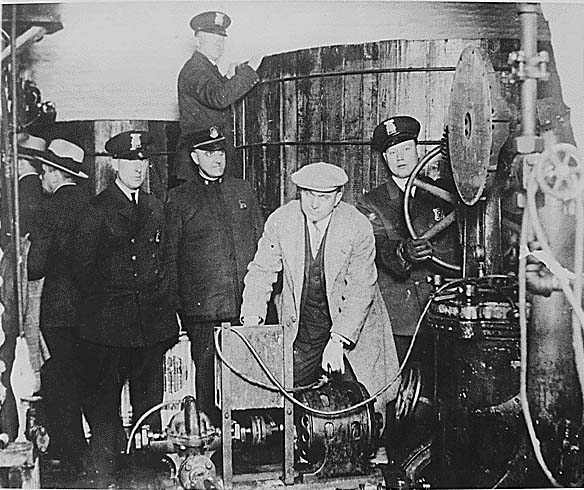
Detroit Police inspect a brewery during Prohibition courtesy https://en.wikipedia.org/wiki/Prohibition_in_the_United_States.

On December 8, 1941, the First Lady, reeling from the attack on Pearl Harbor, commented:  "The clouds of uncertainty and anxiety have been hanging over us for a long time.  The work for those who are at home seems to me to be obvious.  First, to do our own job, whatever it is, as well as we can possibly do it.  Second, to add to it, everything we can do in the way of civilian defense.  Now, at last. every community must go to work to build up protection from attack."


President Roosevelt's "A Date That Will Live Infamy" Speech courtesy http://likesuccess.com/52034.


On October 29, 1947, regarding HUAC (The House on Un-American Activites Committee) investigating Hollywood, Eleanor Roosevelt said:  "One thing is for sure -- none of the arts flourishes under censorship and repression.  And by this time it should be evident that the American public is capable of doing its own censoring.  Certainly, the Thomas Committee is growing more ludicrous daily.  The picture of six officers ejecting a writer from the witness stand because he refused to say whether he is a Communist or not is pretty funny and I think before long we are all going to see how hysterical and foolish we have become."


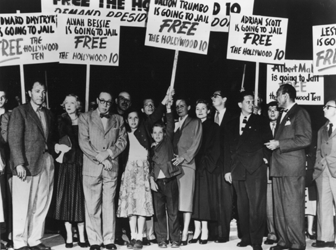
Protesters march against impending incarceration of the Hollywood Ten circa 1950 courtesy https://en.wikipedia.org/wiki/Hollywood_blacklist.


During the Second World War, the First Lady, a champion of childhood literacy, "urged parents to read aloud to their children as a way of bolstering family morale and maintaining an atmosphere of normality on the home front."  The advent of Little Golden books helped this come to fruition (see How a Poky Puppy Brought the Picture Book to the Masses at http://alinefromlinda.blogspot.ca/2013/07/how-poky-puppy-brought-picture-book-to.html).


Golden Legacy courtesy 

Monday, 11 July 2016

Washington's Cherry Blossoms


The roots of the cherry tree orchard that lines Washington's Tidal Basin at Potomac Park go back to American Eliza Scidmore.  She had visited Japan back in 1885 and suggested that Washington DC plant some cherry trees along the Tidal Basin, but her idea was rejected for 25 years straight.  Finally, Mrs. Scidmore raised the funds to donate the cherry trees herself, writing a letter to Mrs Taft in 1909 stating her intentions.  A visiting Japanese chemist named Jokichi Takamine happened to be visiting Washington DC and heard about Mrs. Scidmore's plan and offered to donate an extra 2000 trees in the name of the city of Tokyo.

The cherry trees arrived in January 1910, but they were infested with insects and subsequently were burned.  Not to be deterred, the city of Tokyo sent an addtional 3020 cherry trees, of a different variety, shipping them to Seattle on the Awa Maru and then by railcar to Washington DC.  On March 27, 1912, First Lady Helen Taft stood side by side with the wife of the Japanese Ambassador to plant two of these cherry trees in West Potomac Park.  From 1913 to 1920, 1800 of these donated trees were planted along Washington DC's Tidal Basin.  The remaining trees were planted in East Potomac Park.  In 1935 the first Cherry Blossom Festival was held.

Four days after the Japanese attack on Pearl Harbor in 1941, four of the cherry trees were chopped down by an unknown person, probably as a statement against the attack.  The Cherry Blossom Festival was suspended during World War II not to be resumed until 1947.  The city of Tokyo donated an additional 3800 cherry trees, of the Yoshimo variety in 1965 and Lady Bird Johnson planted one in a ceremony at the White House.

In 1915, as a sign of appreciation, the United States gave some flowering dogwood trees to Japan.  To celebrate the centennial of this gift, the U.S. Post Office issued the stamp "Gifts of Friendship".


Gifts of Friendship U.S. Stamp courtesy 


Thursday, 26 May 2016

The Roosevelts: An Intimate History

"Between them Theodore and Franklin Roosevelt for nineteen of the first forty-five years of the twentieth century, years during which much of the modern world -- and the modern state -- was created." (Ken Burns)


No other American family has touched more lives than the Roosevelt's.  Theodore and Franklin Roosevelt shared a common love for politics and people.  They shared a common courage in the face of fear and perseverance in the face of adversity.  They also shared a common relative, Eleanor Roosevelt.


Ken Burns series The Roosevelts:  An Intimate History courtesy http://www.weta.org/tv/program/roosevelts-intimate-history.


Theodore Roosevelt, the 26th President of the United States, had his finger on the pulse of America.  He was a Populist, concerned about the farmers, about grassroots America.  He was also concerned about nature, making a pilgrimage to Yellowstone, the first of America's National Parks.  Theodore Roosevelt was fearless.  While delivering a political speech on one occasion, an assassin shot him. The bullet lodged within a quarter inch of his heart.  However, Theodore insisted on delivering the speech, which lasted a full hour.  Only then did he let his attendants take him to the hospital.


Speed reader Theodore Roosevelt used to read a book a day courtesy


Theodore's fifth cousin, Franklin Roosevelt, became the 32nd President of the United States.  While Theodore was a Republican, Franklin was a Democrat.  The two shared much in common.  Both were fearless.  After contracting polio at Campobello Island at the age of 39, Franklin insisted on learning how to "walk" again using braces and crutches.  Suffering immense pain, he would practise standing so he could deliver a speech, determined to make a political comeback.  Franklin campaigned in every county of New York State in his bid for governor.  Later he ran an extensive presidential campaign.  No stranger to pain and suffering, it was Franklin who led the nation through the Great Depression, building moral through his fireside radio chats.  It was Franklin who delivered the famous "Today will live in infamy speech" after the Pearl Harbor attack. 


A young FDR courtesy 

Franklin married Eleanor Roosevelt, Theodore's niece.  The couple raised five children.  Eleanor, always supportive of her husband's political career, helped him campaign.  More than any other First Lady, she worked diligently to promote her husband's career.  Eleanor wrote a column in a daily newspaper.  She promoted childhood literacy.  She furthered the cause of Black Americans.  And long after her husband passed away, Eleanor was still working.


Friday, 20 May 2016

The War

"Only the soldier really lives the war." (Eric Sevareid)


It is hard to imagine the scope of a war that took 50 to 60 million lives including 400,000 Americans. It touched every corner of the globe.  During the 1940's, everyone was affected by the Second World War.


Ken Burns studies the effects that "the greatest cataclysm in human history" had on residents of these four cities: Mobile, Alabama.  Sacramento, California. Waterbury, Connecticut.  Luverne, Minnesota.  The series is an attempt to explain "the things men do in war and the things war does to men" (https://www.pbs.org/thewar/about_letter_from_producers.htm)

Resident expert Geoffrey Ward wrote the script for Ken Burns series The War and provides much of the commentary.  The War series is divided into seven episodes:

Episode One:  A Necessary War
Episode Two:  When Things Get Tough
Episode Three:  A Deadly Calling
Episode Four:  Pride of Our Nation
Episode Five:  FUBAR
Episode Six:  The Ghost Front
Episode Seven:  A World Without War 


Monday, 9 May 2016

Empire of the Air: The Romance of Radio

"Sound itself attracts -- ask any eavesdropper.  Sound is the first stirring of the infant.  He hears sound -- he puts them together -- they cohere.  Sounds have a romance.  The sound of a cricket at night to establish a mood in a radio drama:  a very simple effect.  The sound of thunder.  The sound of rain.  There is no sound on the moon because it takes air to support it; the vibrations of air create the sound.  And radio was a medium which employed that magic." (Norman Corwin)


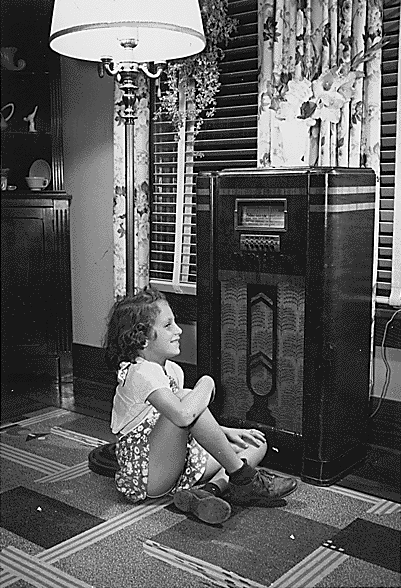
An American girl listening to the radio circa 1937 courtesy 


Long before televisions filled American parlours, the radio was the centre piece for the living room. For fifty years,  radio was the dominant medium.  As CBS radio director and producer Norman Corwin explained:  "There was a kind of romance to radio that has not been extended by its successor medium, television.  The listener was a blind audience, and he collaborated with what he heard.  He could construct the sets, and dress the cast in his own mind and fill in the gaps.  Radio was to a marked degree the medium for poetry and heightened language." (http://www.pbs.org/kenburns/empire/radio/)


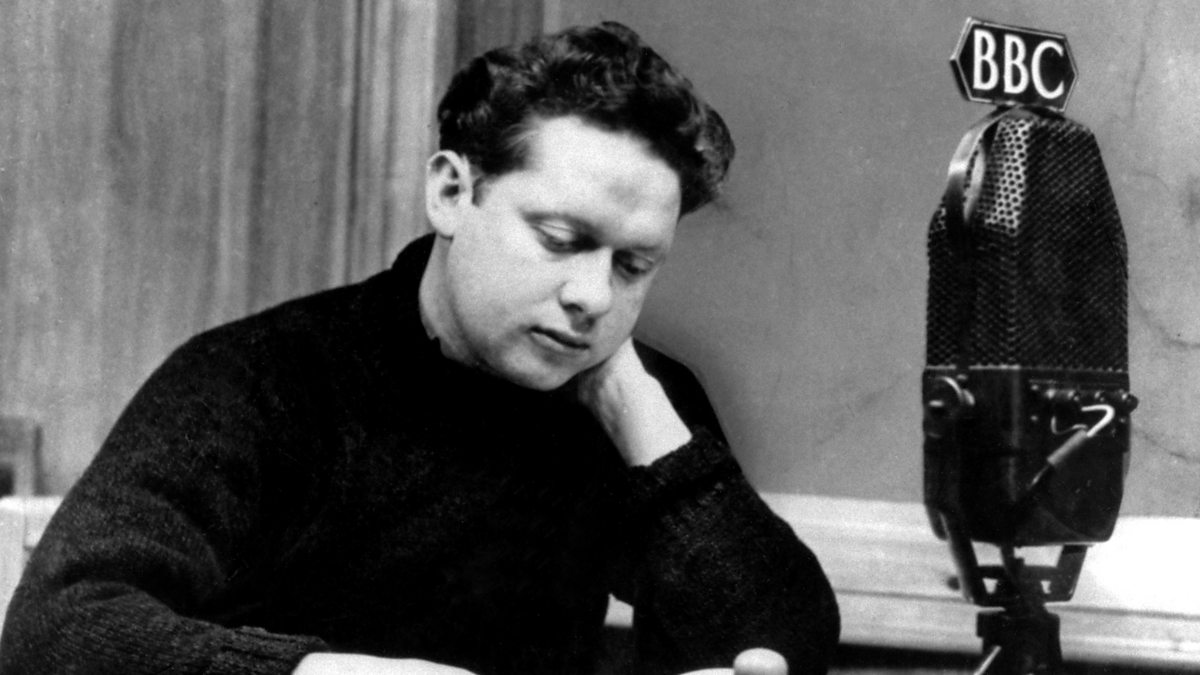
Dylan Thomas' reciting his poetry circa 1940's or 1950's courtesy http://www.bbc.co.uk/programmes/profiles/1m22kf8TT3jJqjyww5LPWpD/on-radio

Ken Burns points out that radio had "a way of bringing people together -- through language, politics, music, news, literature, drama and humour".  Whether it was Franklin D. Roosevelt's fire side chats during the Great Depression, or Bing Crosby's Radio Hour of the 1940's or CBC's Hockey Night in Canada (north of the border), much of the nation had its ears glued to that cathedral like contraption, hanging on every word, united in a common interest.  Here are some monumental events broadcast live via radio:

  • wireless distress signals save many lives on the sinking Titanic in 1912
  • Charles Lindbergh's return from Paris after his trans-Atlantic flight in 1927
  • Orson Welles' War of the Worlds sci-fi broadcast convinces many Americans that New Jersey is truly being invaded by aliens in 1938
  • President Franklin D. Roosevelt delivers his speech after Pearl Harbor attack in 1941

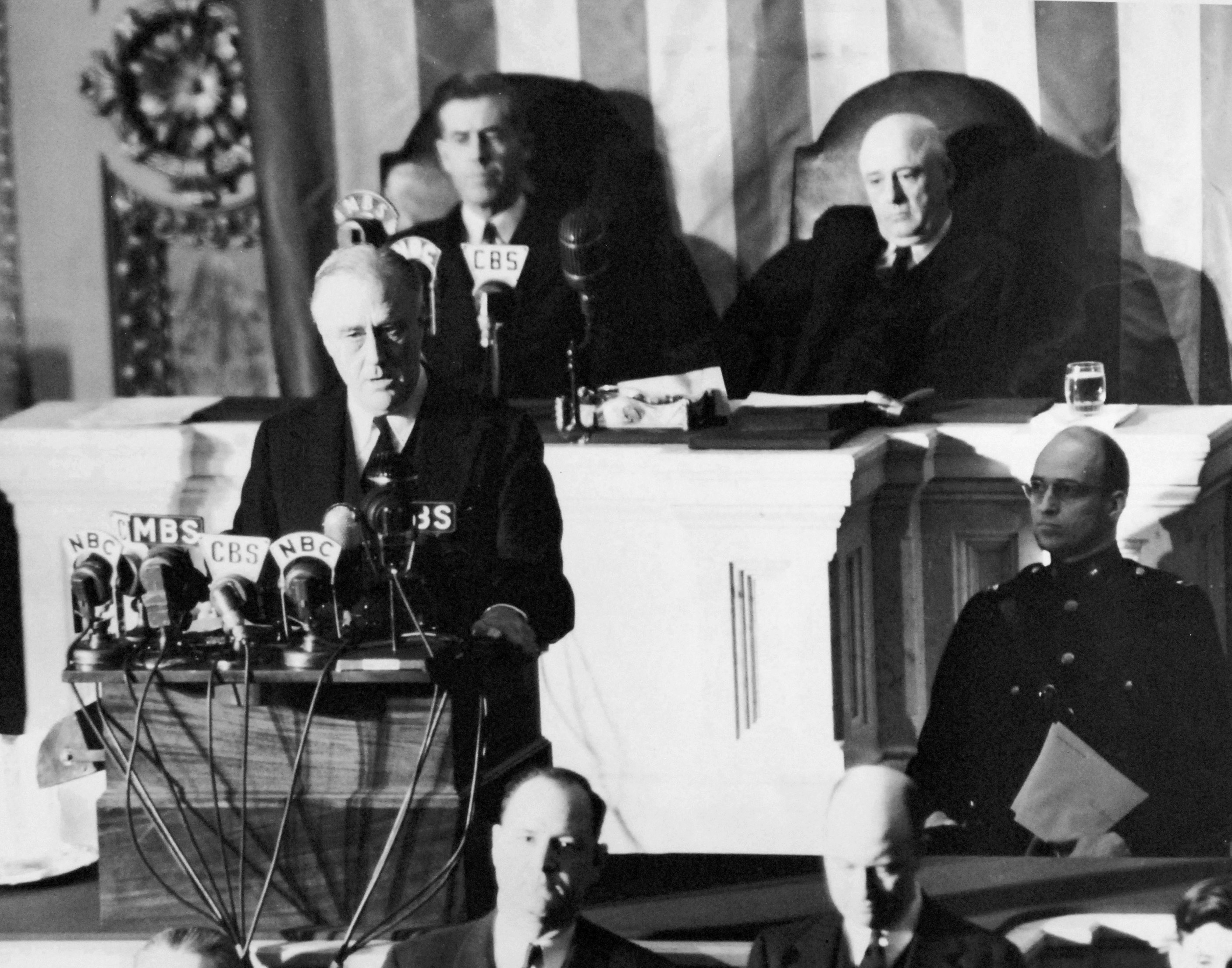
Franklin D. Roosevelt's "A Day Which Will Live in Infamy" speech circa December 8, 1941 courtesy https://en.wikipedia.org/wiki/Infamy_Speech.


In his documentary, Empire of the Air:  The Men Who Made Radio, Ken Burns focusses on three pioneers in the field of radio:  Lee DeForest, Edwin Armstrong and David Sarnoff.  Lee DeForest, a clergyman's flamboyant son, invented the audion tube and formed the wireless telegraph company in 1902.  Edwin Armstrong, a brilliant inventor, pioneered FM technology.  David Sarnoff, a hard driving Russian immigrant, created the most powerful communications company on earth.


David Sarnoff, the Father of Broadcasting, circa 1930's 


"By 1950, there were 90 million radio sets in American homes.  There were also 10 million examples of a new medium:  "As for the picture box that kicked the radio out of the parlor (and into such remote niches as the basement, garage, shower, car, jogging path, virtually everywhere but the living room), Corwin says 'television has a far greater hold on the person who wants to sit and have things come to him pre-digested...There were no couch-potatoes in radio." (http://www.pbs.org/kenburns/empire/radio/) 


For a clip from Ken Burns' documentary, Empire of the Air;  The Men Who Made Radio, visit http://www.pbs.org/kenburns/empire/film/.

For more information, read Tom Lewis' book Empire of the Air:  The Men Who Made Radio (1991).


Tuesday, 10 November 2015

Franklin D. Roosevelt's The Great Arsenal of Democracy

"No man can tame a tiger into a kitten by stroking it." (Franklin D. Roosevelt)


By December of 1940, when the world was at war, President Roosevelt had already delivered dozens of fireside chats.  This speech however was different.  He talked about a world crisis and how the United States would have to be courageous and realistic.  He talked about the alliance of the Soviet Union, Germany and Japan.  He reminded the American people that they could not bury their heads in the sand.  The president pointed out that a hundred years before, the Monroe Doctrine had been drafted in response to another European alliance that threatened the existence of the United States.

"Let us not blind ourselves to the fact that the very forces which have crushed, undermined and corrupted so many others are already within our gates."  The President pointed out that some thought the United States was safe even if Britain fell.  However, the Atlantic Ocean was no longer the obstacle it once was.  Planes could fly from the British Isles to New England and back without refueling.  

President Roosevelt condemned Nazi Germany for its tyranny over Europe.  He said that a dictatorship like Germany could not reconcile itself with a democracy.  He called on America:  "We must be the great arsenal of democracy."  Here is an excerpt from President Roosevelt's speech:

"The experience of the past two years has proven beyond doubt that no nation can appease the Nazis.  No man can tame a tiger into a kitten by stroking it.  There can be no appeasement with ruthlessness.  There can be no reasoning with an incendiary bomb.  We know now that a nation can have peace with the Nazis only at the price of total surrender.  Even the people of Italy have been forced to become accomplices of the Nazis; but at this moment they do not know how soon they will be embraced to death by their allies."  

President Roosevelt's words were prophetic.  On December 7, 1941, Pearl Harbor was bombed by the Japanese and the United States finally entered the Second World War.  In October of 1943, Italy was "embraced to death" by Germany and switched sides in the war.


Sunday, 1 November 2015

President Barack Obama's "This is Your Victory"

Two hundred and forty thousand people assembled in Chicago's Grant Park to hear Barack Obama deliver his victory speech after the 2008 election.  He would not be the first president to hail from Chicago (Lincoln preceded him), he would not be the first youthful president (remember JFK?) but he would be America's first black President.  Here is an excerpt from the brilliant speech that he delivered on that fateful night:

"This election had many firsts and many stories that will be told for generations.  But one that's on my mind tonight's about a woman who cast her ballot in Atlanta.  She's a lot like millions of others who stood in line to make their voice heard in this election except for one thing:  Ann Nixon Cooper is 106 years old.  

She was born just a generation past slavery; a time when there were no cars on the road or planes in the sky; when someone like her couldn't vote for two reasons -- because she was a woman and because of the color of her skin.  

And tonight I think about all she's seen throughout her century in America -- the heartache and the hope; the struggle and the progress; the times we were told that we can't; and the people that pressed on with that American creed:  Yes we can.

At a time when women's voices were silenced and their hopes dismissed, she lived to see them stand up and speak out and reach for the ballot.  Yes we can.

When there was despair in the dust bowl and depression across the land, she saw a nation conquer fear itself with a New Deal, new jobs, a new sense of common purpose.  Yes we can.

When the bombs fell on our harbor and tyranny threatened the world, she was there to witness a generation rise to greatness and a democracy was saved.  Yes we can.

She was there for the buses in Montgomery, the hoses in Birmingham, a bridge in Selma, and a preacher from Atlanta who told a people that We Shall Overcome.  Yes we can.

A man touched down on the moon, a wall came down in Berlin, a world was connected by our own science and imagination.  

And this year, in this election, she touched her finger to a screen, and cast her vote after 106 years in America, through the best of times and the darkest of hours, she knows how America can change.

Yes we can.

America, we have come so far.  We have seen so much.  But there is so much more to do.  So tonight, let us ask ourselves -- if our children should live to see the next century; if my daughters should be so lucky to live as long as Ann Nixon Cooper, what change will they see?  What progress will we have made?

This is our chance to answer that call.  This is our moment."

(https://au.lifestyle.yahoo.com/marie-claire/news-and-views/latest/a/18672507/the-most-inspirational-speeches-of-all-time/)


Monday, 28 September 2015

Dear Miss Breed Letters Shed Light on Japanese Internment Camp

"I was overwhelmed with joy to hear from you."
(Japanese-American internee)


Clara Estelle Breed, city librarian at the East San Diego Library, took a liking to the Japanese-American children who borrowed books.  Every week, they frequented the library, smiles on their faces.  But that all changed after Pearl Harbor.  In 1942, after President Roosevelt announced the interment of 120,000 Japanese Americans, the faces of these children became sullen.  Miss Breed decided to make a difference.

On the day that the San Francisco children accompanied their parents to the train station to travel to the camp, Miss Breed was there.  She handed out stamped, addressed postcards and asked the children to write to her about life in the camp.  Dozens of children took her up on the offer.  She received 250 letters, including one that opened:  "I was overwhelmed with joy to hear from you."  The letter continued:  "Now to answer [your questions] -- yes, we do have chairs and tables.  Father made them out of scraps of wood...But we do not have mattresses.  We use some our blankets as mattresses." (http://www.janm.org/exhibits/breed/title.htm)

The librarian was determined to make life more pleasant for the Japanese-American internees.  She visited the children in the camp, loaded down with reading materials and personal items like soap and toothpaste.  In 1943, Miss Breed also wrote articles protesting the treatment of the Japanese Americans, including "All But Blind" in the Library Journal, and "Americans With the Wrong Ancestors" in the Hornbook Magazine.

Miss Breed passed her collection of letters on to one of her former penpals, Elizabeth Yamada, who in turn donated the letters to the Japanese American National Museum.  

Note:  For more information, read Joanne Oppenheim's book Dear Miss Breed.


Monday, 21 September 2015

When FDR Said "Play Ball"

"Here is another way of looking at it -- if 300 teams use 5,000 or 6,000 players, these players are a definite recreational asset to at least 20,000,000 of their fellow citizens -- and that in my judgement is thoroughly worthwhile." (Franklin D. Roosevelt)


In the months following the attack on Pearl Harbor, America was focussed on battling the Japanese. Few had the time to think about sports.  The 1940 Olympics had been cancelled.  Why not cancel baseball as well?  Spring training was just around the corner.  The baseball commissioner Landis wanted to know if the season would go ahead or not.  It would be up to the President.

As a young lawyer in New York City, Franklin D. Roosevelt used to sneak off to Giants games at the Polo Grounds.  As President, he made a record eight opening day appearances.  So when the rubber hit the road, his love of baseball took precedence.  Roosevelt pointed out that healthy young men were needed for the service.  However, once that need was filled, the remaining players could lace up their cleats once again.

Roosevelt said that the baseball industry could employ many Americans.  He reminded the commissioner that baseball was relatively inexpensive to watch (at the time).

Above all, baseball could serve as a moral booster for Americans during the dark days of the war.  "I honestly feel that it would be best for the country to keep baseball going."  The President announced "Play ball" and the 1942 season went ahead as planned.  Once again, Roosevelt had his pulse on the heart of the American people.  And he gave them what they wanted. 


FDR throws out the opening pitch in Washington DC circa 1934 courtesy https://www.archives.gov/publications/prologue/2002/spring/greenlight.html.