Showing posts with label German POWs. Show all posts

Friday, 25 March 2016

Moscow's Capture Imminent: Wehrmacht Within Sight of Spires of the Kremlin

"The Germans were not equipped for winter warfare, and the bitter cold caused severe problems for their guns and equipment.  Furthermore, weather conditions grounded the Luftwaffe from conducting any large scale operations." (https://en.wikipedia.org/wiki/Operation_Barbarossa#Phase_two)


There were 60,000 of them.  They marched 20 abreast.  They wore soiled uniforms and sober expressions.  Their parade took hours to complete.  Russian soldiers marched on either side of their column, armed with bayonet rifles.  In Moscow, spectators spit on them as they passed by.  How had the Wehrmacht, an army which goose stepped across Europe in the first part of the war, been forced to surrender?


When Hitler commenced Operation Barbarossa, the Wehrmacht waltzed into the Soviet Union and occupied republic after republic:  the Baltic states, the Ukraine, Moldavia and Belorussia.  They seemed to be racing towards Moscow uninhibited.

By September of 1941, Hitler announced Operation Typhoon, the drive towards Moscow.  The Wehrmacht occupied Leningrad where they commenced a two and half year long siege, starving the city into submission.  An early battle took 500,000 Soviet prisoners, bringing the total to 3 million.  The Soviet Union had a mere 90,000 men and 150 tanks to defend Moscow.  The German government announced the imminent capture of Moscow and the collapse of the Soviet Union.

On December 2, 1941, the German troops were within 15 miles of Moscow.  They could see the spires of the Kremlin.  This is where Mother Nature intervened:  the first blizzards had already begun.  Dressed in the same military uniforms as the troops in North Africa, the German troops struggled.  "The Germans were not equipped for winter warfare, and the bitter cold caused severe problems for their guns and equipment.  Furthermore, weather conditions grounded the Luftwaffe from conducting any large scale operations." 

In the meantime, newly created Soviet units, numbering 500,000 men, launched a counter attack on December 5.  By the end of 1941, the Germans had lost the Battle of Moscow.  Casualties numbered 830,000, many of whom were POWs.  

In July 1942, Hitler commenced Case Blue, an attempt to capture Russia's oilfields.  Once again, the German Army conquered huge areas of the Soviet Union.  However, their advance came to a halt with the Battle of Stalingrad in February of 1943.  

In June of 1943, Stalin commenced Operation Bagration which ended in August of 1944 with a decisive victory for the Russians.  The German advance had finally come to an end.  Millions were captured and sent to Soviet labour camps.  The surviving soldiers made a hasty retreat out of Russia, their army decimated, their air force non existent, their horses starving.  


German POWs march in Moscow after Operation Bagration in Belarus circa July 1944 courtesy http://rarehistoricalphotos.com/german-prisoners-march-moscow-defeat-belarus-operation-bagration-17-july-1944/.


Tuesday, 22 March 2016

The Barbarisation of Warfare on the Eastern Front

"The nature of the dictatorships determined the savage character of the conflict" http://www.bbc.co.uk/history/worldwars/wwtwo/soviet_german_war_01.shtml


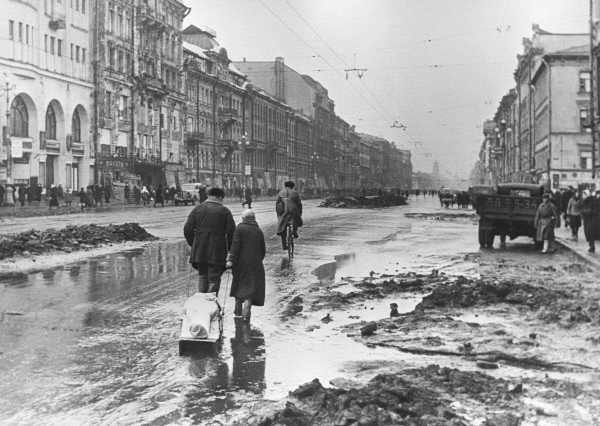
Leningraders during the Siege circa https://en.wikipedia.org/wiki/Siege_of_Leningrad.


My husband's Opa Jonasson fought in the trenches of France in the First World War where he was taken prisoner of war by the British.  Even though he was held captive for about a year, he maintained a certain degree of respect for the British.  He always said that he and his fellow Germans were treated with a certain degree of dignity.  He never forgot that.

The same could not be said of the war between the Germans and the Russians during the Second World War.  Professor Overy explains:  "The so called barbarisation of war has a number of explanations.  Conditions were harsh for both sides, and losses were high.  German forces entered the USSR with instructions from Hitler's headquarters to use the most brutal methods to keep control and to murder Communist commissars and Jews in the service of the Soviet state." (http://www.bbc.co.uk/history/worldwars/wwtwo/soviet_german_war_01.shtml)

From the beginning, Hitler preached that the Russians were "untermensch" (subhuman).  This was evident in the way the Germans treated the citizens of Leningrad.  The Siege of Leningrad, which lasted from September of 1941 to January of 1944, will never be forgotten by Russians.  The 842 -day seige caused the largest loss of life in modern history:  one and one half million soldiers and civilians were killed or starved to death.  Another 1.4 million Leningraders, mainly women and children, were evacuated, many of whom died of starvation or bombardment.  Others died from exposure to the frigid -30C temperatures that first winter.

The Siege, along with other barbarities committed by the Germany Army, stirred up journalists like Ilya Ehrenburg who preached:  "We shall kill.  If you have not killed at least one German a day...you have wasted that day.  Do not count days...do not count miles.  Count only the number of Germans you have killed."  Ehrenburg dehumanized the enemy.

It is no surprise then that when the Russians invaded Germany in late 1944, they did so with hatred in their hearts and revenge on their minds.  Rolling over the hills of East Prussia, they pillaged houses, burned crops, and raped German women en masse.

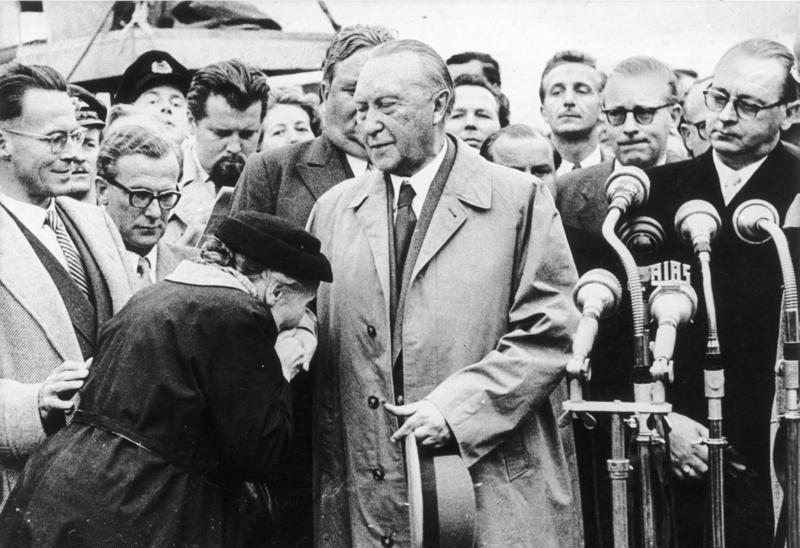
The barbarisation continued even after the Second World War ended on May 8, 1945.  While the British, Canadians and Americans released all prisoners of war by 1947, the Russians were not ready to bury the hatchet.  Many German POWs were not sent home from the Soviet Union until 1956, more than a full decade after the war's end, some so emaciated they were unrecognizable.


Grateful mother thanks Konrad Adenauer for his role in the release of her son, one of 15,000 German POWs freed by the Soviets in 1955 courtesy  https://en.wikipedia.org/wiki/German_prisoners_of_war_in_the_Soviet_Union.