Showing posts with label Cretaceous Period. Show all posts

Saturday, 11 March 2017

Are There Really No Snakes in Ireland?


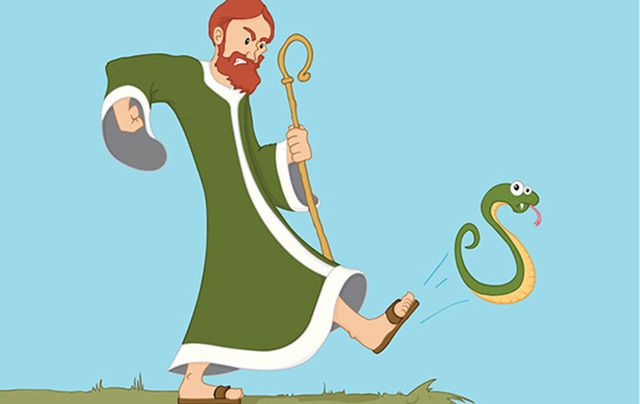
Legend has it that St. Patrick drove the snakes out of Ireland in the 5th Century.  While it is true that Ireland has no snakes it is for geographical, not human, reasons.  When the snake evolved about 100 million years ago, during the late Cretaceous period, Ireland was completed submerged under water. During the Cenozoic Era, about 65 million years ago, the world started to dry out and vast grasslands dominated the Northern Hemisphere.

Predecessors to the cobras and pythons first appeared 50 million years ago while modern day cobras and pythons appeared 25 million years ago.  Today, snakes are found everywhere but Ireland, New Zealand, Greenland, Iceland and Antarctica.  Serpents haven't figured out how to migrate across the ocean to a new home.  While land bridges formed over past millennia, snakes would have frozen during the Ice Age.

How did the myth of St. Patrick and the snakes evolve?  In Christian cultures, snakes have always symbolized paganism starting with the serpent that tempted Eve in the Garden of Eden.  Therefore, St. Patrick, who helped convert many pagans to Christianity in Ireland, would be a likely candidate to banish the snakes.

Source:  http://www.rte.ie/tv/scope/SCOPE4_show03_snakes.html


Tuesday, 21 June 2016

Dinosaur Provincial Park

While the United States is known for its badlands, Canada has its share of beautiful topography, located in southern Alberta.  Opened in 1955 to celebrate the 50th anniversary of Alberta, Dinosaur Provincial Park is home to at least 40 dinosaur species and 500 specimens, exhibited all over the world.  Due to the precious fossils found in the park, it was designated a World Heritage Site in 1979.

The diverse collection of dinosaur bones at the park, part of the late Cretaceous period, include:  ceratopsia, hadrosauridae, ankylosauria, hypsilophodontidae, pachycelphalosauria, tyrannosauridae, ornithomimidae, caenagnathidae, dromaeosauridae, and troodontidae.  Previous to 1985, exhibits of these fossils could be found at the Toronto's Royal Agricultural Museum, Ottawa's Canadian Museum of Nature, and the New York City's American Museum of Natural History.  Today, the exhibits are displayed at Drumheller's Royal Tyrrell Museum of Palaeontology.

Dinosaur Provincial Park, located only two and a half hours southeast of Calgary, supports three ecosystems:  badlands, prairie grasslands and riverside cottonwoods.  Current inhabitants are much smaller than the dinosaurs.  "Choruses of coyotes are common at dusk as well as calls of nightowls."  Daytime visitors can spot cottontail rabbits, mule deer and pronghorns.  In the spring and summer, curlews and Canada geese fill the skies.